
Nanoplastia vs Keratin vs Smoothening: What’s the Difference?
-
Dokmai London
- Posted on
- 0 comments
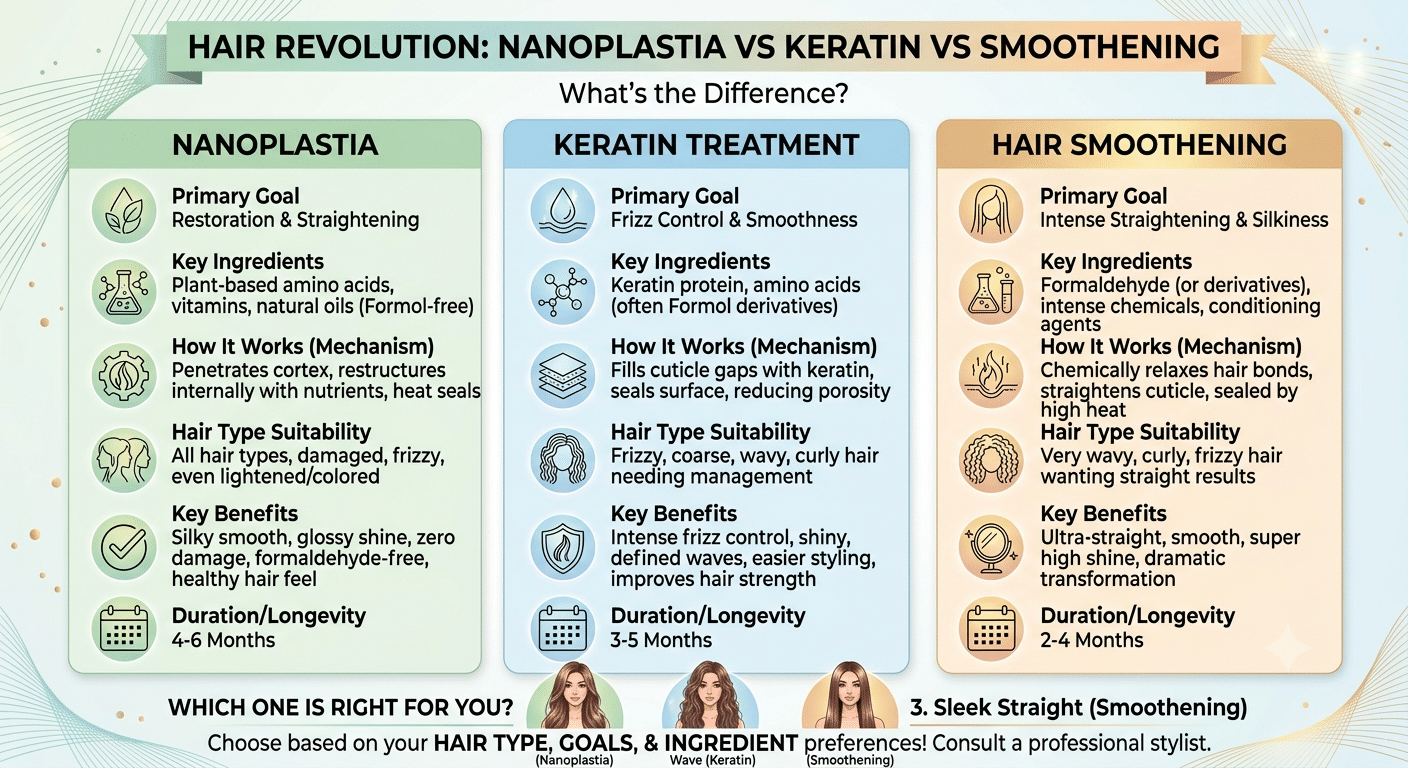
Why These Hair Treatments Are Often Confused
Walk into a salon and ask about making your hair smoother, shinier, and easier to manage, and you may hear three familiar names: Nanoplastia, Keratin, and Smoothening. At first glance, they can sound almost identical because all three are associated with reducing frizz, improving shine, controlling unwanted volume, and making everyday styling easier. But they are not automatically interchangeable. The formula, active ingredients, processing method, desired finish, existing condition of your hair, and the expertise of the stylist can all change the final result. Even the word “keratin” can be confusing because keratin may be present as a conditioning or protein ingredient without being the chemical responsible for the smoothing effect.
The easiest way to understand the difference is to stop thinking about these services as three competing labels and instead think about the result you want from your hair. Do you want softer, smoother hair while keeping natural movement? Do you want a more polished and straighter appearance? Are you mainly trying to control humidity-related frizz? Or is your biggest concern hair that feels rough, porous, and difficult to style? These questions matter because a treatment that works beautifully for one person may not be the right choice for another. Current consumer guidance also emphasizes checking the actual ingredients and asking salon professionals about the product being used rather than relying only on the treatment name.
The Main Goal Behind Each Treatment
In simple terms, Keratin treatments are generally associated with smoothing and frizz control, while traditional hair smoothening is commonly chosen when a straighter, more controlled appearance is desired. Nanoplastia is marketed as a newer smoothing and straightening approach, but the chemistry can vary considerably between products, so the name alone does not tell you exactly what is inside the bottle. Recent industry discussions also show why consumers should look beyond marketing terminology: products sold under names such as “nanoplastia,” “keratin,” or “organic smoothing” can use different active ingredients.
This is why a professional consultation should happen before the treatment begins. Your stylist should consider your hair’s porosity, previous colour or bleach services, existing breakage, curl pattern, thickness, elasticity, and your preferred finish. A good consultation is almost like creating a road map before a journey: it helps determine where your hair is starting and what route can realistically take it toward your desired result.
What Is Nanoplastia Hair Treatment?
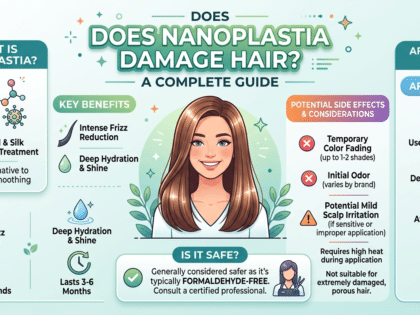
Nanoplastia is a salon hair-smoothing treatment that has become increasingly discussed as an alternative to conventional straightening and smoothing services. However, there is an important point that is often missed online: Nanoplastia is not one universally standardized chemical formula. Different brands can use different technologies and active ingredients, so it is inaccurate to assume that every product sold as Nanoplastia behaves exactly the same way.
Some current Nanoplastia systems use glyoxylic acid or related acid-based smoothing chemistry, while other products may emphasize amino acids, proteins, conditioning ingredients, or proprietary blends. Recent technical and salon-industry sources describe glyoxylic acid as an active used in some Nanoplastia systems. That means the phrase “Nanoplastia is always formaldehyde-free” should not be treated as a universal guarantee. Instead, the actual ingredient list and manufacturer’s safety documentation should be checked.
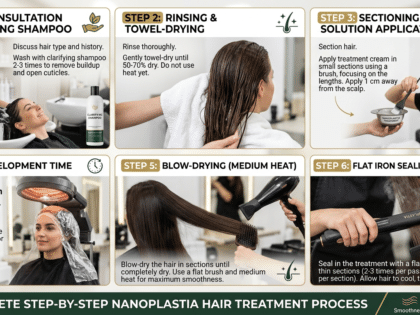
The treatment is generally performed by applying the professional formula to prepared hair, allowing it to process according to the manufacturer’s instructions, and then using controlled heat to help create the final smooth appearance. The combination of chemical action and heat is important because many smoothing systems rely on heat to produce their characteristic finish.
How Nanoplastia Works
The basic concept behind Nanoplastia is to alter the surface and internal behavior of the hair fiber enough to make the hair look smoother, more aligned, and easier to manage. The exact mechanism depends on the formula. Some products use acids, amino acids, proteins, or other conditioning components, while the heat-processing stage helps lock in the desired cosmetic result.
The result can be particularly attractive when hair looks dull, puffy, rough, or difficult to control. Instead of simply trying to flatten every strand, many modern smoothing services aim for a more polished texture with improved shine and reduced frizz. However, the final degree of straightness depends on the product, processing protocol, hair type, and stylist technique.
There is also an important safety distinction. “Formaldehyde-free” and “chemical-free” are not the same thing. A product can be free of formaldehyde and still contain active chemicals capable of changing how hair behaves. The FDA specifically advises consumers to examine ingredients and ask salons about formaldehyde, formalin, methylene glycol, product instructions, ventilation, and safety documentation when considering smoothing services.
What Results Can You Expect?
Depending on the product and hair condition, Nanoplastia may provide a combination of frizz reduction, smoother texture, enhanced shine, easier styling, and a straighter appearance. The treatment is often discussed as a longer-lasting option than a simple blow-dry or temporary conditioning service, but longevity should never be promised as an identical number for every client.
Your lifestyle matters too. Frequent washing, swimming, heat styling, sun exposure, humidity, and the products you use at home can all influence how long the cosmetic effect remains noticeable. The condition of your hair before treatment also matters. Hair that is severely compromised from repeated bleaching or chemical services may need a different approach rather than simply receiving a stronger smoothing treatment.
What Is a Keratin Treatment?
A keratin treatment is a professional hair-smoothing service designed primarily to improve manageability, reduce frizz, and create a smoother-looking finish. The name comes from keratin, the structural protein naturally found in human hair. However, keratin itself should not automatically be assumed to be the chemical ingredient responsible for straightening or smoothing in every commercial formula.
This distinction is important because the term “keratin treatment” is used across many different salon products. Some formulas are designed mainly for conditioning and frizz control, while others use stronger smoothing chemistry that is sealed with heat. Formula differences can therefore produce noticeably different results from one salon to another.
Keratin treatments are often selected by people who want hair that looks polished without necessarily wanting an extremely straight finish. Depending on the formula and hair type, the result may preserve some natural movement while making the hair easier to blow-dry and style.
How Keratin Treatments Smooth Hair
Most professional smoothing services involve a combination of product application and heat processing. A stylist typically prepares the hair, applies the product according to its instructions, processes it, and uses controlled heat to create the intended finish. The exact steps vary between brands, so following the manufacturer’s protocol is essential.
Safety deserves special attention here. Some hair-smoothing products can release formaldehyde gas when heated, particularly when formaldehyde, formalin, or methylene glycol is present. The FDA warns that exposure can irritate the eyes, nose, throat, lungs, and skin, and recommends that consumers ask salons about ingredients, ventilation, and product safety information.
Therefore, never assume that every treatment called “Keratin” is automatically formaldehyde-free. Ask what exact product is being used and, where appropriate, request access to its ingredient list and Safety Data Sheet.
What Is Hair Smoothening?
Hair smoothening is a broad salon category rather than one single formula. It generally refers to chemical services designed to reduce frizz, soften texture, improve manageability, and make hair appear straighter or more polished. The strength and chemistry can vary dramatically between products.
Traditional smoothening services may produce a more noticeable straightening effect than a mild frizz-control treatment. Depending on the formulation, they can significantly alter the behavior of the treated hair. This is why a professional assessment is particularly important when the hair has already been coloured, bleached, relaxed, permed, or subjected to other chemical processes.
The term “smoothening” can also be used differently by different salons. One salon may use the word to describe a mild smoothing service, while another may use it for a stronger straightening process. Instead of choosing based only on the service name, ask what product is being used, what active ingredient it contains, how much straightening is expected, and what aftercare will be required.
How Traditional Smoothening Differs
The biggest practical difference is often the degree and style of straightening. A stronger chemical smoothening service may produce a flatter, more controlled result, whereas a gentler smoothing treatment may focus more heavily on reducing frizz and improving shine.
Traditional chemical straightening should also be distinguished from temporary styling. A blow-dry can make hair appear straight for a short period, but chemical smoothing can change the hair’s behavior for considerably longer. That is why the condition of the hair and the application technique matter so much.
A salon should also maintain appropriate safety practices. The FDA notes that hair-smoothing products may release formaldehyde when heated and recommends proper ventilation and trained professional handling where relevant.
Nanoplastia vs Keratin vs Smoothening: Key Differences
| Feature | Nanoplastia | Keratin Treatment | Hair Smoothening |
|---|---|---|---|
| Main goal | Smoothing, frizz control and straighter finish | Frizz reduction, softness and shine | Smoothing and stronger straightening |
| Formula | Varies by brand; some use glyoxylic acid or other systems | Highly variable by brand | Varies by system |
| Straightness | Can range from natural smoothing to noticeably straight | Usually smoother with natural movement, depending on formula | Often a more pronounced straight finish |
| Frizz control | Generally high when correctly formulated and applied | Generally high | Generally high |
| Hair movement | Can be retained depending on service | Often retains movement | May be reduced more significantly |
| Maintenance | Depends on formula and home care | Depends on formula and washing routine | Depends on formula and regrowth |
| Best approach | Match formula to hair condition and desired result | Choose based on formula and desired finish | Professional consultation is especially important |
| Safety check | Read ingredients and product instructions | Check ingredients and formaldehyde-related claims | Check ingredients and ventilation requirements |
The table highlights an important point: there is no universal formula for any of these labels. A treatment’s name is only the starting point. The actual ingredients, processing temperature, processing time, hair history, and stylist’s technique can make a substantial difference.
Results, Texture, and Straightness
If your goal is soft, manageable, frizz-controlled hair with movement, a smoothing-focused service may be appropriate. If your priority is a visibly straighter finish, you may need a stronger chemical process. Nanoplastia may sit somewhere between smoothing and straightening depending on the system being used.
Keratin treatments are commonly chosen when the client wants smoother, shinier, easier-to-style hair without necessarily eliminating all natural movement. Traditional smoothening can create a more controlled appearance, particularly when the hair is naturally curly or highly frizzy.
The key is to tell your stylist what you actually want rather than simply naming a treatment. Saying “I want less frizz but I still want movement” communicates much more useful information than saying “I want Nanoplastia.”
Ingredients and Safety Considerations
The most important safety lesson is simple: do not judge a hair treatment by its marketing name.
The FDA states that some hair-smoothing products release formaldehyde when heated and specifically identifies formaldehyde, formalin, and methylene glycol as ingredients consumers should look for.
There is also growing medical literature concerning certain glyoxylic-acid-containing hair-straightening products. A 2024 New England Journal of Medicine report described recurrent acute kidney injury in a patient following hair-straightening treatments containing glyoxylic-acid-related chemistry. This does not mean every product containing glyoxylic acid will cause kidney injury, but it demonstrates why ingredient transparency and professional risk assessment matter.
Before booking a chemical smoothing service, ask:
- What exact product will you use?
- What are its active ingredients?
- Does it contain formaldehyde, formalin, or methylene glycol?
- Can I see the product label or Safety Data Sheet?
- What level of straightening should I expect?
- Is my hair strong enough for the service?
- What aftercare products should I use?
Which Treatment Is Suitable for Different Hair Types?
There is no universal treatment that should be applied to every head of hair. Two clients can have the same curl pattern but completely different hair conditions. One may have strong, virgin hair, while the other may have fragile, bleached strands with significant porosity. The treatment decision should therefore consider hair history, elasticity, porosity, thickness, previous chemical services, and desired finish.
Frizzy and Curly Hair
For naturally curly or highly frizzy hair, the first question is whether the client wants to preserve curls or reduce them. If the goal is simply to make curls softer and easier to manage, an aggressive straightening service may be unnecessary.
A smoothing treatment may help reduce puffiness and make blow-drying easier. If the client wants a visibly straighter appearance, a stronger service may be considered after a professional assessment.
Humidity is another major factor. Hair can absorb moisture from humid air, which can make porous or textured hair appear larger and frizzier. A suitable smoothing service can help create a more controlled appearance, but it does not permanently eliminate every environmental effect.
Coloured or Chemically Treated Hair
Coloured hair requires additional caution, especially if it has been bleached. Chemical treatments and high heat can place additional stress on already compromised hair. A stylist should assess elasticity and porosity before proceeding.
If your hair stretches excessively when wet, snaps easily, feels gummy, or has severe split ends and breakage, a straightening or smoothing service may not be the first step. Your stylist may recommend strengthening, conditioning, trimming, or postponing the chemical service until the hair is in better condition.
This is one reason professional consultation matters. A good stylist should be comfortable saying that a particular treatment is not appropriate right now.
Aftercare and Maintenance
The treatment does not end when you leave the salon. Aftercare plays a major role in maintaining the cosmetic result. Your stylist may recommend a suitable shampoo, conditioner, mask, leave-in product, and heat protectant based on the specific system used.
Avoid treating chemically smoothed hair as if it were completely maintenance-free. Excessive heat styling, harsh cleansing products, frequent swimming, and neglecting conditioning can affect the look and feel of the hair.
A simple maintenance routine can include gentle cleansing, regular conditioning, heat protection, and occasional professional trims. If your hair is coloured, choose products compatible with both the smoothing service and your colour-care needs.
The exact washing schedule should follow the instructions for the product used because modern smoothing systems have different protocols. There is no universal rule that every client must follow the same waiting period before the first wash.
Common Mistakes to Avoid
One of the biggest mistakes is choosing a treatment purely because it is trending on Instagram or because someone else achieved a beautiful result with it. Your friend’s hair may have completely different porosity, density, colour history, and chemical damage. A treatment should be selected according to your own hair rather than someone else’s before-and-after photo.
Another mistake is assuming that expensive automatically means safer or better. Price can reflect product quality, stylist expertise, salon standards, location, and service time, but price alone does not tell you what chemical system is being used.
It is also a mistake to believe that labels such as “organic,” “natural,” or “chemical-free” automatically prove that a treatment has no safety concerns. Hair-smoothing products can contain active chemical ingredients even when their marketing sounds gentle. Reading the ingredient list and asking the salon direct questions is far more useful.
Finally, never ignore burning eyes, breathing irritation, unusual scalp discomfort, or another significant reaction during a chemical service. Stop the process and seek appropriate professional advice if you experience a concerning reaction.
Conclusion
Nanoplastia vs Keratin vs Smoothening is not simply a comparison of three different names. The real difference lies in the formulation, active ingredients, processing method, degree of straightening, condition of your hair, and the result you want to achieve.
Keratin treatments are commonly associated with smoother, shinier, more manageable hair and reduced frizz. Smoothening services can provide a more controlled and straighter appearance, depending on the chemical system. Nanoplastia is a modern salon category whose formulation can vary significantly, with some products using glyoxylic-acid-based chemistry and others using different ingredient systems.
The smartest approach is to look beyond the label. Ask what exact product is being used, understand its ingredients, discuss your hair history with a trained stylist, and choose a service based on your desired finish and hair condition. Safety information from the FDA also makes ingredient transparency, ventilation, professional application, and appropriate precautions important considerations for hair-smoothing services.
Beautiful hair is not just about getting the straightest possible result. It is about finding the right balance between appearance, manageability, hair condition, maintenance, and informed treatment choices.
FAQs
1. Is Nanoplastia better than Keratin?
Nanoplastia and Keratin are different categories, and the result depends heavily on the exact product formulation and your hair condition. Some Nanoplastia systems focus strongly on smoothing and straightening, while many Keratin services focus on frizz reduction, shine, and manageability. Compare the actual product and desired finish rather than choosing solely from the treatment name.
2. Does Nanoplastia permanently straighten hair?
Nanoplastia results are not identical across all products. Some systems can create a substantial straightening effect, while others provide more moderate smoothing. New hair growth will retain its natural texture, and the treated length may gradually change as the cosmetic effect wears down.
3. Is Keratin treatment the same as smoothening?
No. “Keratin treatment” and “smoothening” can refer to different professional services, although their results can overlap. The chemistry varies between brands, so the ingredient list and manufacturer’s instructions are more informative than the service name alone.
4. Can I do Nanoplastia or Keratin on coloured hair?
It may be possible, but the condition of the coloured hair needs to be assessed first. Bleached or heavily processed hair can be more fragile and porous, so a professional should check its elasticity and strength before applying another chemical service.
5. How do I choose between Nanoplastia, Keratin and Smoothening?
Start with your desired result. Decide whether you mainly want frizz control, softer texture, easier styling, or a noticeably straighter appearance. Then discuss your hair history and the exact product with a professional stylist, including its active ingredients, processing method, aftercare requirements, and relevant safety information.
🔍 Want to find the best keywords and rank this article faster? Try the #1 SEO & AI visibility toolkit free for 14 Days . Track your keyword rankings, audit your site, and monitor your AI search visibility on ChatGPT, Gemini & Google AI Overviews
✨ Get better articles, faster. This prompt is powerful. But Pro Article Writer takes it further — AI humanizer, SEO tools, full editor, one-click options, and more control all in one place. Try it free →
If this prompt helped you, please leave a review — it keeps this prompt ranked #1.