
Does Nanoplastia Damage Hair? Side Effects, Benefits & Aftercare
-
Dokmai London
- Posted on
- 0 comments
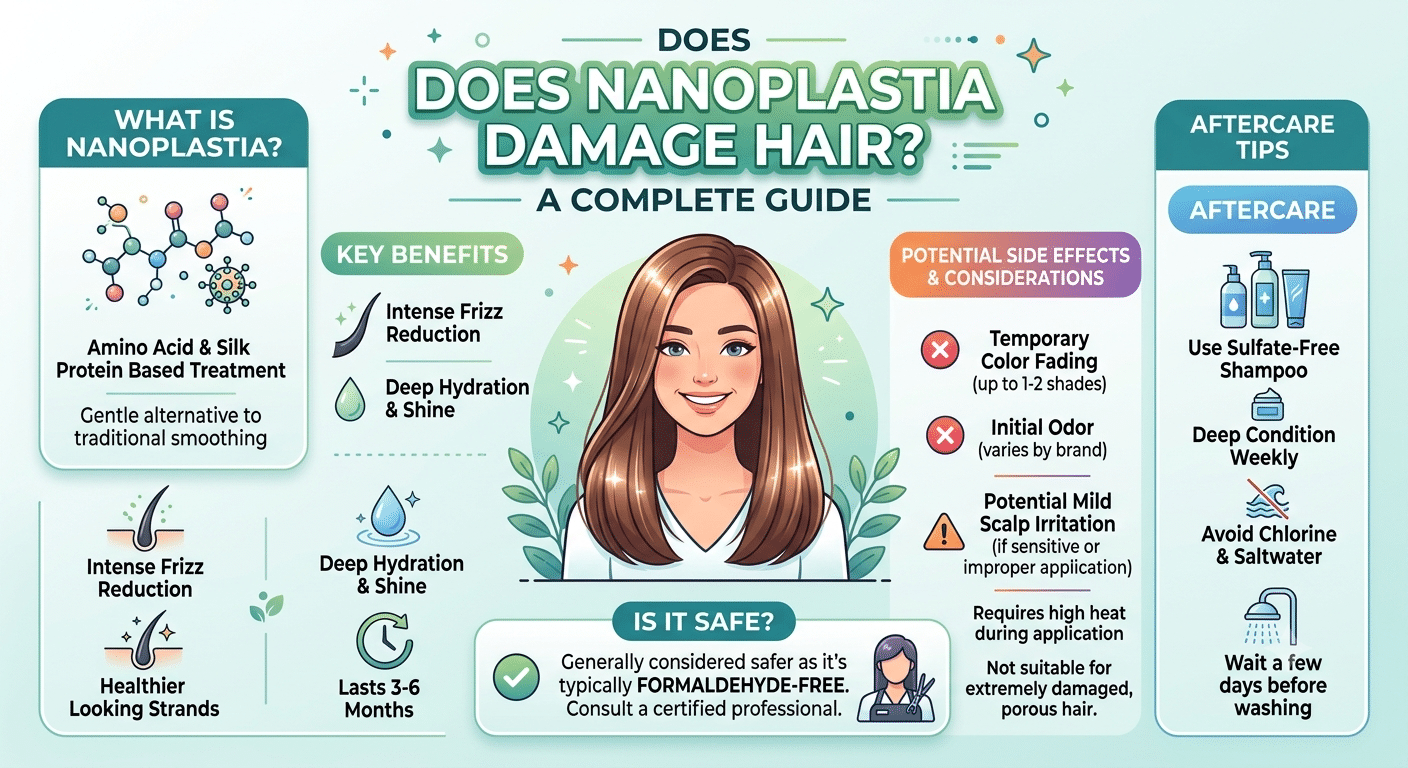
If you have dry, frizzy, wavy, or difficult-to-manage hair, you have probably heard about Nanoplastia hair treatment. It has become a popular salon service for people who want smoother, shinier, more manageable hair without committing to traditional permanent straightening. But there is one question that often comes before the appointment: Does Nanoplastia damage hair?
The honest answer is that the result depends on several factors, including the condition of your hair, the product formula, the amount of heat used, the professional applying it, and your aftercare routine. Nanoplastia is commonly marketed as a gentler smoothing treatment, and many modern formulas use amino acids, proteins, oils, and organic acids rather than relying on formaldehyde-based straightening chemistry. However, calling every Nanoplastia product completely risk-free would be misleading because formulations vary considerably. Recent medical and scientific literature also shows why consumers should look beyond the treatment’s marketing name and ask what ingredients are actually being used.
That distinction matters. Hair is not an inert material that can be treated endlessly without consequences. It is a protein fiber, and repeated chemical processing plus high heat can eventually reduce its strength and elasticity. A well-executed treatment on suitable hair may leave the strands looking dramatically smoother and easier to style, while the same type of service on severely over-processed hair may increase dryness or breakage. So rather than asking only whether Nanoplastia is “good” or “bad,” it is more useful to understand how Nanoplastia works, its potential side effects, its benefits, who should avoid it, and how proper aftercare can protect your hair.
What Is Nanoplastia Hair Treatment?
Nanoplastia is a professional hair-smoothing treatment designed primarily to reduce frizz, improve shine, soften the hair’s appearance, and make styling easier. Current descriptions of Nanoplastia commonly mention ingredients such as amino acids, proteins, nourishing oils, and other conditioning or smoothing compounds. The treatment is generally applied to sections of the hair and then activated or sealed with heat, often using a blow dryer and flat iron. The exact procedure varies from salon to salon because there is no single universal Nanoplastia formula or standardized process used by every brand.
The appeal is easy to understand. Imagine your hair cuticle as a collection of tiny overlapping tiles. When those tiles are rough or lifted, light scatters, moisture moves in and out more easily, and the hair tends to look dull, rough, and frizzy. When the surface becomes smoother, the strands reflect more light and feel softer. Nanoplastia aims to create that smoother appearance while also conditioning the hair fiber. Some product descriptions specifically position the treatment as an alternative to older smoothing methods, although the actual chemistry should always be checked on the product label rather than assumed from the word “Nanoplastia.”
How Nanoplastia Works on the Hair
The process usually involves several stages. The stylist cleanses the hair, applies the treatment formula section by section, allows it to process according to the manufacturer’s instructions, and then uses controlled heat to activate and seal the treatment. Heat is important because many smoothing products rely on thermal activation to change the hair’s temporary shape and improve surface alignment.
This is also where professional technique becomes extremely important. Hair that is fine, bleached, porous, or already weakened cannot necessarily tolerate the same heat level as thick, virgin hair. A skilled stylist should consider the hair’s history before choosing processing time and temperature. The treatment should therefore be viewed as a professional chemical-and-heat service, not simply as a nourishing hair mask.
Recent scientific research into glyoxylic-acid-containing heat-activated smoothing products also highlights why ingredient transparency matters. A 2026 study evaluated consumer and stylist exposure during realistic use of two such products and reported low measured formaldehyde and oxalic-acid exposure under the tested conditions. At the same time, previous medical reports have documented acute kidney injury associated with some hair-straightening products containing glyoxylic-acid derivatives, demonstrating that the safety profile cannot automatically be generalized to every product marketed as a smoothing treatment.
Does Nanoplastia Damage Hair?
Nanoplastia does not automatically mean hair damage, but it is also inaccurate to say that every Nanoplastia treatment is completely incapable of damaging hair. Any salon treatment that combines chemical processing with significant heat can potentially contribute to dryness, brittleness, or breakage when the hair is already compromised or the procedure is performed incorrectly. The risk is influenced by the condition of the hair before treatment and how aggressively the service is performed.
Healthy or moderately dry hair may tolerate the service well when the stylist follows the product instructions and chooses an appropriate heat setting. The immediate cosmetic effect can be impressive: reduced frizz, increased shine, smoother texture, and easier combing. However, hair that has already undergone repeated bleaching, colouring, rebonding, relaxing, or multiple high-heat services may have considerably less structural strength. Applying another intensive treatment without assessing that history can push the hair beyond what it can comfortably tolerate.
There is another important distinction: cosmetic smoothness is not the same thing as biological hair repair. When a product makes hair look healthier, that does not necessarily mean the internal structure has been permanently restored. The hair fiber is non-living once it emerges from the scalp, so “repair” in cosmetic haircare usually means improving the surface, filling or conditioning damaged areas, reducing friction, and making the strand behave more smoothly. Understanding this prevents unrealistic expectations and helps you judge the treatment by its actual results.
When Nanoplastia May Cause Hair Damage
The biggest concern is often not the name of the treatment but the combination of chemical exposure, repeated processing, and heat. If a stylist uses excessive temperature or repeatedly passes a flat iron over already fragile sections, the hair can become dry and brittle. Over-processing can also make hair feel unusually stiff, rough, or weak after the initial smooth appearance wears off.
Another risk comes from poor product selection. Not every product sold under a similar treatment name contains the same ingredients. Some smoothing products can contain organic acids or other chemical compounds that behave differently when heated. The U.S. FDA specifically warns that certain hair-smoothing products can release formaldehyde when heated, creating inhalation and irritation concerns. That warning applies to products that release formaldehyde and should not automatically be interpreted as proof that every Nanoplastia formula contains formaldehyde.
For this reason, ask your salon to show you the actual product label and ingredient list before treatment. If you have a history of severe hair damage, scalp sensitivity, allergies, or previous reactions to smoothing products, a professional consultation is particularly important.
Common Nanoplastia Side Effects
Most people seek Nanoplastia because of its cosmetic benefits, but understanding possible downsides is just as important. One possible issue is temporary dryness, especially if the hair has already been heavily processed. Another is increased brittleness when excessive heat is used. Some people may also experience scalp irritation or sensitivity depending on the ingredients in the specific product.
A treatment may also alter your natural curl or wave pattern. That is not necessarily “damage,” but it can be an unexpected result for someone who wants to keep their original texture. Nanoplastia is generally used to reduce volume and frizz and create a smoother appearance, so naturally curly hair may look significantly looser after the procedure. If preserving your natural curl pattern is important, discuss the desired result with your stylist before treatment.
Dryness, Breakage and Changes in Hair Texture
Dryness after a smoothing service can occur when the hair loses too much moisture or when repeated heat processing stresses the fiber. You might notice that the hair feels smooth initially but later becomes dry at the ends. Breakage is more concerning because it indicates that the strand has become physically weaker.
This is why the starting condition of the hair matters so much. Hair that has been repeatedly bleached or chemically processed should not be treated exactly like virgin hair. A professional may recommend postponing the treatment, trimming damaged ends, improving conditioning first, or choosing a less intensive service.
Pay attention to how your hair behaves after treatment. Excessive shedding from the scalp is different from breakage along the hair shaft. If you notice significant scalp irritation, burning, swelling, persistent rash, or unusual hair loss after a cosmetic procedure, stop using irritating products and seek appropriate medical advice rather than trying to cover up the symptoms with another salon treatment.
Is Nanoplastia Safe for Chemically Treated Hair?
Nanoplastia can sometimes be performed on coloured or chemically treated hair, but “can be used on coloured hair” does not mean “safe for every chemically treated head of hair.” Hair history matters more than a simple label. A client who coloured their hair several months ago may have very different hair strength from someone who recently bleached their hair multiple times.
Porosity is another useful factor. Highly porous hair tends to absorb products quickly and can lose moisture quickly as well. Such hair may need a more conservative approach. Your stylist should examine the texture, elasticity, previous chemical history, split ends, and overall condition before deciding whether to proceed.
A strand test can be useful when there is uncertainty. It gives the stylist an opportunity to observe how the hair responds before the entire head is processed. This small step can prevent a much larger problem later. For anyone with severely damaged, stretchy, gummy, or breaking hair, postponing a smoothing treatment may be a wiser professional recommendation than trying to force an immediate transformation.
Key Benefits of Nanoplastia Hair Treatment
The most noticeable benefit is usually frizz reduction. When the hair surface becomes smoother, strands become easier to comb and style. This can be particularly appealing in humid environments where untreated hair tends to expand and become difficult to control.
Another benefit is visual shine. A smoother cuticle reflects light more consistently, which can make the hair appear glossy. Many people also appreciate reduced styling time because hair becomes easier to blow-dry and manage. Current consumer-facing medical and salon resources describe Nanoplastia as a smoothing treatment aimed at improving manageability, shine, softness, and frizz control.
The treatment can also make a dramatic difference in the feel of coarse or unruly hair. Instead of spending a long time fighting tangles and frizz every morning, you may find that the hair falls into place more easily. Think of it as reducing the “resistance” you experience while styling.
Frizz Control and Improved Manageability
Frizz is often a combination of hair texture, humidity, porosity, friction, and surface irregularity. A smoothing treatment cannot change the weather, but it can change how the hair responds to moisture and styling. That is one reason these services are particularly popular in humid climates.
The benefit is not only aesthetic. Easier detangling can reduce the amount of aggressive brushing required. Less daily manipulation may help minimize mechanical stress on the hair. However, the result still depends on maintenance. A person who uses very hot tools every day and skips conditioner may gradually lose the smooth, soft appearance regardless of how good the initial salon service was.
Nanoplastia vs Keratin vs Hair Smoothening
People often use the terms Nanoplastia, keratin treatment, and hair smoothening interchangeably, but they are not necessarily identical. Formulas, processing methods, ingredients, and expected results can vary significantly between brands and salons.
| Feature | Nanoplastia | Keratin Treatment | Traditional Smoothening |
|---|---|---|---|
| Main goal | Smoothing and frizz control | Smoothing and manageability | Longer-lasting texture change |
| Typical ingredients | Amino acids, proteins, oils and other smoothing agents | Varies by formula | Chemical restructuring agents vary |
| Heat used | Commonly yes | Commonly yes | Commonly yes |
| Effect on texture | Usually smoother and less frizzy | Smoother and easier to style | Can produce a stronger straightening effect |
| Suitable for damaged hair | Requires professional assessment | Requires professional assessment | Often requires greater caution |
| Aftercare | Gentle, conditioning routine | Treatment-specific routine | Stronger maintenance may be needed |
| Formula safety | Depends on exact product | Depends on exact product | Depends heavily on chemistry |
There is no universal formula for any of these categories, so comparing only the treatment names can be misleading. The ingredient list, manufacturer’s directions, heat procedure, and stylist’s technique are much more useful when assessing a particular service.
Which Treatment Is Different and Why?
The biggest difference is usually the desired outcome. Some people want natural-looking smoothness while retaining movement; others want a much straighter finish. A consultation should establish whether you want frizz control, reduced volume, smoother waves, or a visibly straight appearance.
It is also important to distinguish a marketing claim from a scientific guarantee. Terms such as “repair,” “nano,” “organic,” “natural,” or “damage-free” can sound reassuring, but they do not replace ingredient information or professional assessment. If a treatment is described as completely risk-free, ask what that claim is based on.
Who Should Consider Nanoplastia?
Nanoplastia may be worth discussing with a professional if your main concerns are frizz, rough texture, excessive volume, difficult styling, or a lack of shine. It can be especially attractive to people who want a smoother appearance without choosing a permanent rebonding service.
People with wavy or curly hair may also choose it when they want to loosen the appearance of their texture. The important thing is to communicate the desired finish clearly. “I want less frizz” is very different from “I want completely straight hair.”
If your hair is healthy enough to tolerate the process and your expectations are realistic, the treatment can provide a convenient styling change. But convenience should never replace a proper hair assessment.
Who Should Avoid or Delay Nanoplastia?
You may need to postpone the service if your hair is severely bleached, extremely brittle, breaking easily, or visibly over-processed. Hair that stretches excessively when wet or feels gummy can be a warning sign that another chemical or high-heat service may not be appropriate.
You should also tell your stylist about recent bleaching, colouring, rebonding, relaxing, keratin services, or other chemical treatments. Don’t assume the stylist can determine your entire hair history simply by looking at it.
Anyone who has experienced a previous allergic or irritant reaction to hair products should discuss that history before treatment. If you have concerns about a particular ingredient, ask for the full ingredient list rather than relying only on statements such as “formaldehyde-free” or “chemical-free.”
Nanoplastia Aftercare: How to Protect Your Results
Aftercare is where many people unintentionally shorten the life of a smoothing treatment. The first step is to follow your specific product manufacturer’s instructions, because recommended waiting periods can vary. Some Nanoplastia systems advise avoiding washing for 48–72 hours, while others may have different instructions. Current product guides commonly recommend a short stabilization period and gentle hair handling immediately afterward.
Avoid unnecessary heat during the early period and do not repeatedly manipulate the hair. If your stylist gives you a specific post-treatment schedule, follow it instead of mixing instructions from unrelated products.
After the initial period, focus on gentle cleansing, regular conditioning, and protection from excessive heat. Hair does not need an aggressive routine simply because it has been treated.
Shampoo, Conditioner and Washing Routine
A gentle, sulphate-free shampoo is commonly recommended for maintaining smoothing results, particularly because harsh cleansing can make treated hair feel dry and may shorten the cosmetic longevity of some services. Follow with conditioner every time you wash. If your ends feel dry, a suitable weekly conditioning mask can help maintain softness.
Water temperature matters too. Very hot water can leave hair feeling dry and may increase the roughness of the cuticle. Lukewarm water is a practical choice for regular washing.
Do not aggressively rub wet hair with a towel. Instead, gently squeeze excess water and use a soft towel or microfiber towel. Wet hair is more vulnerable to mechanical stress, so treating it gently can reduce unnecessary breakage.
Environmental factors also matter. Humidity, pollution, hard water, swimming, and frequent heat styling can all influence how long a smoothing result looks fresh. Some post-Nanoplastia guidance specifically recommends avoiding chlorine and saltwater shortly after treatment and using leave-in products or serums as part of ongoing maintenance.
How Long Does Nanoplastia Last?
The longevity of Nanoplastia varies according to the formula, hair type, washing frequency, heat exposure, environmental conditions, and aftercare. Some professional and salon sources describe results lasting approximately four to six months with suitable maintenance, but this should be treated as an estimate rather than a guarantee.
Your hair will continue to grow normally from the scalp, so new growth will eventually have its original texture. The treated lengths gradually lose their cosmetic smoothness as the effect diminishes and the hair is exposed to washing, styling, sunlight, humidity, and other daily stresses.
The goal should not be to repeat the full treatment as frequently as possible. Instead, let your stylist evaluate the condition of your hair before scheduling another service. Repeated chemical processing and high heat can accumulate stress even when each individual appointment appears successful.
Conclusion: Is Nanoplastia Worth Considering?
So, does Nanoplastia damage hair? It can contribute to dryness or breakage under unfavorable conditions, but the treatment should not automatically be classified as damaging simply because it is a chemical smoothing service. The outcome depends on the exact formulation, hair condition, processing technique, heat exposure, and aftercare. Modern Nanoplastia products are often promoted as smoothing systems using amino acids, proteins, oils, and related conditioning ingredients, but there is enough variation between products that consumers should evaluate the actual formula rather than relying solely on the treatment name.
The biggest mistake is expecting a salon treatment to solve every hair problem permanently. Nanoplastia can make hair look smoother, shinier, and easier to manage, but it cannot magically turn severely damaged hair into virgin hair. If your hair is healthy enough for the service, a trained professional uses appropriate heat, and you follow a sensible aftercare routine, you can improve manageability while minimizing unnecessary stress.
Before booking, ask three simple questions:
What is in the product?
What heat and processing method will be used? Is my current hair condition suitable for this service?
Those questions are far more useful than simply asking whether Nanoplastia is “damage-free.”
Frequently Asked Questions
1. Does Nanoplastia permanently straighten hair?
Nanoplastia is primarily a smoothing treatment, but the degree of straightening can vary according to the product, hair type, and technique. Wavy or curly hair may appear significantly straighter or more relaxed after treatment. If maintaining your natural curl pattern is important, discuss the expected result with your stylist before the service.
2. Can Nanoplastia be done on coloured hair?
It may be possible to perform Nanoplastia on coloured hair, but the condition and recent treatment history of the hair should be assessed first. Recently bleached, highly porous, or heavily processed hair may require a delay or alternative service. A strand test can be useful when the hair’s tolerance is uncertain.
3. How should I wash my hair after Nanoplastia?
Follow the specific instructions provided for your product. Many Nanoplastia systems recommend avoiding washing for approximately 48–72 hours, but the manufacturer’s directions should take priority. After that period, gentle shampoo, regular conditioner, moderate water temperature, and minimal aggressive towel drying are sensible maintenance practices.
4. Can Nanoplastia cause hair fall?
Nanoplastia primarily acts on the hair shaft rather than the hair follicle. Breakage from weakened hair can sometimes be mistaken for hair loss because shorter broken strands appear in the brush or shower. However, significant scalp irritation or unusual shedding after a treatment should not be ignored and may require professional medical evaluation.
5. How can I make Nanoplastia last longer?
Use the recommended post-treatment shampoo and conditioner, avoid unnecessary high heat, condition regularly, protect the hair while swimming, and minimize harsh mechanical handling. Your stylist may also recommend a suitable serum or leave-in conditioner. Most importantly, avoid repeatedly applying strong chemical treatments simply to maintain smoothness; assess the condition of the hair before every future appointment.
Important: Hair-smoothing formulas vary substantially. Some products marketed for smoothing may contain ingredients that behave differently when heated, so always ask the salon for the exact product and ingredient information before treatment. The FDA has specifically warned about formaldehyde exposure from certain heated hair-smoothing products, while recent research has evaluated the exposure profile of glyoxylic-acid-containing products separately.