
Nanoplastia Hair Treatment Step by Step: Complete Process Explained
-
Dokmai London
- Posted on
- 0 comments
What Is Nanoplastia Hair Treatment?
Nanoplastia is a professional hair-smoothing treatment designed to reduce frizz, improve manageability, enhance shine, and create a smoother-looking hair surface. The term nanoplastia is used commercially for a range of salon formulations, so there is no single universally standardized formula or one exact procedure that every salon follows. Depending on the product, formulations may contain conditioning agents, amino acids, proteins, acids, oils, or other cosmetic ingredients intended to alter the feel and appearance of the hair. That is why the name of the service alone should not be treated as proof that a particular product is automatically formaldehyde-free, damage-free, or suitable for every client.
The process generally combines a chemical or cosmetic treatment with controlled heat. The product is applied to prepared hair, allowed to process according to the manufacturer’s instructions, and then activated or sealed with heat, often using a blow dryer and flat iron. Research into acid-based hair straightening shows that heat and formulation chemistry can influence the hair fibre significantly, including changes to the hair’s internal structure and mechanical properties. The result can be dramatically smoother-looking hair, but the quality and condition of the hair before treatment, the exact formula, processing conditions, and stylist technique all matter.
How Nanoplastia Works on Hair
The easiest way to understand nanoplastia is to think of the hair strand as a flexible fibre with a protective outer layer and a protein-rich internal structure. A smoothing formula interacts with that fibre, while heat helps the treatment produce its intended cosmetic effect. With acid-based straightening systems, scientific studies have observed conformational changes in the hair fibre and alterations involving keratin structures and disulfide bonds.
This does not mean that every product sold as nanoplastia behaves identically. Ingredients and concentrations vary considerably between brands. Some products may rely on glyoxylic acid or related chemistry, while others use different systems. A 2023 study comparing acid and alkaline straighteners found that glyoxylic-acid treatment could produce significant protein loss and changes in hair strength, demonstrating why professional assessment and careful processing matter.
Why the Treatment Uses Heat
Heat is an important part of many smoothing systems because it helps activate, shape, or seal the cosmetic treatment into the hair fibre. The flat iron is not simply being used to “make the hair straight”; it is typically part of the chemical and physical process that creates the final appearance. The temperature and number of passes therefore matter, especially when dealing with bleached, coloured, porous, or previously chemically treated hair.
A higher temperature is not automatically better. Excessive heat can weaken already compromised hair, while insufficient heat may fail to deliver the desired result. Professional stylists therefore need to balance the product’s instructions with the client’s hair condition rather than applying one temperature or number of passes to everyone.
Who Can Benefit From Nanoplastia?
Nanoplastia is generally considered by people who want smoother, more manageable hair without spending significant time every day controlling frizz. Clients with naturally wavy, curly, coarse, porous, dry-looking, or frizz-prone hair may be interested because smoothing treatments can make brushing and styling easier. People who frequently use blow dryers or flat irons may also appreciate a treatment that reduces the effort needed to achieve a polished appearance.
However, suitability is not determined only by curl pattern. Hair health is often more important than hair type. Hair that has been heavily bleached, repeatedly coloured, relaxed, permed, or exposed to excessive heat may have reduced strength and greater porosity. Applying another chemical or acid-based treatment to such hair without a proper assessment can increase the chance of breakage or undesirable texture changes.
Hair Types That May Respond Well
Healthy virgin hair often gives a stylist more flexibility, but previously treated hair can also sometimes be suitable when its condition is carefully assessed. The stylist should look at elasticity, porosity, density, previous chemical services, colour history, split ends, breakage, and the overall feel of the hair. A strand test can be particularly useful when there is uncertainty.
The goal should not be to force every head of hair into an identical straight finish. Some clients want a very sleek result, while others primarily want frizz control and easier styling while retaining some natural movement. A professional consultation helps determine whether the requested finish is realistic without unnecessarily stressing the hair.
What Happens Before a Nanoplastia Treatment?
The consultation is one of the most important parts of the entire process, even though clients often focus only on the application and flat-ironing stages. Before applying anything, a stylist should ask about previous treatments, colouring, bleaching, relaxers, keratin services, smoothening, heat damage, allergies or sensitivities, and the client’s desired result. The stylist should also inspect the hair and scalp and explain what the chosen product is designed to achieve.
A good consultation prevents the common mistake of treating the service like a simple beauty shortcut. For example, hair that looks dry may actually be structurally fragile, while hair that appears healthy near the roots may have highly processed lengths and ends. A client may also assume that “nanoplastia” means the same thing at every salon, when formulations and instructions can differ. The exact ingredient list and manufacturer’s directions should therefore be checked before treatment.
Hair Consultation and Strand Assessment
A strand assessment can reveal information that is difficult to judge from appearance alone. The stylist may examine whether the hair stretches and returns normally, whether it snaps easily, how porous it feels, and how previous colour or chemical work has affected it. If the hair is severely compromised, postponing or declining the service may be safer than attempting to achieve an immediate transformation.
This assessment is particularly important because scientific research has shown that straightening chemistry can affect protein content, fibre strength, and structural properties. The consultation should therefore be treated as a technical evaluation rather than merely a sales conversation.
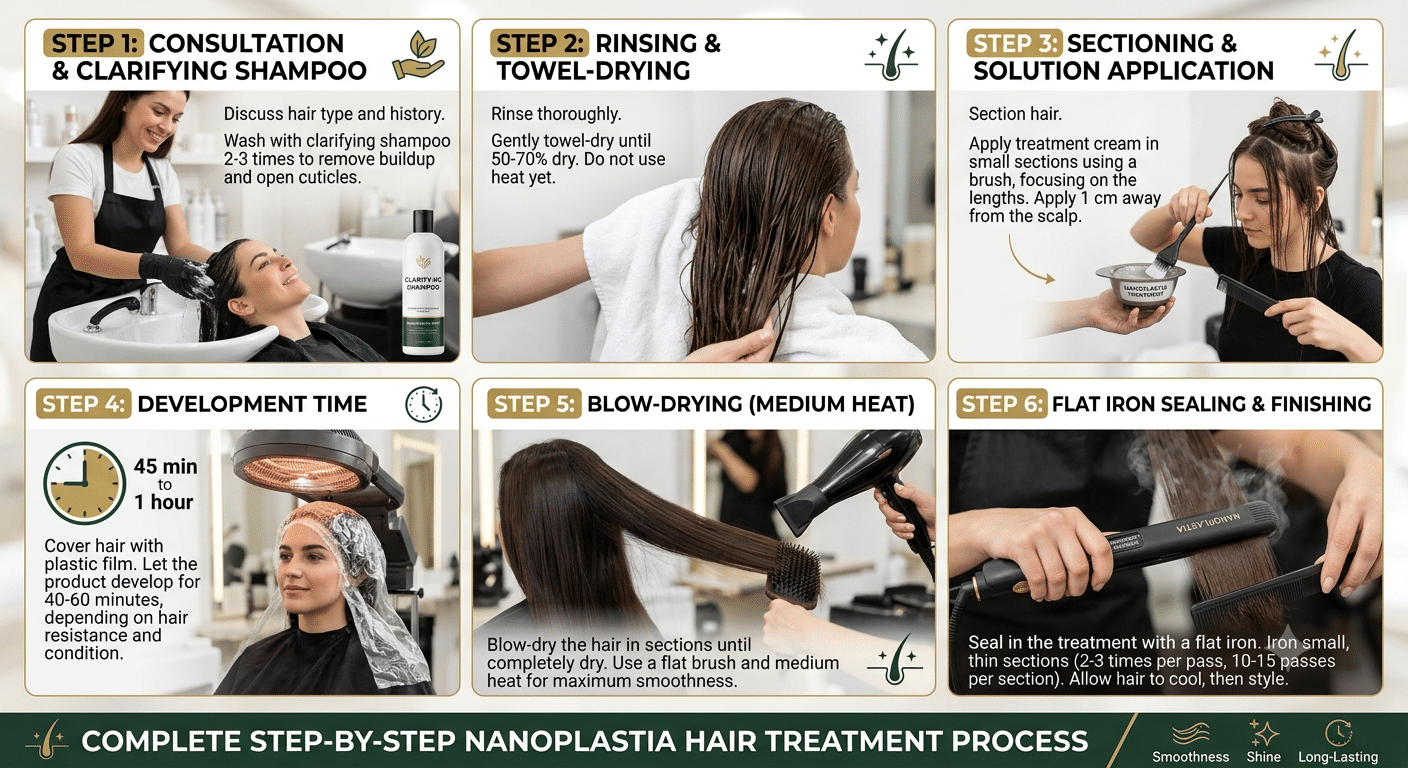
Step 1 — Hair Preparation and Cleansing
The first practical stage usually involves cleansing the hair so that dirt, styling products, excess oil, and other residues do not interfere with product distribution. Depending on the manufacturer’s instructions, the stylist may use a specific cleansing or clarifying shampoo. The objective is to create a clean, consistent base for the treatment rather than simply washing the hair as part of a normal salon service.
The exact washing method varies by product, which is why a stylist should follow the manufacturer’s instructions instead of copying a generic online recipe. Some systems specify a particular shampoo, number of washes, water temperature, or drying condition before application. The hair is then prepared to the condition required by the selected formula.
Step 2 — Sectioning the Hair
After preparation, the hair is divided into manageable sections. Sectioning is much more important than it may look because smoothing products need to be distributed consistently from one area to another. Large, uneven sections can result in missed areas, excessive product in some locations, and inconsistent results.
A professional stylist normally works systematically from the lower sections toward the upper sections while controlling the amount of product used. The scalp and skin should also be treated carefully according to the product’s directions. The aim is controlled application rather than simply saturating the entire head.
Step 3 — Applying the Nanoplastia Formula
The nanoplastia formula is applied to the hair in small sections, generally with enough product to coat the strands evenly without unnecessary excess. Application technique depends heavily on the specific product. Some formulations are applied away from the scalp, while others have their own specific placement instructions. The product label and professional instructions should always take priority over a generic step-by-step guide.
The stylist should work carefully through the lengths and ends because uneven application can produce an uneven final texture. Overapplication does not necessarily produce a better result. In fact, unnecessary product accumulation can make rinsing, drying, and heat processing more difficult.
Why Even Product Distribution Matters
Imagine painting a wall: if one section receives several coats while another receives almost none, the final finish will not look uniform. Hair treatments work in a similar way. Consistent product distribution gives the stylist better control over the subsequent drying and flat-ironing stages.
The stylist should also avoid treating the service as a race. Speed matters far less than controlled application, particularly when the hair has different levels of porosity. Highly porous ends may absorb product differently from healthier roots, which is another reason professional observation is valuable.
Step 4 — Processing Time
Once the formula has been applied, the hair is left to process for the period specified by the manufacturer. There is no universal “nanoplastia processing time” that is appropriate for every product. Product chemistry, hair condition, desired result, and manufacturer instructions can all influence the required time.
Leaving a chemical treatment on longer than instructed is not a reliable shortcut to better results. Acid straightening research shows that factors such as pH, temperature, and exposure conditions can influence both smoothing performance and changes to the hair fibre. A professional should therefore monitor the hair rather than relying on the idea that more processing automatically means more smoothing.
Step 5 — Blow-Drying the Hair
After processing, the hair is typically prepared for heat activation according to the product instructions. Blow-drying helps remove moisture and align the hair so that the next stage can be performed consistently. The stylist generally works in sections and uses controlled tension rather than aggressively pulling the hair.
This stage is where technique begins to make a noticeable difference. Poor sectioning or uneven drying can make the flat-ironing stage less predictable. The objective is to create a controlled base in which the hair is sufficiently prepared for the treatment’s heat-sealing stage.
Step 6 — Flat-Iron Sealing
Flat-ironing is usually the most recognizable part of the nanoplastia process. The stylist works through small sections with a professional flat iron, using the temperature and number of passes appropriate for the selected product and the condition of the hair. Heat helps produce the smooth, polished finish associated with these treatments.
This stage should never be approached as “the hotter, the better.” Research on acid straightening demonstrates that temperature and chemistry can affect structural changes within hair. Excessive heat can also be especially problematic for porous or previously bleached hair. Professional control is therefore essential.
Step 7 — Rinsing or Post-Treatment Cleansing
Some nanoplastia systems require the hair to be rinsed after heat processing, while others have different finishing instructions. This is one of the clearest examples of why there is no universal nanoplastia procedure. The stylist should follow the exact instructions supplied with the product being used.
If the product requires rinsing, the hair is thoroughly washed according to those directions before the finishing stage. Removing the appropriate amount of product helps prepare the hair for conditioning and styling. Skipping or changing this step without product-specific guidance can alter the final result.
Step 8 — Conditioning and Final Styling
The final stage commonly involves conditioning or using a recommended finishing product before the hair is dried and styled. The purpose is to improve softness, manageability, shine, and the overall cosmetic finish. At this point, the client can see the combined effect of product chemistry, heat, and styling technique.
The finished hair often appears smoother and more reflective because the surface has been aligned and conditioned. Frizz may be reduced, and styling can become easier. However, the result should not be described as permanent because hair continues to grow and the treatment gradually changes with washing, environmental exposure, and normal wear.
What Does Nanoplastia Do to the Hair?
Nanoplastia is primarily valued for its smoothing and cosmetic effects. Depending on the formulation and hair type, clients may notice reduced frizz, improved shine, easier combing, softer-feeling hair, and a straighter or more controlled appearance. The treatment can also reduce the amount of daily styling required, which is one reason smoothing services remain popular.
At the same time, “smooth” does not automatically mean “healthy.” A chemical treatment can make hair look polished while still changing its internal or surface properties. Scientific research into glyoxylic-acid straightening has found structural changes and measurable effects on hair protein and strength. The visual result and the biological or mechanical condition of the fibre are therefore two different things.
Nanoplastia vs Keratin vs Smoothening
People often use nanoplastia, keratin treatment, and smoothening interchangeably, but they should not automatically be considered identical services. The chemistry, expected result, processing method, longevity, and aftercare can differ between products and salons. Even within one category, two brands may use completely different formulations.
| Feature | Nanoplastia | Keratin/Smoothing Treatment | Traditional Chemical Straightening |
|---|---|---|---|
| Main goal | Smoothness, frizz control, manageability | Smoothing and frizz reduction | More permanent structural straightening |
| Formula | Varies by product | Varies by product | Usually specific chemical straightening agents |
| Heat involved | Commonly yes | Commonly yes | Depends on system |
| Result | Often smoother, straighter-looking hair | Smoother, more manageable hair | Can produce stronger straightening |
| Hair assessment | Important | Important | Essential |
| Result duration | Product and hair dependent | Product and hair dependent | New growth remains untreated |
| DIY suitability | Not recommended | Not recommended | Not recommended |
The most important comparison is not simply which service sounds more advanced. Instead, clients should ask what exact product will be used, which active ingredients it contains, what result it is intended to produce, and what safety instructions apply. That approach gives a much clearer picture than relying on marketing terms alone.
How Long Does Nanoplastia Last?
The duration of a nanoplastia result depends on the specific formula, the client’s hair, washing frequency, styling habits, environmental exposure, and aftercare. Marketing claims can vary significantly, so it is better to treat any stated duration as an estimate rather than a guarantee. New hair growth also retains its natural texture, meaning that the overall appearance can gradually become less uniform.
Frequent washing, harsh cleansing products, swimming, heat styling, and repeated chemical services can influence how quickly the cosmetic effect changes. Good aftercare may help preserve the smooth appearance for longer, but it cannot permanently freeze the hair in its treated state.
Nanoplastia Aftercare: What Should You Do?
Aftercare should begin immediately after the salon service. Clients should follow the specific recommendations supplied for the product rather than assuming every nanoplastia treatment requires exactly the same routine. A gentle shampoo, appropriate conditioner, regular moisturizing treatments, heat protection, and sensible styling habits can help maintain the cosmetic appearance of treated hair.
It is also useful to avoid unnecessary chemical overload. If you repeatedly colour, bleach, straighten, and heat-style the same lengths, the cumulative stress can become more important than any single treatment. Hair should be viewed as a fibre that can be conditioned and cosmetically improved but cannot biologically repair itself like living skin.
A practical aftercare routine may include:
- Use a gentle, suitable shampoo recommended for treated hair.
- Condition the mid-lengths and ends regularly.
- Use a heat protectant before hot styling.
- Reduce unnecessary high-temperature flat-ironing.
- Schedule chemical services carefully instead of stacking them closely.
- Trim severely split or damaged ends when necessary.
- Follow the product-specific instructions given by the salon.
Possible Risks and Safety Considerations
The phrase “formaldehyde-free” should not automatically be interpreted as “risk-free.” Some hair-smoothing products use glyoxylic acid or related chemistry, and scientific literature has raised safety questions about certain glyoxylic-acid-containing hair-straightening products. A 2024 report described acute kidney injury associated with glyoxylic-acid-containing hair straighteners, while a 2025 case series reported 12 cases of acute kidney injury among 13 patients evaluated after exposure to such products.
At the same time, newer 2026 exposure research reported much lower estimated systemic exposure under the specific realistic treatment conditions studied and concluded that the measured exposure in those products did not indicate a health concern under those conditions. The researchers also disclosed financial relationships involving manufacturers of glyoxylic-acid-containing products, so that context should be considered when interpreting the findings. The evidence therefore does not justify treating every nanoplastia product as either universally safe or universally dangerous; the actual formulation, exposure conditions, ventilation, application technique, and individual circumstances matter.
There is also a straightforward issue of formaldehyde exposure. The FDA states that some hair smoothing products can release formaldehyde gas during heating and recommends professional application, ingredient checking, protective measures, and adequate ventilation. Anyone experiencing unusual irritation, breathing symptoms, severe headache, nausea, or other concerning symptoms during or after a chemical hair treatment should stop exposure and seek appropriate medical advice.
When Should You Avoid Nanoplastia?
A smoothing service should be reconsidered when hair is extremely weak, severely breaking, heavily over-processed, or otherwise unable to tolerate another chemical and heat-based service. A professional may recommend a conditioning or strengthening period instead. The same applies when the scalp is irritated or damaged, because applying cosmetic chemicals to compromised skin may increase discomfort or adverse reactions.
People with known sensitivities should discuss the ingredients with an appropriate professional before treatment. If a salon cannot tell you what product it is using or cannot provide an ingredient list or safety instructions, that is a reason to pause rather than proceed blindly. The safest salon experience begins with transparency: know what is being applied, understand how it is processed, and make sure the stylist is trained to use it.
Conclusion
Nanoplastia hair treatment is best understood as a professional smoothing service rather than a single universal chemical formula. The process commonly involves consultation, cleansing, sectioning, product application, controlled processing, blow-drying, heat sealing, and product-specific rinsing or finishing. The final result can include smoother-looking hair, reduced frizz, enhanced shine, and easier daily styling, but results vary according to the formulation and the condition of the hair.
The most important part of the process is not simply the flat iron. Hair assessment, product selection, controlled processing, appropriate temperature, ventilation, and aftercare all work together. Scientific research shows that acid-based straightening systems can change hair structure and strength, while recent medical literature has also highlighted safety questions around some glyoxylic-acid-containing formulations.
If you are considering nanoplastia, ask the salon for the exact product name, ingredient information, expected result, processing instructions, and aftercare recommendations. A professional stylist should be willing to assess your hair before treatment rather than promising that one formula will work perfectly for everyone. When the procedure is approached as a controlled professional service instead of a one-size-fits-all beauty shortcut, you can make a much more informed decision about whether it fits your hair goals.
FAQs About Nanoplastia Hair Treatment
1. Is nanoplastia the same as keratin treatment?
No. The names are often used loosely in the beauty industry, but nanoplastia and keratin treatments can involve different formulations and processing systems. Always check the exact product and ingredient list rather than comparing services by name alone.
2. Does nanoplastia permanently straighten hair?
No smoothing treatment should automatically be described as permanently straightening all of the hair. The result gradually changes as the treatment wears down and untreated new growth appears. Longevity depends on the product, hair type, washing routine, and aftercare.
3. Can nanoplastia be done on coloured hair?
It may be possible, but it depends on the condition of the coloured hair and the specific product. Previously bleached or heavily processed hair can be more fragile, so a professional assessment and, when appropriate, a strand test are important before proceeding.
4. Can I do nanoplastia at home?
Professional application is the safer approach because these treatments can involve chemical exposure and high heat. The FDA specifically advises consumers not to apply hair-smoothing products themselves at home and recommends professional application and appropriate safety precautions.
5. How can I choose a safe nanoplastia treatment?
Ask for the exact product name, ingredient list, manufacturer instructions, expected processing method, and ventilation precautions. Do not assume that terms such as “natural,” “organic,” or “formaldehyde-free” automatically mean a product has no safety considerations. A qualified stylist should evaluate your hair and explain the treatment before applying it.