
How Long Does Nanoplastia Hair Treatment Last? Complete Guide
-
Dokmai London
- Posted on
- 0 comments
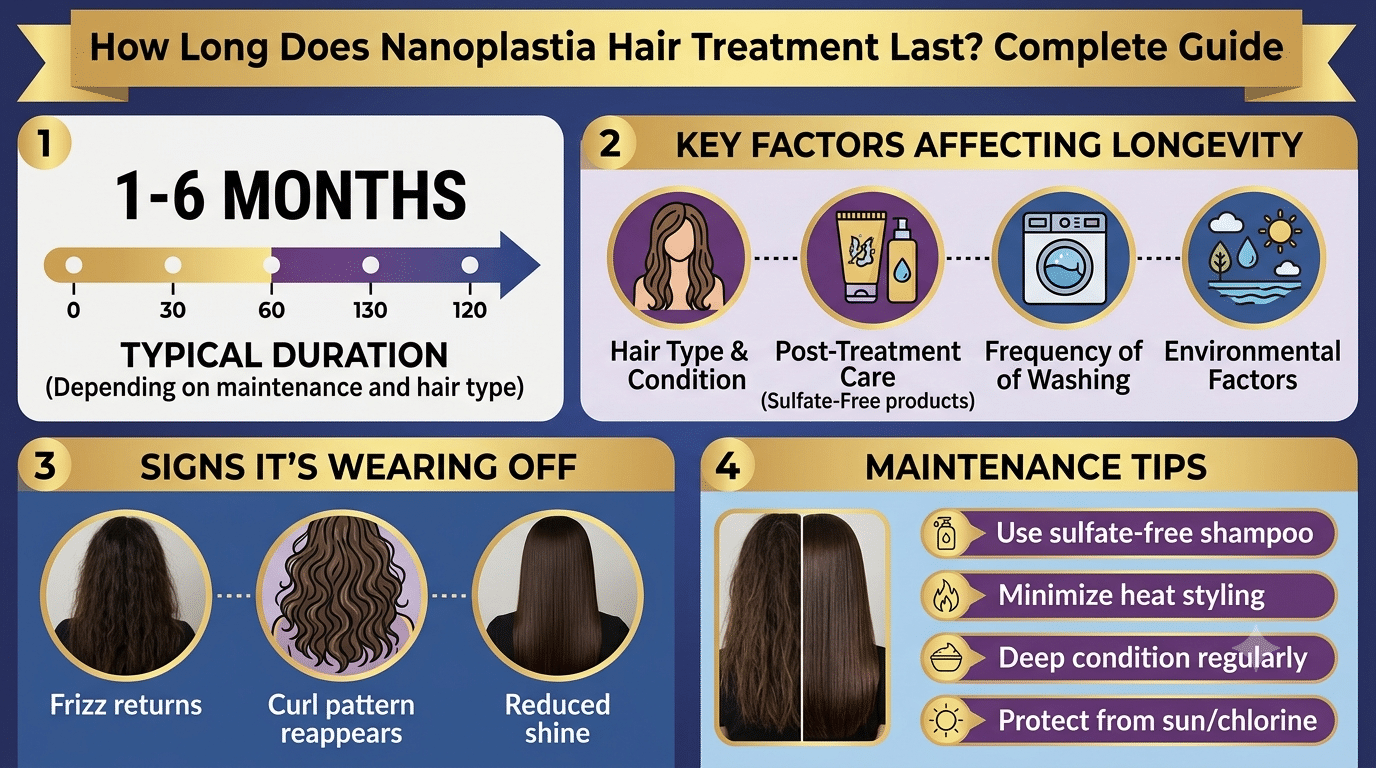
If you are thinking about getting Nanoplastia hair treatment, one of the first questions you will probably ask your stylist is simple: how long will the results actually last? Nobody wants to spend hours in a salon, invest in a professional treatment, and then discover that the smooth, shiny finish disappears after a few washes. The good news is that Nanoplastia can provide long-lasting smoothing, frizz control, softness, and easier hair management when the treatment is professionally performed and maintained correctly. Current professional guidance commonly places the results around 3 to 6 months, although some systems and hair types may show results for longer.
The important point is that there is no universal expiration date for Nanoplastia. Your hair’s natural texture, porosity, previous chemical treatments, washing habits, water quality, climate, heat styling, and the specific Nanoplastia formulation all influence longevity. For example, someone who washes their hair every day with a strong cleansing shampoo may notice the smoothing effect fading much sooner than someone who washes two or three times a week with products designed for chemically treated hair. Similarly, curly, highly porous or heavily processed hair may behave differently from healthy, moderately wavy hair. Think of Nanoplastia like maintaining a polished surface: the original professional service matters, but what you do afterward determines how long that finish stays beautiful.
What Is Nanoplastia Hair Treatment?
Nanoplastia hair treatment is a professional hair-smoothing service designed to reduce frizz, improve manageability, enhance shine, and create a smoother-looking hair texture. The term is used commercially for different formulations, so it is important not to assume that every product sold as Nanoplastia has exactly the same ingredients or works in precisely the same way. Professional formulas may contain combinations of amino acids, proteins, conditioning agents and other ingredients intended to modify the feel and appearance of the hair when combined with controlled heat. Some professional sources describe Nanoplastia as a formaldehyde-free smoothing system, while other experts caution that safety depends on the exact formulation rather than the treatment name itself.
This distinction matters because Nanoplastia is not a single standardized chemical formula. A salon should be able to tell you which professional product it uses, provide the ingredient information when requested, and explain the recommended processing and aftercare instructions. The FDA also advises consumers considering hair-smoothing products to check ingredient information and ask professionals about the product, safety data and ventilation, particularly because some hair-smoothing products can release formaldehyde when heated. A reputable salon should therefore focus not only on the final glossy result but also on consultation, hair assessment, correct product selection, professional application and appropriate ventilation.
How Nanoplastia Works on Hair
The basic purpose of Nanoplastia is to make hair smoother, more manageable and less prone to visible frizz. Depending on the formulation, the service generally involves applying the product carefully to sections of the hair, allowing it to process according to the manufacturer’s instructions, and then using controlled heat to help create the finished result. The exact procedure varies significantly between professional systems, so the stylist should follow the product manufacturer’s technical instructions rather than applying one generic method to every client.
The finished hair can look straighter, softer and more polished, but the degree of straightening depends on the hair’s natural pattern and the formula used. Someone with loose waves may achieve a very sleek finish, while someone with tight curls may experience significant frizz reduction and elongation without necessarily getting permanently straight hair. This is why a professional consultation is so important. A stylist can assess density, porosity, elasticity, previous colour services, bleaching history and overall condition before deciding whether Nanoplastia is appropriate. On severely compromised hair, adding a strong smoothing service and substantial heat may not be the smartest first step; some professional salons recommend rebuilding or conditioning fragile hair before considering additional chemical smoothing.
How Long Does Nanoplastia Hair Treatment Last?
For most clients, a realistic expectation is approximately 3 to 6 months of visible smoothing and frizz control, provided the treatment is suitable for the hair and maintained properly. Several current professional sources give a similar range, while some individual product systems claim longer durations under specific conditions. This means it is better to think in terms of a range rather than expecting an exact number of months. Your results do not suddenly switch off on a particular day; instead, the effect gradually becomes less noticeable as the hair is washed, exposed to environmental factors, and grows out with its natural texture.
A useful way to understand the process is to imagine a beautifully maintained hairstyle. Immediately after leaving the salon, the hair can look exceptionally smooth, controlled and glossy. Over the following weeks, washing and daily exposure gradually reduce that freshly treated appearance. By the later months, you may still notice easier styling and less frizz even though the original salon finish is no longer as pronounced. Some people may schedule a refresh around the four-to-six-month point, while others may prefer to wait longer depending on how their natural texture returns.
Average Nanoplastia Duration
| Factor | Typical effect on longevity |
|---|---|
| Professional application | Can help achieve more consistent results |
| Sulfate-free, treatment-friendly care | Helps preserve smoothness |
| Frequent washing | Can shorten visible results |
| Harsh clarifying shampoos | May accelerate fading |
| Swimming and chlorine | Can reduce longevity |
| Humidity | Can make returning frizz more noticeable |
| Heat styling without protection | Can contribute to dryness and damage |
| Hair growth | Natural texture gradually returns at the roots |
Current sources commonly report around 3–6 months, with some professional systems claiming 4–6 or even 6–8 months under particular conditions. Because formulations differ, your salon’s product-specific instructions should take priority over a generic internet timeframe.
Why Results Differ From Person to Person
Why can two people receive the same salon service and get noticeably different longevity? The answer is hair history and lifestyle. Hair that is highly porous, frequently bleached, heavily coloured or exposed to repeated heat styling behaves differently from relatively healthy virgin hair. Your washing frequency also matters. If you shampoo your hair every day, you are repeatedly exposing the treated hair to water, cleansing agents and friction, whereas washing less frequently may help maintain the cosmetic effect for longer.
Climate can also influence the way treated hair looks. Humid weather can make frizz more visible, while hard-water minerals may build up on the hair and contribute to dullness or rough texture. One current Indian aftercare guide specifically highlights sulphates, hard-water minerals, humidity and excessive heat as factors that can make maintaining smoothness more difficult. This does not mean Nanoplastia has suddenly stopped working. Instead, environmental and lifestyle factors can affect the appearance and feel of the treated hair.
Nanoplastia Longevity by Hair Type
Hair type is one of the biggest variables when discussing how long Nanoplastia lasts. Curly, wavy, straight, fine, thick, porous and chemically treated hair can respond differently to the same service. A current professional guide, for example, estimates approximately 3–5 months for curly hair, 4–6 months for wavy hair and around 3–5 months for chemically treated hair, while emphasizing that aftercare, humidity, swimming and hair history also influence the outcome.
The key thing to understand is that “lasting” can mean different things. If your goal is completely straight hair, you may notice the return of your natural pattern sooner. If your goal is simply less frizz, easier blow-drying and increased shine, you may continue to feel that the treatment is useful even after the strongest smoothing effect has reduced. In other words, the visual result and the practical styling benefit do not necessarily disappear at exactly the same time.
Curly and Wavy Hair
Curly and wavy hair can respond beautifully to Nanoplastia because reducing excessive frizz can make the natural pattern easier to manage. However, clients with stronger curl patterns should not automatically expect every strand to become permanently straight. The result depends on the formulation, processing technique, hair condition and the desired finish discussed during consultation. Some professional systems describe their products as capable of smoothing curly and wavy hair while preserving some movement, whereas others are designed to create a much straighter appearance.
For wavy hair, the smoothing effect may remain noticeable for several months, especially when the client follows an appropriate home-care routine. Curly hair may show returning texture more visibly at the roots as new hair grows. This is normal and does not necessarily mean the treatment failed. Your untreated new growth has its original natural structure, while the previously treated lengths retain the cosmetic effect for a period of time. That is why many clients eventually choose a professional maintenance appointment rather than repeatedly treating the entire head from roots to ends.
Coloured and Chemically Treated Hair
If your hair has been coloured, highlighted or chemically processed, the consultation becomes even more important. Treated hair may have increased porosity and reduced elasticity, meaning it can respond differently to heat and chemical services. Some professional Nanoplastia systems are specifically marketed for coloured or chemically treated hair, but that does not mean every damaged head of hair is automatically suitable.
A professional should assess the condition of the hair before proceeding. If the strands are extremely brittle, breaking easily or severely compromised from bleaching, the priority may need to be improving hair condition rather than immediately pursuing maximum smoothness. This is especially important because the heat-sealing stage is a significant part of many smoothing procedures. A dermatologist and trichologist discussing Nanoplastia has also highlighted that high heat can contribute to cuticle damage, brittleness and breakage when the procedure is not appropriate for the hair.
What Affects How Long Nanoplastia Lasts?
The biggest mistake is assuming that the salon appointment alone determines longevity. Aftercare is part of the treatment. Your shampoo, washing frequency, water quality, swimming habits, heat styling and general hair maintenance can all affect how long the smooth appearance remains.
Think about it like maintaining a premium car. The initial detailing creates the polished finish, but repeatedly using harsh products, exposing the surface to damaging conditions and ignoring maintenance will eventually reduce the effect. Hair works differently biologically, of course, but the maintenance principle is similar. If you invest in professional smoothing and then immediately return to habits that strip moisture or increase damage, you are making it harder to preserve the result.
Hair Washing Frequency
Every wash exposes your hair to water, cleansing ingredients, friction and manipulation. That does not mean you should stop washing your hair; healthy scalp hygiene still matters. Instead, the goal is to find a washing routine appropriate for your scalp and hair while using products recommended for treated hair.
Several current Nanoplastia aftercare guides recommend limiting washing to roughly 2–3 times per week when practical and using a suitable sulfate-free shampoo. However, this should not be interpreted as a universal medical rule. People with oily scalps, active lifestyles, heavy sweating or specific scalp needs may require a different schedule. Your stylist can help you choose a routine that balances scalp cleanliness with preservation of the cosmetic result.
Shampoo and Hair Products
Your shampoo choice can make a noticeable difference to how treated hair looks and feels. Many professional aftercare systems recommend sulfate-free shampoo and conditioner because aggressive cleansing can reduce the longevity of smoothing results. Clarifying shampoos are also commonly listed among products to avoid unless your stylist specifically recommends them for a particular reason.
The same principle applies to styling. Excessive heat from straighteners, curling irons and high-temperature blow-drying can contribute to dryness and breakage. If you use heat, apply an appropriate heat protectant and avoid unnecessarily high temperatures. A good routine should not attempt to “lock” Nanoplastia into the hair forever; instead, it should protect the condition and appearance of the treated lengths for as long as reasonably possible.
How to Make Nanoplastia Last Longer
Getting the maximum practical lifespan from Nanoplastia starts with choosing the right treatment for your hair rather than simply choosing the strongest possible smoothing service. During consultation, tell your stylist about colouring, bleaching, previous straightening, keratin treatments, hair fall concerns, heat styling and any other chemical services. The more accurately your stylist understands your hair history, the easier it becomes to select an appropriate professional formula and technique.
After the appointment, follow the exact aftercare instructions supplied for the product used. There is no single universal Nanoplastia protocol because different formulations have different processing and maintenance requirements. Some current professional guides recommend waiting 48–72 hours before the first wash, while others may have different manufacturer instructions. Therefore, do not blindly follow a generic online rule if your stylist provides product-specific instructions.
The First 48–72 Hours
The initial period deserves special attention because many professional systems instruct clients to avoid washing the hair for a defined period after treatment. Depending on the product, this may be approximately 48–72 hours. During this time, avoid unnecessarily wetting the hair and follow the salon’s instructions about tying, sleeping and styling.
Some professional aftercare guidance also recommends avoiding swimming, heavy sweating and unnecessary moisture exposure during this stabilization period. If your hair becomes wet accidentally, do not panic; contact your stylist if the product instructions specifically require action. The important thing is to understand that the first few days are not the time to experiment with new shampoos, masks, swimming pools or intensive styling.
Long-Term Aftercare Routine
Once you complete the initial waiting period, your routine should focus on gentle cleansing, hydration and protection. Use products appropriate for chemically treated or smoothed hair, avoid unnecessary clarifying washes, protect your hair from excessive heat and consider your local water quality if you notice mineral buildup or persistent dullness. In areas with hard water, a stylist may recommend an occasional appropriate chelating or mineral-removing product, but it should be used carefully because excessive clarification can work against your goal of maintaining smoothness.
Swimming is another factor. Chlorinated or salt water can make treated hair feel drier and less manageable, particularly when combined with frequent washing. If you swim regularly, ask your stylist for a routine specifically designed around your lifestyle rather than trying to follow a generic “perfect” routine. The best aftercare routine is the one you can realistically maintain week after week.
Nanoplastia vs Keratin: How Long Do Results Last?
Nanoplastia and keratin treatments are often compared because both are used to make hair smoother and easier to manage. However, you should be careful with simple claims such as “Nanoplastia always lasts longer” because both categories contain different products and formulations. Current sources commonly place Nanoplastia around 3–6 months, while some professional providers claim longer periods for specific systems.
| Feature | Nanoplastia | Keratin/Smoothing Treatments |
|---|---|---|
| Main goal | Smoothing, frizz control, manageability | Smoothing and frizz reduction |
| Typical reported duration | About 3–6 months | Varies significantly by formula |
| Formula | Varies by manufacturer | Varies by manufacturer |
| Straightening effect | Depends on product and hair type | Depends on product and hair type |
| Aftercare | Treatment-specific | Treatment-specific |
| Safety considerations | Depends on exact ingredients and process | Depends on exact ingredients and process |
| Professional consultation | Recommended | Recommended |
The most useful comparison is therefore not simply “which lasts longer?” Instead, ask which formula is being used, what ingredients does it contain, what result should I expect, and what aftercare does it require? The FDA specifically recommends checking ingredient information and asking professionals about safety data and ventilation for hair-smoothing products.
When Should You Repeat Nanoplastia?
For many clients, a professional consultation around 4–6 months is a reasonable point to assess whether the smoothing effect has reduced enough to justify another service. Some people may need attention earlier, while others may comfortably wait longer. The decision should be based on how the hair looks and behaves, how much natural texture has returned, and the condition of the hair—not simply on a calendar reminder.
It is also important to avoid automatically applying a strong treatment over every inch of hair each time. Your previously treated lengths have already undergone the service, while new growth is untreated. A skilled stylist can assess whether a targeted approach is more appropriate and how to avoid unnecessary processing of already-treated hair. Repeated chemical processing and high heat can contribute to cumulative damage, particularly when hair is already dry, porous or chemically compromised.
Is Nanoplastia Suitable for Everyone?
Nanoplastia may be attractive for people dealing with frizz, dryness, difficult-to-manage texture and excessive styling time, but it is not automatically suitable for every person or every hair condition. Severely bleached, brittle or breaking hair should be assessed carefully before any smoothing service. Some professional salons specifically advise against straightening treatments for extremely damaged hair until the condition of the hair has improved.
Safety also depends on the exact product. The word “Nanoplastia” itself does not guarantee that every formulation is identical or free from every potentially concerning ingredient. One current professional reference emphasizes that Nanoplastia is a category with varying formulas and recommends checking the ingredient list and safety documentation. The FDA similarly advises consumers to check ingredients and ask salons about the product and safety precautions when considering hair-smoothing services.
If you are pregnant, breastfeeding, have a scalp condition, have allergies or have recently undergone extensive chemical processing, discuss the treatment with an appropriate healthcare professional and your stylist before proceeding. A salon should never pressure you into a treatment without a proper consultation. Good hair results begin with healthy decision-making, not simply with the promise of ultra-straight hair.
Conclusion
So, how long does Nanoplastia hair treatment last? For many clients, a realistic expectation is approximately 3 to 6 months, although the actual duration can vary considerably depending on hair type, formulation, technique, washing frequency, aftercare, climate, water quality and previous chemical processing. Current professional sources support this general range, while some individual systems report longer durations under specific conditions.
The biggest takeaway is that longevity is not determined by the salon appointment alone. Choosing an experienced professional, having your hair properly assessed, following product-specific first-wash instructions, using suitable aftercare, controlling unnecessary heat and avoiding harsh cleansing can all help preserve the smooth and manageable appearance. At the same time, remember that Nanoplastia is not a permanent transformation: natural hair continues to grow, and the treated lengths gradually change with washing and everyday exposure.
If you are considering Nanoplastia, ask your stylist three simple questions before booking: Which product will you use? How long should I realistically expect the result to last on my hair? What exact aftercare do you recommend? Those answers will tell you much more than a generic promise of “six months” or “one year.” The goal should be healthy, manageable and beautiful hair—not simply the longest possible treatment duration.
Frequently Asked Questions
1. How long does Nanoplastia hair treatment usually last?
Nanoplastia commonly lasts around 3 to 6 months, although the duration depends on the specific product, hair type, washing frequency and aftercare. Some professional systems report longer results, so your stylist’s product-specific guidance is important.
2. Can Nanoplastia last for 6 months?
Yes. Six months can be a realistic result for some clients when the treatment is professionally applied and the hair is maintained properly. Frequent washing, harsh shampoos, humidity, swimming and excessive heat styling may shorten the visible smoothing effect.
3. How often should I wash my hair after Nanoplastia?
Many professional aftercare guides suggest washing approximately 2–3 times per week when practical, using suitable sulfate-free products. However, your ideal schedule depends on your scalp, lifestyle and the specific treatment system used.
4. Can I use regular shampoo after Nanoplastia?
It is generally better to use a shampoo specifically recommended for treated or smoothed hair. Many professional systems recommend sulfate-free shampoo because harsh cleansing can reduce the longevity of the cosmetic smoothing effect.
5. Is Nanoplastia permanent?
No. Nanoplastia is a long-lasting smoothing treatment, not a permanent alteration of every new strand of hair. As new hair grows, your natural texture appears at the roots, while the treated lengths gradually lose some of their original salon-fresh effect.
🔍 Want to find the best keywords and rank this article faster? Try the #1 SEO & AI visibility toolkit free for 14 Days. Track your keyword rankings, audit your site, and monitor your AI search visibility on ChatGPT, Gemini & Google AI Overviews
✨ Get better articles, faster. This prompt is powerful. But Pro Article Writer takes it further — AI humanizer, SEO tools, full editor, one-click options, and more control all in one place. Try it free →
If this prompt helped you, please leave a review — it keeps this prompt ranked #1.