
D-Tan Face Pack: Benefits, Uses & How to Use It for Brighter-Looking Skin
-
Dokmai London
- Posted on
- 0 comments
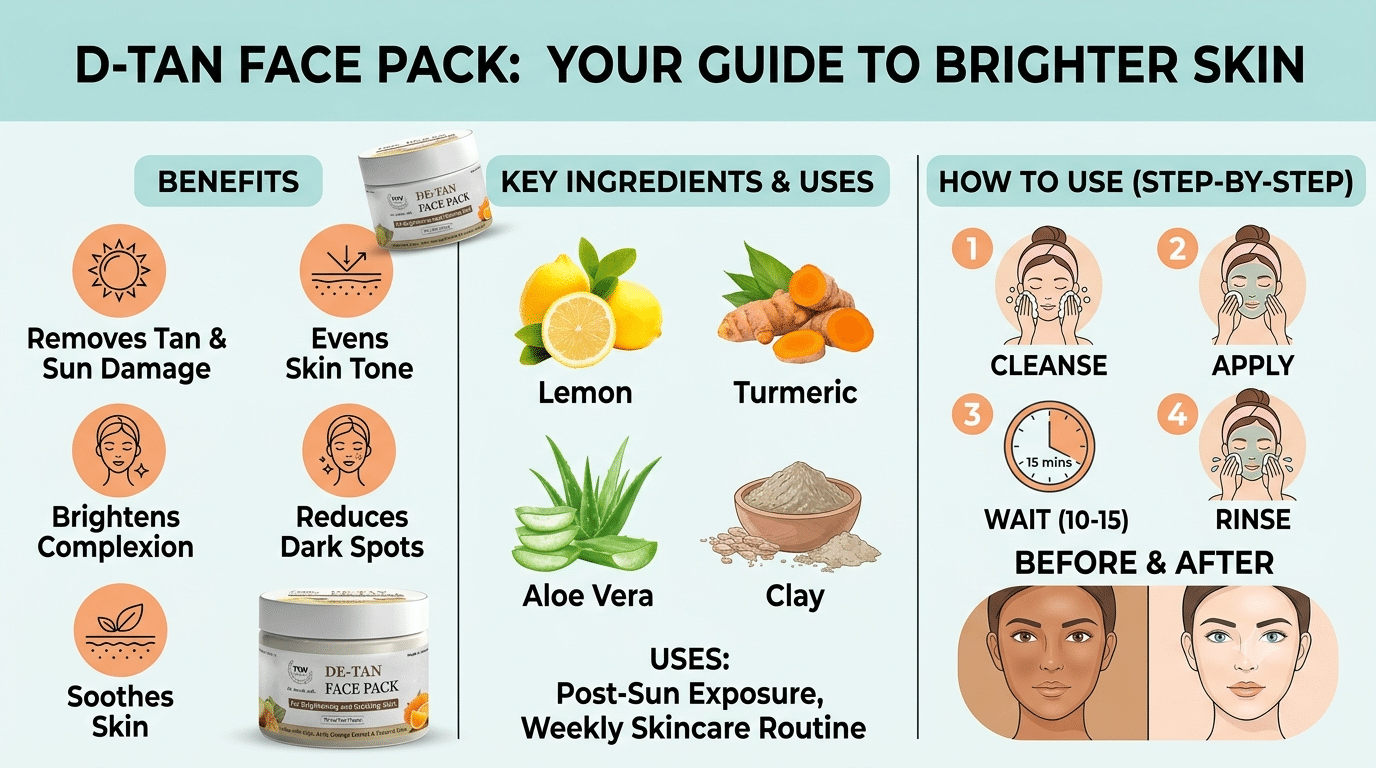
Spending time outdoors can leave your skin looking noticeably darker, duller, or less even than usual, especially after long exposure to strong sunlight. That is where a D-Tan face pack has become a popular skincare option for people who want their complexion to look fresher and more radiant. Unlike the idea of permanently changing your natural skin colour, a de-tan treatment is generally intended to improve the appearance of surface tanning, dullness, uneven-looking tone, and accumulated impurities. Modern D-Tan products can contain very different combinations of ingredients, ranging from clays and botanical extracts to aloe vera, licorice, niacinamide, arbutin, fruit extracts, and moisturising ingredients. Current products sold in India show just how varied these formulations can be, so checking the ingredient list and following the product’s directions is important.
A good D-Tan routine should also be viewed as one part of broader sun-care rather than a quick fix that cancels out repeated UV exposure. Dermatologists at the American Academy of Dermatology explain that tanning is a sign of skin damage from ultraviolet radiation, and sunlight can also contribute to pigmentation and dark spots. Broad-spectrum sunscreen with SPF 30 or higher, along with shade and protective clothing, is therefore central to preventing additional tanning and pigmentation. So, if your goal is brighter-looking, healthier-looking skin, think of a D-Tan face pack as a supporting step: cleanse gently, use an appropriate treatment, moisturise, and protect your skin from the sun consistently.
What Is a D-Tan Face Pack?
A D-Tan face pack is a cosmetic face treatment formulated to help improve the appearance of skin that looks tanned, dull, uneven, or tired after sun exposure. The phrase “D-Tan” is commonly used in the beauty industry for products designed around the appearance of sun tan rather than as a medical treatment for pigmentation disorders. Depending on the formulation, a face pack may combine cleansing clays, botanical extracts, moisturisers, exfoliating ingredients, antioxidants, or skin-conditioning agents. For example, commercially available D-Tan formulations currently list ingredients such as aloe vera, licorice, mulberry, arbutin, clay, glycerin, niacinamide, fruit extracts, and other conditioning ingredients.
The important distinction is that not every D-Tan face pack works in exactly the same way. One formula may primarily absorb excess oil and impurities, while another may focus more on hydration and soothing, and another may contain ingredients intended to improve the appearance of uneven pigmentation. Some products are marketed for all skin types, while others are positioned toward oily, normal, combination, or sensitive skin. That is why blindly choosing a product because the label says “de-tan” is not the best approach. Look at the ingredients, consider your skin type, follow the recommended contact time, and avoid treating a face pack as a replacement for professional treatment when you have persistent pigmentation.
How D-Tan Face Packs Work
The visible effect of a D-Tan face pack can come from several different mechanisms depending on its formulation. A clay-based product, for example, may help absorb excess oil and leave the skin feeling cleaner and fresher, while moisturising ingredients can make the surface appear smoother and more comfortable. Some formulations also contain ingredients such as niacinamide, licorice, arbutin, or botanical extracts that are commonly included in products aimed at improving the appearance of uneven tone. A 2025 formulation study on a herbal D-Tan face pack examined a combination of ingredients including sandalwood, orange peel, Multani mitti, beetroot, rose, gram flour, rose water, aloe vera, honey, and vitamin E, illustrating how diverse the category can be.
However, the phrase “removes tan” should be interpreted carefully. A face pack cannot simply erase UV exposure as though it were dirt sitting on the skin. Sun exposure stimulates pigment production, and visible light can also contribute to hyperpigmentation, particularly in people with darker skin tones. A D-Tan pack may help your skin look fresher, more even, and brighter, but protecting the skin from further exposure is what helps prevent the cycle from immediately returning.
Why Does Skin Look Tanned?
Skin can become darker after exposure to ultraviolet radiation because the body responds to UV exposure by increasing pigment production. Melanin is the pigment responsible for much of the colour in our skin, hair, and eyes, and increased pigment production can result in a darker-looking complexion after sun exposure. The American Academy of Dermatology explains that UV radiation contributes to tanning and that there is no completely safe way to tan because tanning represents skin damage. UVA and UVB radiation affect the skin differently, with UVA strongly associated with premature skin ageing and UVB being a major cause of sunburn.
This is why someone may notice a difference after a holiday, outdoor sports, commuting, a beach visit, or simply spending long hours outside during intense sunlight. The face, neck, arms, and hands can become particularly exposed because they are often not covered by clothing. A D-Tan face pack may improve the appearance of the face after such exposure, but it should not encourage repeated sun exposure. If your skin continues receiving substantial UV exposure without adequate protection, any temporary improvement can be undermined by new tanning and pigmentation. Good skincare therefore starts with understanding the cause rather than focusing only on the visible symptom.
The Role of UV Exposure and Melanin
Melanin is not something your skin needs to “get rid of.” It is a natural pigment and an important part of how the skin responds to environmental exposure. When ultraviolet radiation reaches the skin, biological processes can increase melanin production, resulting in a darker appearance. Sun exposure can also contribute to longer-lasting pigmentation problems, including conditions such as melasma, which dermatologists treat with carefully selected approaches rather than relying solely on cosmetic face packs.
This distinction matters when you search for the best D-Tan face pack. A responsible skincare goal is not to make naturally deeper skin suddenly appear unnaturally pale. Instead, the focus should be on restoring a fresher appearance and improving uneven-looking tone while keeping the skin barrier comfortable. If a product causes burning, intense redness, peeling, or irritation, using more of it will not necessarily produce better results. Healthy-looking skin should feel comfortable as well as look radiant.
D-Tan Face Pack Benefits
One of the main reasons people use D-Tan face packs is the desire to reduce the appearance of sun tan and dullness. Depending on its ingredients, a face pack can cleanse the skin, remove surface impurities, condition the skin, and provide ingredients designed to support a more even-looking complexion. Current D-Tan products in the Indian market describe benefits such as refreshing the skin, improving the appearance of tan, supporting an even-looking tone, and leaving the skin softer or more radiant.
The results can vary considerably from person to person because tanning itself varies with exposure, skin type, pigmentation, skincare habits, and how consistently the person uses sun protection. A single application may make the skin look cleaner and fresher, but that should not be confused with permanent pigment removal. Think of the treatment as polishing the appearance of your skincare routine rather than pressing a reset button on your skin. When combined with gentle cleansing, moisturisation, and daily sunscreen, a suitable D-Tan product can fit comfortably into a practical skincare routine.
Helps Improve the Appearance of Sun Tan
A D-Tan face pack can be particularly useful when the skin looks temporarily darker or duller after outdoor exposure. Many products are formulated with ingredients selected for cleansing, soothing, moisturising, or brightening purposes. For example, commercially available products include formulas containing aloe vera, cucumber, shea butter, licorice, mulberry, arbutin, clay, and other cosmetic ingredients.
The word “improve” is important here. A cosmetic face pack may help the skin look more refreshed, but it cannot guarantee that all tanning will disappear after one application. Deeper pigmentation or persistent dark patches may have causes beyond ordinary surface tanning. If pigmentation continues despite consistent sun protection and appropriate skincare, it is sensible to seek professional advice instead of repeatedly increasing the frequency or intensity of face-pack treatments.
Supports a More Even-Looking Skin Tone
Another reason people choose a D-Tan treatment is to improve the appearance of uneven tone. When the skin has been exposed to sunlight, different areas may appear darker depending on how much exposure they receive. Uneven application of sunscreen, uncovered areas around the hairline, cheeks, forehead, or neck, and repeated outdoor exposure can all make the complexion appear less uniform.
Ingredients such as niacinamide, licorice, arbutin, and selected botanical extracts are frequently found in cosmetic products marketed for brighter or more even-looking skin. Current commercial D-Tan products demonstrate the variety of formulations available, but the presence of an ingredient does not automatically guarantee a specific result. Your skin’s response, the concentration and formulation, frequency of use, and sun exposure all matter.
Can a D-Tan Face Pack Make Skin Look Brighter?
Yes, a D-Tan face pack can make skin look brighter and fresher, particularly when dullness is related to surface buildup, dryness, excess oil, or the appearance of recent tanning. Cleansing and conditioning can improve how light reflects from the skin, while suitable cosmetic ingredients may help support a more even-looking complexion. This is one reason many people notice a visible “glow” after a facial or face-mask treatment even though their fundamental skin colour has not changed.
The healthier way to think about brightening is restoring clarity rather than changing identity. Your natural skin tone is not something that needs to be corrected, and a good skincare routine should focus on comfort, evenness, hydration, and protection. If the goal is to reduce the appearance of dark patches, especially persistent patches, a dermatologist may recommend a more targeted approach. The American Academy of Dermatology notes that pigmentation conditions such as melasma often require tailored treatment and consistent sun protection.
Brightening vs. Changing Your Natural Skin Tone
“Brightening” in skincare generally refers to improving the appearance of dullness and uneven pigmentation, not permanently changing the skin’s natural colour. This is an important distinction because marketing language around fairness and whitening can create unrealistic expectations. A sensible skincare routine aims for skin that looks healthy, smooth, hydrated, and more even rather than promising a completely different complexion.
If you are choosing a D-Tan face pack for glowing skin, look for a product that suits your skin type and has transparent ingredient information. Avoid assuming that stronger means better. Excessive exfoliation or harsh ingredients can irritate the skin, and irritation itself can sometimes make pigmentation concerns more difficult to manage.
Common Ingredients in D-Tan Face Packs
There is no single universal ingredient list for a D-Tan face pack. Some formulas are built around clay and cleansing ingredients, while others combine moisturisers with botanical extracts or cosmetic brightening ingredients. Examples found in current products include aloe vera, licorice, mulberry, arbutin, niacinamide, kaolin, Multani mitti, cucumber, papaya, orange peel, sandalwood, and other plant-derived ingredients.
Because formulations differ, the safest approach is to judge the actual product rather than the category name. A product containing fragrance or essential oils may not suit everyone, particularly if the skin is sensitive. Similarly, a product containing exfoliating acids may need more careful use than a simple hydrating mask. Always read the ingredient list, patch-test when appropriate, and stop using the product if you develop significant irritation.
Aloe Vera, Licorice, Clay and Botanical Extracts
Aloe vera is frequently included in cosmetic products because it provides a soothing and moisturising feel, while clay ingredients can help absorb oil and impurities. Licorice and other botanical extracts are often used in formulations targeting uneven-looking tone. Current Indian D-Tan products show combinations ranging from aloe vera and licorice to clay, fruit extracts, turmeric, almond, and other botanicals.
That variety is useful, but it also means you should not assume that every natural ingredient is automatically gentle or suitable for your skin. Essential oils and fragrances can irritate some people, while physical exfoliants can be too aggressive when used frequently. A good face pack should fit your skin rather than forcing your skin to tolerate an unnecessarily strong formula.
How to Use a D-Tan Face Pack Correctly
Using a D-Tan face pack properly is just as important as selecting the product. Start with a clean face so that makeup, sunscreen, sweat, and surface impurities do not interfere with application. Apply an even layer according to the product instructions, avoiding the delicate eye and lip areas. Different products recommend different contact times, so do not automatically leave every D-Tan pack on until it becomes completely dry; follow the manufacturer’s directions instead. For example, current products on the market give directions ranging from approximately 10–12 minutes to around 15–20 minutes.
After the recommended time, rinse gently with water without aggressive rubbing. Pat the skin dry with a clean, soft towel and follow with a suitable moisturiser. If the product contains potentially sensitising ingredients, it is particularly important to avoid unnecessary friction or combining it immediately with several other strong active products. A simple routine is often better than stacking multiple treatments together.
Step-by-Step Application Guide
A practical D-Tan routine can be kept simple and gentle:
- Cleanse your face with a mild cleanser and pat it dry.
- Patch-test the product if you are using it for the first time or have reactive skin.
- Apply an even layer to the face and, if appropriate according to the product instructions, the neck.
- Avoid the eyes, lips, broken skin, and irritated areas.
- Leave it on only for the recommended time printed on the product.
- Rinse gently without scrubbing aggressively.
- Moisturise after rinsing.
- Use sunscreen during the day, especially if you are going outdoors.
The exact routine can vary because D-Tan products are not standardized formulas. A professional facial kit may include several stages, while a simple home face pack may be a single treatment step. For example, one current professional-style D-Tan kit lists cleanser, exfoliator, preparing gel, D-Tan pack, treatment cream, and an algae mask as separate stages.
How Often Should You Use a D-Tan Face Pack?
There is no universal rule saying that every person should use a D-Tan face pack on a particular number of days per week. The correct frequency depends on the formulation, your skin type, how your skin reacts, and the manufacturer’s instructions. If a product contains exfoliating ingredients, using it too frequently may cause dryness or irritation. If it is primarily a soothing or hydrating mask, the recommended schedule may be different.
A sensible approach is to start conservatively and observe your skin. If your face feels comfortable afterward, without excessive tightness, burning, persistent redness, or peeling, you can follow the product’s recommended routine. More frequent application is not automatically equal to faster results. Your skin needs time to maintain its natural barrier, and repeated irritation can work against the smooth, healthy-looking appearance you are trying to achieve.
Adjusting Frequency for Different Skin Types
Oily skin may tolerate certain clay-based masks well, while dry skin may prefer a more moisturising formulation. Combination skin can benefit from a balanced product that does not excessively dry the cheeks while addressing oilier areas. Sensitive skin requires the most caution, particularly around fragrance, essential oils, strong exfoliants, and aggressive physical scrubbing.
Rather than choosing a D-Tan pack solely because it claims to be suitable for “all skin types,” read the complete label and pay attention to your own response. Even a product advertised for all skin types can feel different depending on the individual’s skin condition. If you already use prescription skincare, strong exfoliating acids, retinoids, or other active products, consider asking a dermatologist or qualified skincare professional how to combine treatments safely.
D-Tan Face Pack for Oily, Dry and Combination Skin
For oily skin, a D-Tan pack containing suitable clay or oil-absorbing ingredients may provide a clean, refreshed feeling without requiring harsh scrubbing. For dry skin, the priority should be a formulation with moisturising and soothing ingredients so that the treatment does not leave the skin uncomfortably tight. Combination skin may require a middle ground because the T-zone can become oily while the cheeks remain comparatively dry. These differences are why “one product for everyone” is not always the most useful way to approach skincare.
Current products demonstrate this broad range. Some D-Tan products feature clay and botanical ingredients, while others contain aloe vera, glycerin, shea butter, hyaluronic acid, or other conditioning ingredients. If your skin becomes dry after using a pack, reduce the frequency and focus on moisturisation rather than adding another aggressive treatment.
D-Tan Face Pack for Sensitive Skin
Sensitive skin needs a gentler strategy. Before applying a new product to the entire face, consider a patch test according to the product’s instructions. Avoid using a D-Tan pack on skin that is sunburned, freshly irritated, scratched, or otherwise compromised. A product containing fragrance, peppermint oil, lemon-derived ingredients, or other potentially irritating components may not be appropriate for everyone, even when it is marketed as natural or herbal.
If you experience significant burning, swelling, itching, blistering, or persistent redness, rinse the product off and discontinue use. Repeatedly applying a product that irritates your skin will not make it work faster. When pigmentation is accompanied by persistent inflammation or sensitivity, professional assessment can help identify the underlying issue instead of treating every dark area as ordinary tanning.
D-Tan Face Pack Before an Event
A D-Tan face pack can be useful as part of a pre-event skincare routine when your objective is a fresh, clean, hydrated-looking complexion. However, trying a brand-new product immediately before an important event is risky because you do not know how your skin will react. A patch test and an earlier trial are much safer than experimenting on the morning of a wedding, party, photoshoot, or important function.
For best results, keep the pre-event routine simple. Cleanse gently, use a familiar face pack if your skin tolerates it, moisturise, and avoid excessive exfoliation. If the event is outdoors, remember that sunscreen remains essential. A temporary glow is useful, but protecting the skin from further UV exposure is what helps maintain an even-looking complexion.
D-Tan Face Pack vs. Regular Face Mask
A regular face mask can have many purposes, including hydration, oil control, soothing, cleansing, or simply providing a relaxing skincare step. A D-Tan face pack is generally positioned more specifically around the appearance of tanning, dullness, and uneven tone. The difference is therefore often more about the formulation’s intended purpose than the physical format of the product.
For example, a hydrating mask might focus heavily on ingredients that support moisture, while a D-Tan product might combine cleansing, conditioning, and tone-focused ingredients. There is no requirement that one category be universally better than the other. If your main problem is dryness, a rich hydrating mask may be more relevant; if your concern is recent tanning and dullness, a suitable D-Tan product may make more sense.
D-Tan Face Pack vs. Professional De-Tan Facial
A home D-Tan face pack is usually a single skincare product or simple treatment, while a professional de-tan facial may involve multiple stages performed by a trained beauty professional. Professional treatments can include cleansing, exfoliation, massage, treatment application, masking, moisturisation, and other steps depending on the salon and the specific facial protocol. Some commercially available professional kits are themselves structured as multi-step treatments, with separate cleanser, exfoliator, preparing gel, treatment cream, and mask stages.
The advantage of professional treatment is not simply that it is “stronger.” A trained professional can consider the client’s skin condition and adjust the service accordingly, while a home routine offers convenience and control. If your skin has persistent pigmentation, melasma-like patches, active irritation, or another unexplained change, however, a dermatologist is the more appropriate professional for diagnosis and medical treatment.
Mistakes to Avoid When Using a D-Tan Face Pack
One of the biggest mistakes is assuming that more product means better results. Applying a very thick layer or leaving the product on far longer than recommended can increase irritation without necessarily increasing its benefits. Another common mistake is scrubbing the skin aggressively before or after application because the person believes the tan needs to be physically “removed.” Skin is living tissue, not a stained surface that needs sanding.
Other mistakes include using multiple exfoliating products together, skipping moisturiser, ignoring a patch test, applying the pack to damaged skin, and using a D-Tan product immediately before prolonged sun exposure. People may also forget the most important step: sunscreen. The AAD recommends broad-spectrum SPF 30 or higher and advises reapplication approximately every two hours when outdoors, or after swimming or sweating according to the product directions.
Why Sunscreen Matters After De-Tan Treatments
If you want to maintain a brighter-looking complexion, sun protection is non-negotiable. A D-Tan treatment may improve the appearance of existing dullness or tanning, but it does not create permanent immunity against UV-related pigmentation. The AAD states that UV exposure contributes to tanning and skin damage, while sunlight can also worsen hyperpigmentation conditions.
Use a broad-spectrum sunscreen with SPF 30 or higher and apply it generously to exposed skin. If you spend significant time outdoors, reapply according to the product’s instructions and the AAD’s general guidance. People who are particularly concerned about pigmentation may also benefit from considering a tinted sunscreen containing iron oxide, because visible light can contribute to hyperpigmentation, especially in darker skin tones.
Can D-Tan Face Packs Remove Deep Pigmentation?
A D-Tan face pack should not be treated as a guaranteed solution for deep or persistent pigmentation. Sun tan, post-inflammatory hyperpigmentation, melasma, freckles, acne marks, and other pigmentary changes can look similar to an untrained eye but may have different causes and require different approaches. A cosmetic product may improve the appearance of mild dullness or recent tanning without treating the underlying cause of a pigmentation disorder.
If dark patches continue to develop, become more noticeable, have an unusual pattern, or fail to improve with sensible skincare and sun protection, professional evaluation is appropriate. The AAD notes that melasma treatment is individualized according to factors such as skin tone, pigmentation depth, and triggers, with sun protection forming a key part of management.
When Should You See a Dermatologist?
Consider professional advice if your pigmentation is persistent, rapidly changing, painful, itchy, associated with significant irritation, or not behaving like ordinary temporary tanning. A dermatologist can determine whether you are dealing with sun-induced pigmentation, melasma, post-inflammatory hyperpigmentation, or another condition. This matters because repeatedly applying cosmetic brightening or exfoliating products without knowing the cause can sometimes make irritated skin more difficult to manage.
Professional guidance is also useful if you are already using prescription medicines or strong active ingredients. Some medications and skincare ingredients can increase sensitivity to sunlight, and the AAD notes that certain medications, including some retinoids and antibiotics, can make skin more sensitive to sunlight. When in doubt, protecting the skin and getting the cause identified is more useful than simply increasing the number of treatments.
How to Build a Simple Anti-Tan Skincare Routine
A practical anti-tan routine does not need ten different products. Start with a gentle cleanser, followed by a suitable moisturiser and broad-spectrum sunscreen during the daytime. A D-Tan face pack can be added according to its instructions when your skin needs a treatment focused on the appearance of tanning or dullness. At night, cleanse gently and moisturise rather than constantly exfoliating.
The most important habit is consistency. Sunscreen protects against the exposure that contributes to tanning in the first place, while a suitable face pack can be a supporting cosmetic treatment. Shade, protective clothing, hats, and sunglasses can add another layer of protection when you are outdoors. The AAD specifically recommends combining sunscreen with shade and sun-protective clothing for better protection.
Frequently Asked Questions
1. What is a D-Tan face pack used for?
A D-Tan face pack is generally used to improve the appearance of sun-tanned, dull, or uneven-looking skin. Depending on the formulation, it may also cleanse, soothe, moisturise, or condition the skin. Products marketed for this purpose can contain very different ingredients, so always check the label and follow the manufacturer’s directions.
2. Can I use a D-Tan face pack every day?
Daily use is not automatically recommended. The appropriate frequency depends on the specific formula and your skin’s tolerance. If the product contains exfoliating or potentially irritating ingredients, excessive use can cause dryness or irritation. Follow the product instructions and reduce frequency if your skin becomes uncomfortable.
3. Does a D-Tan face pack permanently remove tanning?
No cosmetic face pack should be treated as a guarantee of permanent tan removal. It may help improve the appearance of tanning and dullness, but continued UV exposure can lead to additional tanning and pigmentation. Consistent broad-spectrum sunscreen, shade, and protective clothing are important for preventing further sun-related darkening.
4. Is a D-Tan face pack suitable for sensitive skin?
Some formulations may be suitable for sensitive skin, but not every D-Tan product will work for every person. Check the ingredients, patch-test when appropriate, avoid applying it to irritated skin, and stop using it if you experience significant burning, swelling, or persistent redness. If your skin is particularly reactive, professional skincare advice can help you select appropriate products.
5. Should I use sunscreen after a D-Tan face pack?
Yes. Sunscreen is an important part of any routine aimed at reducing the appearance of sun-related tanning and pigmentation. The AAD recommends broad-spectrum SPF 30 or higher and advises reapplication approximately every two hours when outdoors, as well as after swimming or sweating according to product directions.
Conclusion
A D-Tan face pack can be a useful addition to a skincare routine when your goal is to improve the appearance of recent tanning, dullness, and uneven-looking skin. The best results come from choosing a formulation that matches your skin type, using it according to the manufacturer’s instructions, moisturising afterward, and avoiding aggressive scrubbing. Current D-Tan formulations demonstrate that there is no single standard recipe: some rely on clay and botanical ingredients, while others contain aloe vera, licorice, arbutin, niacinamide, fruit extracts, or other cosmetic ingredients.
The bigger picture is even more important. Tanning is a response to UV exposure, and a face pack cannot replace sun protection. If you want your complexion to continue looking fresh and even, make broad-spectrum sunscreen, shade, and protective clothing part of your everyday routine. For persistent or unusual pigmentation, professional assessment is more appropriate than repeatedly increasing the use of cosmetic de-tan treatments. With realistic expectations and consistent care, a D-Tan face pack can be one helpful step toward brighter-looking, smoother, fresher-looking skin.