
Hair Spa Before and After: Results, Benefits & How Long They Last
-
Dokmai London
- Posted on
- 0 comments
What Is a Hair Spa?
A hair spa is a conditioning-focused hair-care treatment designed to improve the feel, appearance, and manageability of the hair. A typical professional treatment may involve cleansing, application of a conditioning or treatment product, gentle massage, controlled warmth or steaming depending on the service, rinsing, and final conditioning or styling. The exact process varies between salons and products, so “hair spa” does not describe one standardized medical procedure. What makes the treatment attractive is its focus on restoring softness, reducing roughness, improving shine, and making hair easier to comb and style. Scientific reviews of hair cosmetics explain that conditioners work mainly by reducing friction between hair fibers, smoothing the cuticle surface, improving manageability, and creating a temporary protective effect over damaged areas. Think of your hair like a fabric that is exposed to sunlight, pollution, shampooing, brushing, heat styling, coloring, and other daily stresses. Over time, the outer surface can become rougher, which is why hair may start feeling dry, tangled, dull, or frizzy. A well-selected conditioning treatment can make that surface feel smoother without permanently changing the biological structure of the hair. This distinction matters because hair fibers are made of non-living cells; cosmetic treatments can improve their physical properties and appearance, but they cannot literally turn an already damaged strand back into completely new, untouched hair. Research describes intensive conditioning as a way of temporarily covering or filling imperfections in the hair cuticle and restoring some desirable physical properties.
How a Hair Spa Treatment Works
The goal of a professional hair spa is usually to give the hair a more intensive conditioning experience than a quick everyday conditioner. Deep conditioners tend to contain higher concentrations of moisturizing and conditioning ingredients and are generally left on the hair longer than ordinary rinse-out conditioners. A review of hair-care science notes that intensive conditioners are commonly left in contact with the hair for around 20–30 minutes, while regular conditioners may have much shorter contact times. Depending on the treatment, ingredients can include emollients, humectants, oils, silicones, conditioning polymers, amino acids, or hydrolyzed proteins.
The massage that accompanies many salon hair spa services also makes the experience feel relaxing, but it should not be confused with a proven treatment for every scalp or hair-loss condition. The main cosmetic benefit comes from the conditioning process and the way the formulation interacts with the hair fiber. When the hair surface becomes smoother, individual strands slide past one another more easily, reducing friction and making detangling simpler. Research on conditioners has found that conditioning can reduce combing forces and improve softness and smoothness, especially when hair has experienced cosmetic or mechanical damage.
Why Hair Needs Deep Conditioning
Hair can become dry and rough for many reasons. Frequent washing, bleaching, coloring, chemical processing, heat styling, environmental exposure, and repeated brushing can all contribute to changes in the hair surface. Bleaching, for example, can leave strands more porous and brittle, while repeated heat exposure can contribute to surface damage and moisture loss. A controlled study examining hair-dryer exposure found that increasing drying temperature was associated with greater surface damage, reinforcing the importance of sensible heat-styling habits.
Deep conditioning does not erase every form of damage, but it can make damaged hair look and feel significantly better. Conditioning ingredients can coat or interact with rough areas of the cuticle, reduce friction, increase smoothness, and improve shine. Protein-based ingredients can also provide temporary reinforcement or surface conditioning, although these effects need to be maintained because cosmetic conditioning is not permanent. This is why a hair spa is best viewed as part of a consistent hair-care routine rather than a one-time “repair” that permanently fixes every problem.
Hair Spa Before and After: What Results Can You Expect?
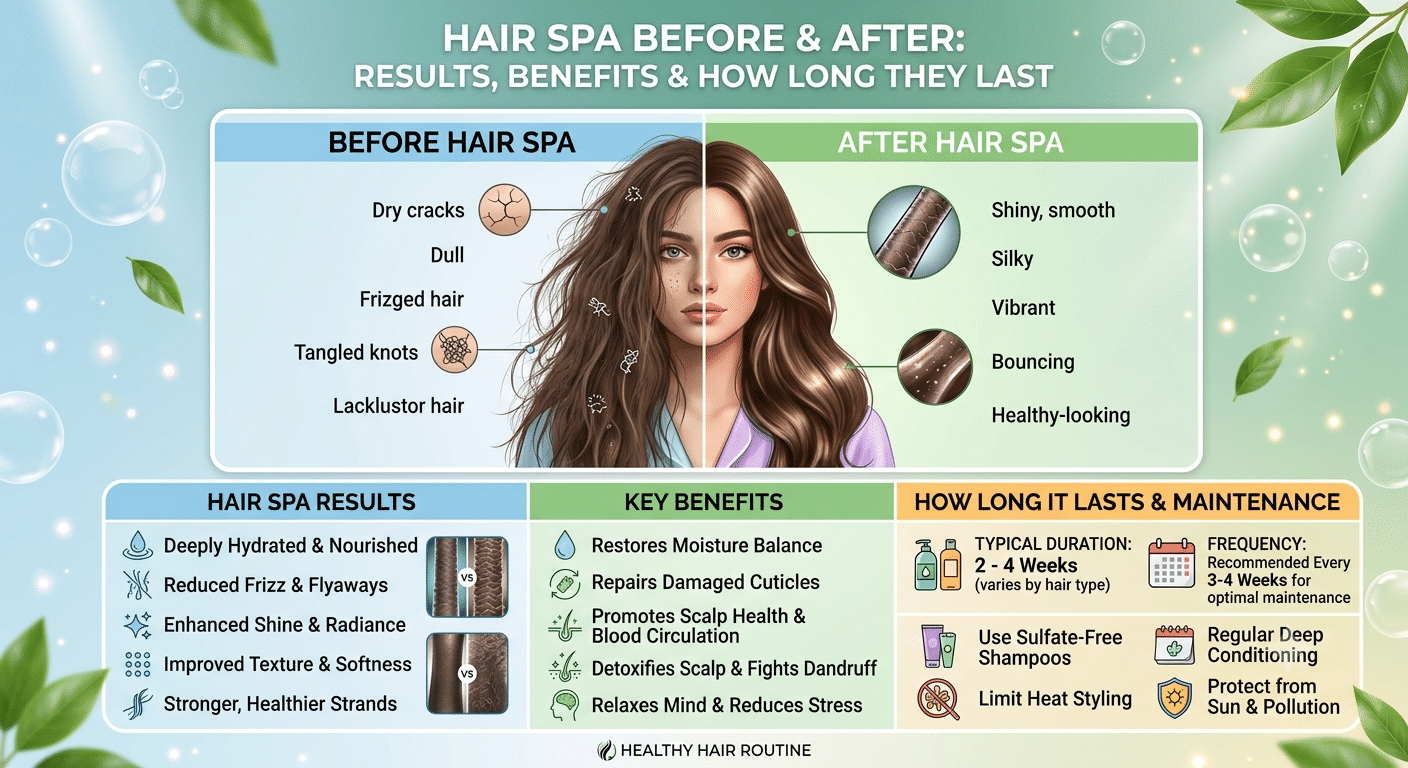
The most noticeable hair spa before and after results are usually cosmetic and tactile rather than a dramatic biological transformation. Before treatment, dry or stressed hair may feel rough when you run your fingers through it, become tangled easily, look dull under light, or develop visible frizz. After a suitable conditioning treatment, the same hair can appear smoother and shinier and may feel softer and easier to comb. People with very dry, porous, or chemically treated hair may notice the difference more clearly because those strands often have greater surface irregularity and therefore respond noticeably to conditioning products.
The difference can be especially visible immediately after professional styling because the hair has been cleansed, conditioned, detangled, dried, and finished. That means the “after” photograph may reflect several factors rather than the hair spa product alone. Lighting, blow-drying technique, brushing, styling products, and the initial condition of the hair can all influence the final appearance. For an honest comparison, look beyond the photograph and pay attention to how the hair feels after washing at home, how easily it detangles, whether frizz is reduced, and how long the softness and shine remain.
Hair Texture Before and After
Texture is one of the easiest changes to notice. Dry hair often feels coarse or straw-like because the outer surface is less smooth and individual fibers create more friction. Conditioning ingredients can reduce that friction and make the strands feel more slippery, flexible, and manageable. Scientific literature describes conditioners as products that improve manageability, lubricity, softness, gloss, and combability by interacting with the hair surface.
That does not mean a hair spa permanently changes your natural hair texture. If your hair is naturally curly, wavy, straight, fine, or coarse, the underlying structure remains the same. What changes is the condition of the surface and the way the strands behave. Curly hair may appear more defined because reduced dryness and friction allow curls to group more neatly, while straight hair may appear smoother and less fluffy because the cuticle lies more uniformly and the strands move more easily against one another.
Shine, Smoothness and Frizz Control
Shine is another common before-and-after improvement. A rough hair surface scatters light in different directions, while a smoother surface reflects light more consistently, creating the appearance of greater gloss. Conditioning agents can help smooth the cuticle and improve light reflection, which is one reason conditioned hair often looks healthier immediately after treatment.
Frizz can also become less noticeable because conditioning reduces friction and improves the feel of the hair surface. However, frizz is influenced by humidity, hair porosity, curl pattern, damage, styling technique, and environmental conditions, so no hair spa can guarantee completely frizz-free hair. The realistic goal is better frizz control, not a permanent transformation. If your hair is extremely damaged, the improvement may be visible but temporary, and a professional may recommend a broader routine involving trimming, gentler cleansing, heat protection, and appropriate conditioning.
Major Benefits of a Hair Spa
A good hair spa can offer several cosmetic benefits at the same time. The most common include improved softness, better manageability, enhanced shine, easier detangling, reduced dryness, and temporary frizz control. These benefits are particularly useful when hair has been exposed to frequent styling, chemical processing, environmental stress, or repeated washing. Research on hair conditioning supports the idea that conditioning products can reduce friction, improve combability, increase softness, and help protect hair from further mechanical damage.
The key is choosing a treatment according to your hair rather than selecting the most expensive or heavily marketed option. Fine hair may become weighed down by very rich formulas, while coarse or highly porous hair may benefit from a more intensive conditioning approach. Chemically treated hair can require different care from untreated hair, and a professional should consider the hair’s current condition before recommending a treatment. The best hair spa is therefore not necessarily the strongest one; it is the one whose formulation and process match what your hair actually needs.
Deep Moisture and Hydration
Dry hair often feels rough because its surface lacks sufficient conditioning and protection. Deep conditioning treatments can provide moisturizing ingredients and emollients that improve the feel of the hair and reduce moisture loss. Dermatology guidance on deep conditioning explains that humectants attract water while emollients soften the hair and can help reduce moisture loss by creating a protective film.
This is why a hair spa can be particularly appealing after a period of excessive heat styling or chemical processing. The treatment does not magically create new moisture inside every strand, but it can improve the surface environment and make the hair feel more hydrated and flexible. Maintaining that result requires appropriate washing, conditioning, heat protection, and protection from unnecessary mechanical stress.
Better Manageability and Detangling
Have you ever spent several minutes fighting through knots after washing your hair? Hair conditioning can make that experience easier because it reduces friction between individual fibers. Smoother strands slide against one another more readily, meaning less force may be required during combing and detangling. This matters because excessive pulling and repeated mechanical stress can contribute to breakage, particularly when hair is already fragile.
After a hair spa, many people therefore notice that brushing takes less effort. This can be one of the most practical benefits because it affects everyday hair care rather than just the appearance immediately after leaving the salon. Using a wide-tooth comb, avoiding aggressive brushing of soaking-wet hair, and applying suitable leave-in protection can help preserve the benefit.
Protection for Dry and Damaged Hair
Hair spa treatments are often marketed as “repair,” but the word needs some context. Because the visible hair shaft consists of non-living material, cosmetic products cannot biologically regenerate damaged hair. Instead, conditioners and treatment products can temporarily fill surface irregularities, coat the fiber, reduce friction, improve flexibility, and make the strand behave more like healthier hair.
This distinction is actually good news because it gives you realistic expectations. A treatment can make hair look dramatically better without pretending that the damaged structure has been permanently rebuilt. If the ends are severely split, for example, a haircut may still be necessary. If hair is breaking because of repeated bleaching or excessive heat, reducing the underlying damage is more important than repeatedly masking the symptoms with treatments.
How Long Do Hair Spa Results Last?
The answer depends heavily on hair condition, washing frequency, treatment formulation, styling habits, and environmental exposure. There is no scientifically fixed number of days that applies to every hair spa because salon “hair spa” is a broad category rather than one standardized treatment. In practical terms, the strongest softness and shine are often most noticeable immediately after treatment and gradually reduce as the hair is washed and exposed to normal daily wear. Research on conditioning products confirms that many conditioning and protein effects are temporary and need to be reapplied to maintain their cosmetic benefits.
For some people, the hair may continue feeling noticeably softer for several washes; for others, especially those who shampoo frequently or have highly porous hair, the effect may fade sooner. Product buildup can also become an issue if intensive conditioning is performed too frequently or if products are poorly matched to the hair. A sensible routine therefore focuses on maintenance rather than chasing a permanent “after” result. Regular conditioning, gentle handling, appropriate heat protection, and occasional professional treatments can work together to preserve the look and feel of healthier hair.
Factors That Affect Hair Spa Results
Several factors determine how long your results remain noticeable:
- Hair porosity: Highly porous or damaged hair may absorb conditioning products readily but can also lose moisture and cosmetic conditioning effects quickly.
- Washing frequency: Frequent shampooing can remove conditioning materials sooner.
- Heat styling: Repeated high-heat exposure can work against the benefits of conditioning.
- Chemical treatments: Bleaching, coloring, straightening, and perming can increase the need for careful conditioning.
- Hair texture: Fine, thick, curly, straight, and coarse hair can respond differently to the same formula.
- Home-care routine: Shampoo, conditioner, leave-in products, and heat protection all influence maintenance.
- Treatment formulation: Not every hair spa uses the same ingredients or process.
How Often Should You Get a Hair Spa?
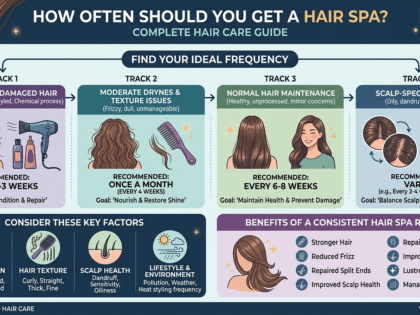
There is no universal schedule that every person should follow. Someone with severely dry, chemically treated hair may need intensive conditioning more often than someone with healthy, untreated hair, while a person with very fine or oily hair may find frequent rich treatments unnecessary. Dermatology guidance on deep conditioning commonly discusses approximately weekly use as a general starting point for many people, while also emphasizing that hair texture, washing frequency, and styling habits should influence the routine.
For salon treatments, the appropriate interval should be based on how your hair behaves rather than following a rigid calendar. If your hair remains soft, manageable, and comfortable after a treatment, there may be little reason to repeat it immediately. If dryness, roughness, or tangling returns after several washes, a professional can reassess the condition and decide whether another conditioning treatment makes sense. The objective is healthy-looking, manageable hair—not the maximum possible number of salon sessions.
Hair Spa for Different Hair Types
Dry hair generally benefits from moisture-focused conditioning because it tends to feel rough, dull, and difficult to manage. Curly hair can benefit from treatments that improve moisture balance and reduce friction without unnecessarily weighing down the curl pattern. Fine hair requires more caution because heavy oils and rich conditioners can leave it flat or greasy. Thick or coarse hair may tolerate richer formulas and longer conditioning times, depending on its condition.
Color-treated and bleached hair deserve special consideration because chemical processing can make the hair more porous and vulnerable to dryness and breakage. Research and dermatology reviews consistently emphasize the role of conditioning in reducing friction and helping manage weathered hair. A professional should therefore consider the hair’s history, not just its current appearance, before selecting the treatment.
Hair Spa for Chemically Treated Hair
If you regularly color, bleach, straighten, perm, or otherwise chemically process your hair, conditioning becomes especially important. Chemical services can alter the hair’s surface and internal properties, leaving strands more susceptible to dryness and mechanical stress. Deep conditioning can improve softness and manageability and can temporarily improve the feel of weathered hair.
However, a hair spa should not be treated as permission to continue aggressive processing without limits. If your hair is already severely compromised, adding more chemical services may create additional problems even if a treatment temporarily makes the hair feel smoother. A better strategy combines appropriate conditioning with sensible chemical-service spacing, regular trims when needed, lower heat exposure, and professional assessment of the hair’s condition.
Hair Spa vs Regular Conditioner
| Feature | Regular Conditioner | Hair Spa / Deep Conditioning |
|---|---|---|
| Typical use | Frequent or after washing | Periodic intensive treatment |
| Contact time | Usually short | Usually longer |
| Main purpose | Everyday manageability | More intensive conditioning |
| Shine | Can improve shine | Often more noticeable immediately after treatment |
| Frizz control | Mild to moderate | Can be stronger depending on formulation |
| Dry hair | Useful | May provide more intensive conditioning |
| Damaged hair | Important for maintenance | Can provide temporary additional conditioning |
| Professional process | Usually home-based | Often includes salon cleansing, treatment and styling |
The biggest difference is intensity and process rather than a completely different biological mechanism. A regular conditioner already performs many of the same basic cosmetic functions: reducing friction, improving manageability, smoothing the surface, and enhancing softness. A hair spa typically combines a more intensive formulation, longer contact time, and sometimes additional salon steps. Scientific literature describes deep or intensive conditioners as more concentrated than instant conditioners and commonly used for longer periods.
What Happens During a Professional Hair Spa?
A professional hair spa commonly starts with an assessment of the scalp and hair condition. The hair may then be cleansed to remove oil, dirt, and styling residue before the selected conditioning treatment is applied. Depending on the salon protocol, the stylist may massage the scalp, work the product through the lengths, use controlled warmth, allow a specified processing time, and then rinse and style the hair. The precise steps vary considerably from one salon and product system to another, so consumers should ask what products and techniques are actually being used.
The final result is often enhanced by careful blow-drying and styling, which is why the hair may appear exceptionally polished immediately afterward. That visual finish should not be mistaken for permanent treatment results. A good professional will explain what the treatment is intended to do, what limitations it has, and what home care will help maintain the effect.
Common Hair Spa Mistakes to Avoid
One common mistake is assuming that more treatment always means healthier hair. Over-conditioning or using very rich products too frequently can create buildup, make fine hair limp, or leave the scalp feeling uncomfortable. Another mistake is choosing a treatment simply because it contains a fashionable ingredient without considering whether the formula suits the individual’s hair type.
A second mistake is using a hair spa to hide severe damage while continuing the same damaging routine. If hair is repeatedly exposed to high heat, aggressive bleaching, tight hairstyles, rough brushing, and inadequate conditioning, a temporary smooth appearance does not remove the underlying stress. Research has shown that thermal exposure can contribute to hair-surface damage, so heat management remains an important part of long-term hair care.
How to Maintain Hair Spa Results at Home
The easiest way to extend the results is to reduce the things that make the hair rough again. Use a suitable shampoo, follow with conditioner when washing, detangle gently, and use a heat-protective product when styling with heat. If your hair is dry or highly textured, a periodic deep-conditioning routine may also help, provided the product is appropriate for your hair. Dermatology guidance emphasizes that conditioning after washing helps improve manageability and that deeper conditioning can be useful for dry hair.
Your drying technique matters too. Avoid holding very hot airflow close to one section of hair for a prolonged period. A study of hair-dryer exposure found greater surface damage at higher temperatures, while distance and continuous movement reduced damage compared with concentrated high heat. Small habits like these may not seem dramatic on a single day, but they can make a meaningful difference when repeated for months.
When Should You Avoid a Hair Spa?
A hair spa is primarily a cosmetic conditioning service, so it should not be used as a substitute for professional diagnosis of a scalp or hair disorder. If you have persistent scalp irritation, unexplained hair loss, significant breakage, painful lesions, severe dandruff, or another ongoing scalp concern, consider speaking with a dermatologist rather than relying only on salon treatments. Some fragranced or heavily formulated conditioning products can also irritate sensitive skin.
People with known sensitivities should tell the stylist before treatment and check the ingredients when appropriate. The treatment should also be modified or postponed if the scalp is irritated or damaged. A professional salon should prioritize the condition of the hair and scalp over selling a particular service.
Can Hair Spa Reduce Hair Fall?
This is one of the most misunderstood claims surrounding hair spa treatments. A hair spa may make hair feel smoother and may reduce some mechanical stress by improving conditioning and combability, which can help with the appearance and handling of fragile hair. However, that is different from treating the medical causes of hair shedding or hair loss. Hair cosmetics literature describes conditioning as a way to reduce friction and protect the hair fiber, not as a universal treatment for disorders affecting hair follicles.
If you notice excessive shedding, widening of the part, bald patches, persistent scalp symptoms, or a sudden change in hair density, the right approach is to identify the underlying cause. Nutrition, hormones, medications, genetics, illness, stress, scalp conditions, and other factors can contribute to hair loss. A cosmetic spa can be part of grooming, but it should not replace medical evaluation when there is a persistent or concerning change.
Professional Hair Spa vs DIY Hair Spa
A DIY hair spa can be perfectly reasonable when the goal is basic deep conditioning. The advantage is convenience and the ability to maintain a consistent routine at home. A professional treatment adds the benefit of a stylist assessing the hair, selecting a formulation, controlling application and processing, and finishing the hair carefully.
The important point is that professional does not automatically mean permanent or dramatically superior. A salon treatment can provide a better experience and more individualized product selection, but the everyday habits between appointments have a major influence on how the hair looks. In many cases, the combination of occasional professional conditioning and consistent home care makes more sense than relying on repeated salon visits alone.
How to Choose the Right Hair Spa Treatment
Start by identifying the actual problem. Is your hair dry? Frizzy? Chemically treated? Tangled? Dull? Rough after frequent heat styling? Or does it simply need occasional conditioning before an event? Once the goal is clear, the stylist can select a treatment designed around moisture, smoothness, strengthening, color care, or general conditioning.
Do not choose solely based on words such as “premium,” “luxury,” “repair,” or “deep repair.” Ask what the treatment contains, how long it will remain on the hair, whether heat is used, and what kind of home care is recommended afterward. The most useful treatment is one that matches your hair’s condition and your lifestyle rather than one chosen because its name sounds impressive.
What Should You Expect After Your First Hair Spa?
After your first treatment, you may notice softer hair, easier detangling, reduced roughness, improved shine, and a more polished appearance. These effects can be particularly noticeable if your hair was previously dry or difficult to manage. Deep conditioning is specifically associated with improvements in detangling, smoothness, shine, and frizz control.
Do not expect the treatment to permanently eliminate split ends, completely reverse severe chemical damage, or stop every form of hair loss. If the ends are split, cutting them remains the reliable way to remove that visibly damaged portion. If the hair has been heavily processed, a longer-term care plan may be more important than a single intensive treatment.
Hair Spa Before and After: A Realistic Timeline
Immediately after treatment: Hair commonly feels softer and smoother, with improved shine and manageability. The professional blow-dry or styling finish can make the visual difference even more noticeable.
After the first few washes: Some of the conditioning effect may remain, although the strongest salon-finish effect may gradually decrease. How quickly this happens depends on washing habits, hair porosity, product formulation, and styling.
After several weeks: Without maintenance, hair generally returns toward its normal condition as conditioning materials are removed and everyday exposure continues. This does not mean the treatment “failed”; temporary conditioning is the expected nature of many cosmetic hair treatments.
With consistent maintenance: Regular conditioning, careful heat styling, suitable products, gentle detangling, and appropriate professional treatments can help hair remain more manageable over time. The goal is not to keep hair permanently in a salon-finished state, but to build habits that reduce unnecessary damage and maintain a smoother, healthier-looking surface.
Conclusion
A hair spa before and after comparison can reveal a meaningful cosmetic difference, particularly when the hair starts out dry, rough, frizzy, tangled, or chemically treated. The most realistic benefits are improved softness, shine, smoothness, manageability, and temporary frizz control. Scientific evidence on hair conditioning supports these effects by showing that conditioning agents can reduce friction, smooth the hair surface, improve combability, and temporarily compensate for some surface damage.
The most important thing to remember is that a hair spa is not a permanent repair or a medical treatment for hair loss. Its results depend on the condition of your hair, the treatment formulation, how often you wash your hair, your heat and chemical-styling habits, and the care you provide afterward. If you combine professional conditioning with sensible home care, the result can be more than a one-day shine boost—it can become part of a practical routine for keeping your hair looking and feeling its best.
FAQs
1. How long does a hair spa last?
There is no fixed duration that applies to every person. The softness, shine, and manageability may remain noticeable through several washes, but the exact duration depends on hair type, washing frequency, product formulation, porosity, and styling habits.
2. Is hair spa good for dry and frizzy hair?
Yes, a suitable conditioning treatment can be helpful for dry and frizzy hair because conditioning ingredients can improve smoothness, reduce friction, and increase manageability. However, the results are cosmetic and temporary rather than a permanent restructuring of the hair.
3. How often should I get a hair spa?
The ideal frequency depends on your hair condition and routine. People with very dry or chemically treated hair may benefit from more regular intensive conditioning, while fine or oily hair may need it less often. Your stylist can recommend an interval based on how your hair responds.
4. Can a hair spa permanently repair damaged hair?
No. Hair fibers cannot biologically regenerate once damaged, but conditioning products can temporarily coat, fill, or smooth damaged areas and improve the appearance and feel of the hair. Severely split or damaged ends may still need to be trimmed.
5. Does a hair spa stop hair fall?
A hair spa should not be considered a treatment for medical hair loss. It can improve conditioning and reduce mechanical friction, but persistent or excessive shedding should be evaluated to determine the underlying cause.
🔍 Want to find the best keywords and rank this article faster? Try the #1 SEO & AI visibility toolkit free for 14 Days. Track your keyword rankings, audit your site, and monitor your AI search visibility on ChatGPT, Gemini & Google AI Overviews
✨ Get better articles, faster. This prompt is powerful. But Pro Article Writer takes it further — AI humanizer, SEO tools, full editor, one-click options, and more control all in one place. Try it free →
If this prompt helped you, please leave a review — it keeps this prompt ranked #1.