
Which Is Better: Keratin or Nanoplastia?
-
Dokmai London
- Posted on
- 0 comments
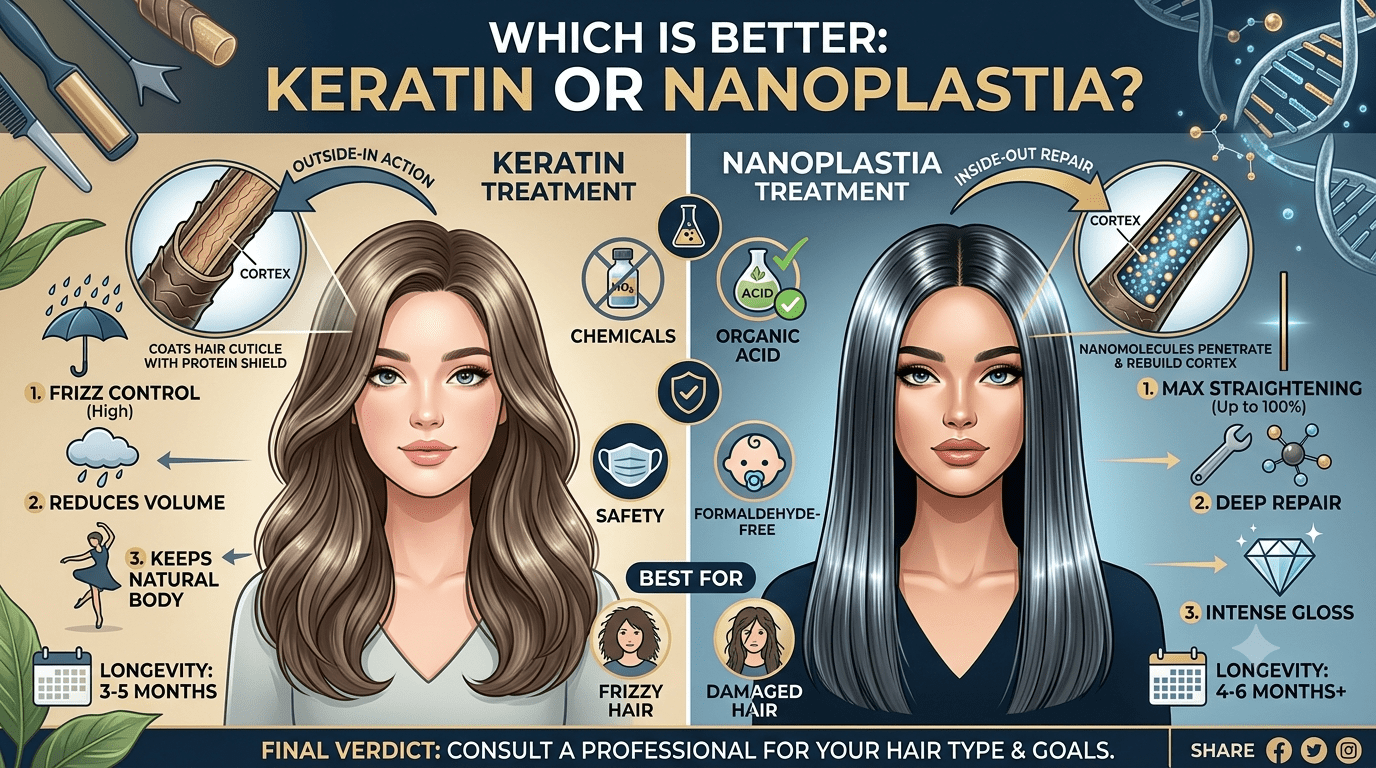
Pre-Article Introduction
If you’re tired of frizzy, rough, unmanageable hair, you’ve probably heard about keratin and nanoplastia hair treatments. Both are popular salon services designed to make hair smoother, shinier, softer, and easier to manage. But which one is actually better for your hair?
The answer isn’t quite as simple as choosing the trendiest treatment. Keratin or nanoplastia may produce different results depending on your hair texture, damage level, styling goals, and the specific professional formula used.
In this comprehensive guide, we’ll compare keratin vs nanoplastia across seven important factors, including straightening power, frizz control, hair feel, longevity, suitability for damaged hair, maintenance, and safety considerations. By the end, you’ll have a much clearer idea of which treatment may be the better fit for you.
Important: Hair-smoothing formulas vary significantly between brands and salons. Always ask your stylist about the exact product, ingredients, processing instructions, and aftercare before booking a treatment.
Comprehensive Article Outline
| Section | What You’ll Learn |
|---|---|
| Keratin vs Nanoplastia | Basic difference between the two treatments |
| What Is Keratin Treatment? | How keratin smoothing works |
| What Is Nanoplastia? | How nanoplastia is performed and what it aims to achieve |
| Keratin vs Nanoplastia | Direct comparison |
| Difference #1 | Smoothing and straightening results |
| Difference #2 | Frizz control |
| Difference #3 | Hair texture and finish |
| Difference #4 | Suitability for damaged hair |
| Difference #5 | Longevity and maintenance |
| Difference #6 | Ingredients and safety |
| Difference #7 | Cost and value |
| Which Is Better for Hair Types? | Hair-type-specific guidance |
| Nanoplastia vs Keratin for Frizzy Hair | Best choice for controlling frizz |
| Aftercare | How to maintain results |
| Common Mistakes | What can reduce treatment results |
| FAQs | Answers to common questions |
| Final Verdict | Which treatment may be right for you |
1. Keratin vs Nanoplastia: What Is the Main Difference?
At a basic level, keratin treatment and nanoplastia are both professional hair-smoothing services, but they’re not identical treatments.
Keratin treatments are traditionally associated with smoothing the hair, reducing frizz, improving shine, and making styling easier. Depending on the formula and technique, some keratin services can also produce a noticeably straighter appearance.
Nanoplastia is generally marketed as a more modern smoothing and straightening approach. The treatment is designed to reduce frizz, improve manageability, add shine, and create a smoother, straighter-looking finish.
However, there’s an important point many online articles skip: there isn’t one universal “keratin treatment” formula or one universal “nanoplastia” formula. Results depend heavily on the product formulation, hair condition, stylist’s technique, heat settings, and aftercare.
So, rather than asking only, “Which treatment is better?”, it’s smarter to ask:
Which treatment is better for my hair and my desired result?
For example, someone with mildly frizzy, wavy hair who wants smoother hair may have different needs from someone with highly curly hair who wants a straighter finish.
2. What Is a Keratin Hair Treatment?
A keratin treatment is a professional chemical hair-smoothing service intended to reduce frizz and improve the appearance and manageability of the hair.
The general process usually involves:
- Hair assessment and cleansing.
- Application of the smoothing formula.
- Processing according to the product instructions.
- Blow-drying.
- Heat sealing with a flat iron.
- Finishing and styling.
- Recommended home-care routine.
The exact procedure varies by product.
Keratin treatments became especially popular because they can make hair appear smoother, shinier, and easier to style. Blow-drying can become quicker, and hair that normally becomes puffy in humid conditions may look more controlled.
However, the word “keratin” shouldn’t automatically be interpreted as “completely natural” or “risk-free.” Some hair-smoothing products may contain or release formaldehyde when heated. The U.S. FDA specifically advises consumers to check ingredients and ask salon professionals about formaldehyde-related ingredients and product safety.
For this reason, a professional consultation is essential.
3. What Is Nanoplastia Hair Treatment?
Nanoplastia is a salon hair-smoothing and straightening treatment that has become increasingly popular among people looking for smoother, shinier, more manageable hair.
It’s often promoted for:
- Frizzy hair
- Dry-looking hair
- Wavy hair
- Curly hair
- Difficult-to-manage hair
- Hair that lacks shine
- People wanting a smoother appearance
Nanoplastia is commonly positioned as an alternative to traditional straightening or smoothing services. Depending on the formulation, it may provide a sleek finish while maintaining some natural movement.
But here’s the catch: “nanoplastia” is a treatment category/marketing term rather than a single standardized chemical formula. Different manufacturers can use different ingredients and instructions.
Therefore, don’t judge a nanoplastia treatment solely by its name. Ask your salon what product they use and whether the ingredient list and Safety Data Sheet are available.
A good stylist should also examine your hair before deciding whether the treatment is appropriate.
4. Keratin vs Nanoplastia: Quick Comparison
| Feature | Keratin Treatment | Nanoplastia |
|---|---|---|
| Main goal | Smoothing and frizz reduction | Smoothing and straighter-looking finish |
| Frizz control | Excellent with suitable formula | Often excellent |
| Shine | Usually improves | Usually improves |
| Straightening | Depends on formula | Often marketed with stronger straightening effect |
| Hair feel | Smooth and manageable | Smooth, sleek, and manageable |
| Suitable for curls | Can reduce curl/frizz | Can provide stronger straightening depending on formula |
| Longevity | Often several months | Often several months |
| Results | Formula and technique dependent | Formula and technique dependent |
| Maintenance | Requires suitable aftercare | Requires suitable aftercare |
| Safety | Product-specific | Product-specific |
The comparison shows why there isn’t a universal winner.
5. Difference #1: Which Gives Straighter Hair?
If your primary goal is straight-looking hair, nanoplastia may be the more appealing option.
Many nanoplastia services are specifically marketed around smoother and straighter-looking results. Depending on the formula and your starting hair texture, the treatment can substantially reduce waves, curls, and puffiness.
Keratin treatments can also make hair significantly smoother and straighter-looking. However, some keratin services focus more heavily on frizz reduction and manageability rather than dramatic straightening.
Choose based on your goal
If you want:
- Less frizz → either treatment may work.
- Easier styling → either may work.
- Smoother hair → either may work.
- A noticeably straighter finish → nanoplastia may be worth considering.
- A softer, smoother appearance with more natural movement → a suitable keratin formula may be preferable.
Still, don’t assume a treatment will produce a specific result without discussing your hair with a stylist.
Hair thickness, curl pattern, previous chemical services, bleaching, and heat damage can all affect the final result.
6. Difference #2: Which Is Better for Frizzy Hair?
For people searching specifically for a solution to dry and frizzy hair, both keratin and nanoplastia can be strong candidates.
Frizz happens for several reasons, including moisture imbalance, hair damage, humidity, raised cuticles, and natural hair texture.
Smoothing treatments can make the hair surface appear more controlled, reducing the fluffy appearance that many people describe as frizz.
Nanoplastia is often chosen by people who want a sleek, polished finish. Keratin, meanwhile, has a long history as a frizz-control service.
So, which wins?
There isn’t a one-size-fits-all answer.
If your biggest problem is frizz plus a desire for a straighter appearance, nanoplastia may be worth discussing with your stylist.
If your biggest problem is frizz and difficult styling, a well-selected keratin service may be sufficient.
Your stylist should consider the actual condition of your hair rather than simply recommending the newest treatment.
7. Difference #3: Hair Texture and Final Finish
One of the biggest differences you’ll notice isn’t necessarily the treatment name—it’s the final finish.
Some people want completely sleek hair.
Others want their hair to remain soft and natural-looking but with much less frizz.
Keratin treatments can be customized through formula selection and technique in some salon settings. Nanoplastia can also produce different results depending on processing and the product being used.
Before your appointment, tell your stylist exactly what you want.
For example:
“I want my hair smoother but I don’t want it extremely flat.”
Or:
“I want maximum straightness and less daily styling.”
These statements help your stylist understand your expectations.
A professional consultation is especially important for colored, highlighted, bleached, or previously chemically treated hair.
8. Difference #4: Which Is Better for Damaged Hair?
This is where you need to be particularly careful.
A hair-smoothing treatment should not automatically be considered a repair treatment simply because it makes damaged hair look shiny.
Damaged hair can temporarily look healthier after a smoothing service because the surface becomes smoother and the hair becomes easier to style. But that doesn’t mean the underlying structural damage has disappeared.
If your hair is:
- Severely bleached
- Extremely brittle
- Breaking easily
- Elastic when wet
- Overprocessed
- Recently subjected to multiple chemical treatments
your stylist may recommend postponing a smoothing service.
A strand assessment matters.
Before treatment, a professional should examine:
- Hair elasticity
- Porosity
- Previous chemical history
- Color history
- Breakage
- Scalp condition
- Overall strength
In some cases, strengthening and conditioning should come before a smoothing treatment.
9. Difference #5: Which Lasts Longer?
The longevity of both keratin and nanoplastia can vary considerably.
Many salon professionals describe results as lasting several months, but the exact duration depends on:
- Hair type
- Washing frequency
- Shampoo ingredients
- Heat styling
- Swimming
- Humidity
- Product formulation
- Application technique
- Hair growth
- Home care
If you wash your hair very frequently with a strong cleansing shampoo, the effect may fade faster.
On the other hand, suitable professional aftercare can help you maintain the smoother appearance for longer.
Don’t focus only on the treatment day.
A good result is partly created in the salon and partly maintained at home.
10. Difference #6: Ingredients and Safety Matter More Than the Name
This may be the most important difference to understand.
Consumers often hear statements such as:
- “Keratin is safe.”
- “Nanoplastia is chemical-free.”
- “This treatment has no chemicals.”
- “It’s completely natural.”
Be cautious with absolute claims.
Every cosmetic treatment has a formulation, and the exact ingredients matter.
The FDA warns that some hair-smoothing products can release formaldehyde gas when heated. It recommends checking ingredients and discussing the product’s Safety Data Sheet and ventilation practices with the salon professional.
OSHA also notes that some hair-smoothing products may contain or release formaldehyde and emphasizes appropriate ventilation, training, hazard communication, and protective measures when applicable.
So, whether you’re choosing keratin or nanoplastia, ask:
- What exact product are you using?
- Can I see the ingredient list?
- Is a Safety Data Sheet available?
- Does the product contain formaldehyde, formalin, or methylene glycol?
- What ventilation is used during treatment?
- What precautions does the stylist follow?
- Is the treatment suitable for my previously colored or bleached hair?
For more consumer information, you can review the U.S. FDA guidance on hair-smoothing products.
11. Difference #7: Which Offers Better Value for Money?
Price shouldn’t be the only factor when comparing keratin and nanoplastia.
A cheaper treatment isn’t necessarily better value.
Consider the entire experience:
| Factor | What to Consider |
|---|---|
| Product | Is the product professionally sourced? |
| Stylist | Does the stylist understand chemical treatments? |
| Consultation | Is your hair assessed first? |
| Technique | Is the treatment applied according to instructions? |
| Safety | Is ventilation adequate? |
| Aftercare | Are you given proper maintenance advice? |
| Longevity | How long can you realistically expect results? |
| Hair condition | Will the service suit your current hair? |
A professional treatment that costs more but is properly assessed and performed may offer better value than an inexpensive service performed without proper consultation.
12. Keratin or Nanoplastia: Which Is Better for Different Hair Types?
There is no single treatment that’s perfect for every person.
For Frizzy Hair
Both can be suitable. Nanoplastia may be preferred if you also want a straighter finish.
For Wavy Hair
Both can reduce frizz and make styling easier. Your desired amount of straightness should guide the choice.
For Curly Hair
Nanoplastia may be considered when a straighter appearance is the primary goal. However, curl pattern and hair condition should be assessed first.
For Thick Hair
Both treatments may make thick hair easier to manage. A professional should select the appropriate formula and technique.
For Fine Hair
Be more cautious. Excessive heat or unsuitable chemical processing can leave fine hair feeling weak or limp.
For Bleached Hair
A professional consultation is essential. Highly processed hair may need conditioning or strengthening before any smoothing service.
13. Nanoplastia vs Keratin for Frizzy Hair: Which Should You Choose?
If you’re specifically asking, “Which is better: keratin or nanoplastia for frizzy hair?”, here’s the practical answer:
Choose keratin if:
- You mainly want frizz reduction.
- You want smoother, easier-to-style hair.
- You prefer a softer smoothing effect.
- Your stylist recommends a keratin formula suitable for your hair.
Consider nanoplastia if:
- You want stronger smoothing.
- You want a straighter-looking finish.
- You want to reduce both puffiness and frizz.
- Your stylist confirms that the chosen formula is appropriate for your hair.
The most important thing is not choosing the treatment with the most impressive name.
Choose the treatment that matches your hair’s condition and your desired result.
14. What Should You Expect During a Professional Treatment?
Although procedures vary, a professional appointment usually follows a general sequence.
Step 1: Consultation
Your stylist checks your hair history and discusses your desired result.
Step 2: Hair Preparation
Hair is cleansed according to the product’s instructions.
Step 3: Product Application
The smoothing formula is applied carefully.
Step 4: Processing
The product remains on the hair for the specified time.
Step 5: Blow-Drying
The hair is dried according to the manufacturer’s instructions.
Step 6: Heat Sealing
A flat iron may be used to seal the treatment into the hair.
Step 7: Finishing
The stylist completes the treatment and explains aftercare.
Because heat is commonly involved in smoothing services, proper technique and ventilation are important.
15. Aftercare: How to Make Your Results Last Longer
Aftercare can make a huge difference.
Follow these general tips:
- Use professional products recommended for treated hair.
- Avoid unnecessary heat styling.
- Use heat protection whenever you use hot tools.
- Don’t overload the hair with heavy products.
- Follow your stylist’s washing instructions.
- Use a gentle cleansing routine.
- Protect hair while swimming.
- Schedule future treatments based on your hair’s condition rather than automatically repeating them.
Your stylist may recommend a specific shampoo, conditioner, mask, or serum based on the treatment used.
Remember, the goal isn’t simply to keep hair straight.
The goal is to keep it looking smooth, healthy, shiny, and manageable.
16. Common Mistakes People Make After Keratin or Nanoplastia
Even a professionally performed treatment can lose its visual impact if aftercare is poor.
Mistake 1: Washing too aggressively
Strong cleansing products may shorten the life of some smoothing treatments.
Mistake 2: Excessive heat
Constant high-temperature styling can contribute to dryness and damage.
Mistake 3: Ignoring hair damage
A smoothing service shouldn’t become an excuse to ignore breakage.
Mistake 4: Repeating treatments too frequently
More treatment doesn’t automatically mean better hair.
Mistake 5: Choosing based only on price
The cheapest service may not provide the best long-term value.
Mistake 6: Assuming every nanoplastia formula is identical
Product formulations vary, so ask what exact product is being used.
17. How to Choose the Right Salon for Keratin or Nanoplastia
Your salon selection matters almost as much as the treatment.
Look for a professional who:
- Performs a consultation first.
- Asks about your chemical history.
- Understands different hair textures.
- Explains realistic results.
- Uses professional products.
- Can provide ingredient information.
- Follows appropriate safety precautions.
- Gives clear aftercare instructions.
Be wary of anyone who promises that one treatment will permanently transform every type of hair without any risk or maintenance.
A professional stylist should be comfortable explaining both benefits and limitations.
18. Keratin vs Nanoplastia: Pros and Cons
| Treatment | Pros | Considerations |
|---|---|---|
| Keratin | Strong frizz control, smoother feel, easier styling | Results vary by formula; ingredient safety matters |
| Nanoplastia | Often offers sleek, straight-looking results, strong manageability | Formulas vary; professional assessment is important |
Keratin Pros
- Reduces visible frizz
- Improves manageability
- Can increase shine
- Makes blow-drying easier
- Can provide smoother-looking hair
Keratin Considerations
- Some formulas may release formaldehyde when heated
- Results vary by product
- Requires aftercare
- May not be appropriate for severely damaged hair
Nanoplastia Pros
- Sleek appearance
- Strong smoothing potential
- Can reduce puffiness
- May provide a straighter-looking finish
- Can make daily styling easier
Nanoplastia Considerations
- Not all formulations are identical
- Results depend on hair type and technique
- Chemical and heat exposure still need to be considered
- It isn’t automatically a treatment for repairing structural damage
19. Frequently Asked Questions
Is nanoplastia better than keratin?
Nanoplastia may be better for someone who wants a stronger straightening and smoothing effect, while keratin may be better for someone primarily focused on frizz control and manageability. The best choice depends on hair condition, texture, desired finish, and the exact formula used.
Which lasts longer, keratin or nanoplastia?
Both can last for several months, but longevity varies. Washing frequency, hair type, product formulation, heat styling, humidity, and aftercare can all influence how long the results remain visible.
Is nanoplastia safe for damaged hair?
It depends on the degree of damage and the exact formulation. Severely bleached, brittle, or breaking hair may not be suitable for a smoothing service immediately. A professional hair assessment should come first.
Does nanoplastia permanently straighten hair?
No salon smoothing treatment should automatically be described as permanently straightening all hair. Results vary, and treated hair eventually grows out and may gradually lose the treatment effect.
Can I do keratin or nanoplastia at home?
Professional chemical smoothing treatments are better handled by trained salon professionals. The FDA advises consumers not to apply hair-smoothing products containing formaldehyde-related ingredients themselves at home and recommends professional application with appropriate precautions.
Which is better for curly hair: keratin or nanoplastia?
Either may be considered, depending on the desired result. If you want to retain more natural movement while controlling frizz, a suitable keratin service may be preferable. If your goal is a significantly straighter appearance, nanoplastia may be considered. A stylist should evaluate your curl pattern and hair condition first.
Can I color my hair after nanoplastia?
The timing depends on the specific treatment and color service. Since chemical services can interact with each other, it’s best to follow the product manufacturer’s instructions and your stylist’s recommendation rather than combining services without a plan.
Can I color my hair after keratin?
It may be possible, but timing matters. Discuss your color history and future color plans with your stylist before the treatment so both services can be scheduled appropriately.
Does keratin repair damaged hair?
Keratin can make hair appear smoother and healthier, but you shouldn’t assume that a cosmetic smoothing effect permanently repairs underlying structural damage. Severely damaged hair needs an appropriate hair-care strategy.
How often should I get nanoplastia?
There’s no universal schedule. Your stylist should assess your hair’s condition and the previous treatment before recommending another application. Repeating chemical services too aggressively can put unnecessary stress on the hair.
20. Final Verdict: Which Is Better—Keratin or Nanoplastia?
So, which is better: keratin or nanoplastia?
The honest answer is: it depends on what your hair needs and what result you want.
If your main concern is frizz, roughness, and difficult styling, keratin can be an excellent smoothing option.
If you’re looking for strong smoothing with a straighter, sleeker appearance, nanoplastia may be the better option to discuss with your stylist.
However, the treatment name isn’t everything.
The exact product, ingredients, hair condition, stylist’s expertise, heat technique, ventilation, and aftercare can have a major impact on the experience and result.
Before booking either service, have a proper consultation. Ask questions. Check the product. Be realistic about your hair’s condition. And don’t choose a treatment simply because someone says it’s “better for everyone.”
The simple decision guide
Want frizz control and easier styling? → Consider Keratin.
Want strong smoothing and a straighter-looking finish? → Consider Nanoplastia.
Have severely damaged or bleached hair? → Get a professional assessment first.
Concerned about ingredients? → Ask for the ingredient list and Safety Data Sheet.
Ultimately, the best hair treatment isn’t the one with the most fashionable name. It’s the one that safely delivers the result you want while respecting the current condition of your hair.
Post-Article Message
If you’re still unsure whether keratin or nanoplastia is right for you, consult a qualified salon professional for a personalized hair assessment before choosing a treatment. A good consultation can help you avoid unnecessary chemical stress and select the service that best matches your hair goals.