
Why Is Nanoplastia Better for Frizzy Hair?
-
Dokmai London
- Posted on
- 0 comments
Understanding Frizzy Hair and Its Causes
Frizzy hair can be difficult to manage, especially when humidity, dryness, heat styling, and environmental exposure are involved. For many people, regular shampooing and conditioning aren’t enough to create the smooth, polished finish they want. This is one reason nanoplastia for frizzy hair has attracted attention in the professional hair-care industry. The treatment is designed to make hair look smoother, softer, shinier, and easier to manage. However, understanding why frizz happens is important before choosing any smoothing service.
What Makes Hair Look Frizzy?
Frizz generally becomes visible when individual strands don’t lie smoothly together. Hair can become more prone to frizz when the outer cuticle is raised, the strands are dehydrated, or the hair has been exposed to repeated chemical and thermal stress.
Several factors can contribute to frizz:
- Dry or dehydrated hair
- Humid weather
- Frequent blow-drying
- Excessive use of straightening irons
- Chemical colouring or bleaching
- Rough towel drying
- Overwashing
- Lack of suitable conditioning
- Naturally curly or wavy hair texture
- Environmental pollution and dust
When hair loses moisture or becomes rougher on the surface, it can appear dull and difficult to control. That’s why simply brushing frizzy hair may not solve the problem.
Why Humidity Makes Frizz Worse
Humidity is one of the biggest challenges for people with frizzy hair.
Hair interacts with moisture in the surrounding environment. When the atmosphere is humid, strands that are dry or porous can respond to that moisture, causing changes in texture and making the hair appear puffier or less defined.
This can be particularly frustrating after spending time styling your hair. You may straighten your hair in the morning, only to find that it becomes wavy or frizzy after going outside.
A professional smoothing treatment may help make the surface of the hair more manageable. However, results depend on the hair’s condition, the products used, application technique, and aftercare.
Common Hair Types That Experience Frizz
Frizz isn’t limited to one specific hair type. It can affect:
| Hair Type | Common Frizz Concern |
|---|---|
| Straight | Flyaways and humidity-related puffiness |
| Wavy | Loss of definition and uneven texture |
| Curly | Dryness, volume, and difficult-to-control frizz |
| Thick | Excess bulk and rough-looking texture |
| Chemically treated | Dryness and increased porosity |
| Colour-treated | Roughness and moisture loss |
For this reason, a professional consultation is important. A stylist should evaluate the hair before recommending nanoplastia or another smoothing service.
What Is Nanoplastia Hair Treatment?
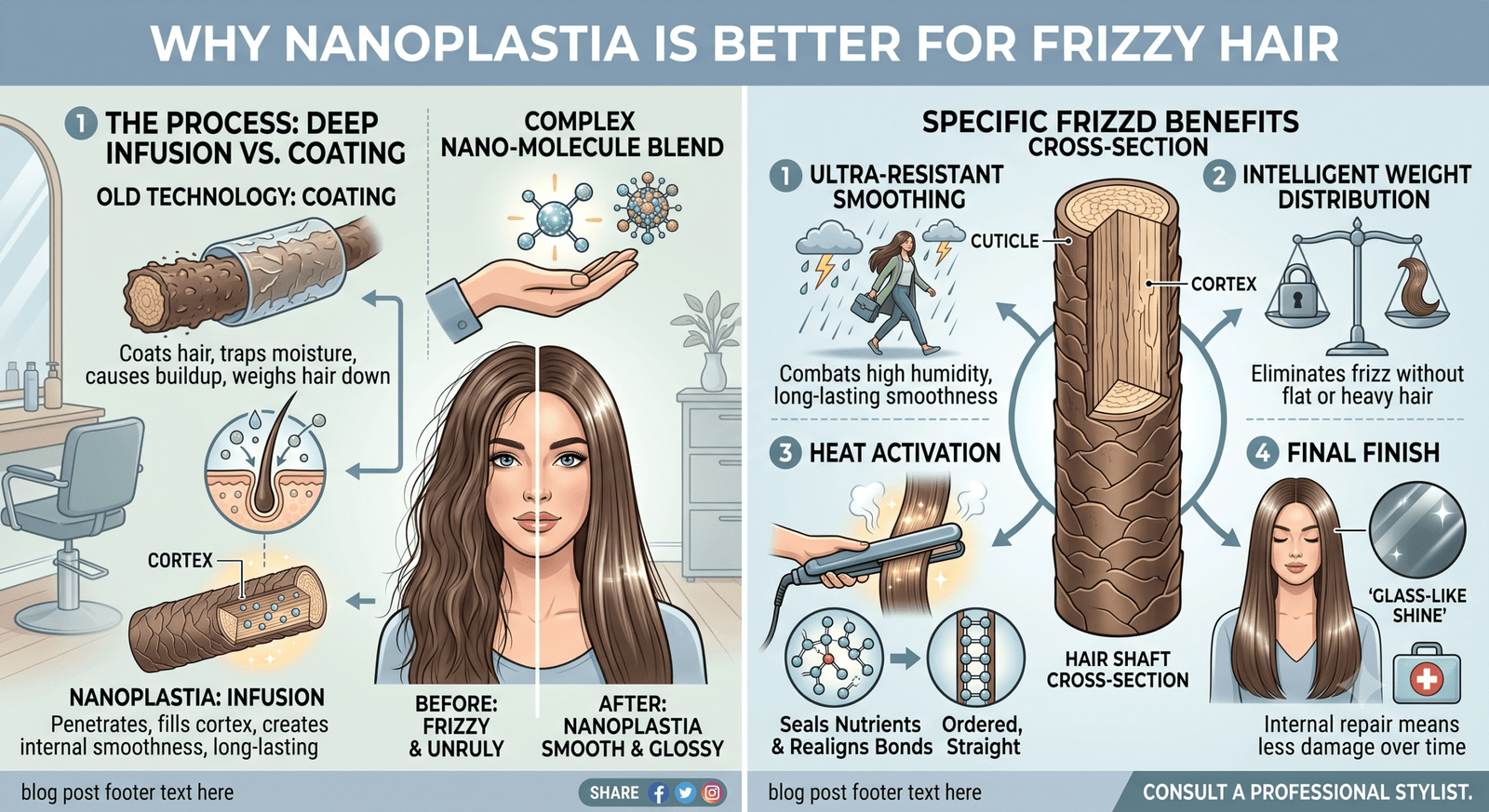
Nanoplastia is a professional hair-smoothing treatment that is marketed to help improve smoothness, reduce visible frizz, enhance shine, and make hair easier to style.
Unlike a simple conditioning service, nanoplastia involves a structured salon process that typically includes product application followed by heat-based processing. The exact formulation and procedure can vary considerably between brands and salons.
It’s important not to assume that every product marketed as “nanoplastia” has the same ingredients or produces identical results.
How Nanoplastia Works
The basic goal of a smoothing treatment is to improve the appearance and manageability of the hair fiber.
During a professional nanoplastia service, the stylist generally:
- Assesses the hair condition.
- Cleanses the hair.
- Applies the selected treatment product.
- Processes the product according to its instructions.
- Uses controlled heat to complete the service.
- Finishes the hair for a smoother appearance.
The treatment can make hair appear straighter, smoother, shinier, and more controlled. The final result depends heavily on the starting hair texture and the specific formulation.
Nanoplastia vs Traditional Smoothing Treatments
People often compare nanoplastia with keratin treatments, smoothening, rebonding, and other hair-straightening services.
The key difference is that these services can use different chemical formulations, techniques, processing temperatures, and intended results.
Nanoplastia is generally promoted as a smoothing-focused service rather than simply a conventional permanent straightening procedure. Some people choose it because they want a smoother appearance while retaining some natural movement.
However, “nanoplastia” isn’t a universal chemical category with one standardized formula. Always ask your salon which product is being used and what results you can realistically expect.
Is Nanoplastia a Permanent Treatment?
No hair-smoothing result should automatically be considered permanent.
The longevity of a nanoplastia service can vary based on:
- Hair type
- Hair porosity
- Product formulation
- Frequency of washing
- Shampoo used
- Heat styling
- Exposure to humidity
- Hair-growth pattern
- Overall hair condition
As new hair grows, the natural texture at the roots will also remain. Therefore, even when treated lengths stay smooth for an extended period, the overall appearance can gradually change.
7 Powerful Benefits of Nanoplastia for Frizzy Hair
For people struggling with stubborn frizz, the biggest attraction of nanoplastia is its focus on creating smoother and more manageable-looking hair.
Benefit 1: Helps Control Frizz
The most obvious reason people consider nanoplastia is frizz control.
A professional smoothing service can help create a smoother-looking hair surface, reducing the appearance of flyaways and rough texture. This can be especially useful for people whose hair becomes noticeably frizzy after washing or during humid weather.
The result isn’t necessarily pin-straight hair. Depending on the formulation and technique, the treatment may produce a smoother, more controlled appearance while maintaining some natural movement.
Benefit 2: Improves Smoothness and Manageability
Frizzy hair can take longer to comb, blow-dry, and style.
After a suitable smoothing treatment, hair may feel easier to brush and style. This can be a major everyday advantage for people with thick, wavy, or unruly hair.
Instead of spending a long time fighting with tangles and puffiness, you may find that your normal styling routine becomes simpler.
Of course, results differ from person to person. Hair condition and professional technique matter a great deal.
Benefit 3: Enhances Shine
Smooth hair tends to reflect light more evenly, which can make it look shinier.
When the hair surface appears more uniform, the overall finish can look polished and healthy. This is one reason smoothing treatments are often associated with a glossy salon finish.
However, shine isn’t the same as hair health. A glossy appearance doesn’t necessarily mean that damaged hair has been biologically repaired.
It’s better to think of nanoplastia as a cosmetic hair-smoothing service that can improve the appearance and manageability of the hair.
Benefit 4: Reduces Styling Time
If you regularly spend 30–60 minutes trying to tame frizz, a smoothing service may help simplify your routine.
Hair that is easier to manage can require less brushing and less repeated heat styling.
For busy professionals, students, brides-to-be, travellers, and anyone who prefers low-maintenance styling, this can be a practical advantage.
Less daily manipulation may also help you avoid repeatedly exposing the hair to very high heat.
Benefit 5: Creates a More Polished Appearance
Nanoplastia can give hair a sleek, salon-finished appearance.
Whether you wear your hair open, in a ponytail, or in a simple blow-dried style, smoother strands can make the overall look appear more refined.
This can be particularly appealing before:
- Weddings
- Parties
- Business events
- Vacations
- Photoshoots
- Festivals
- Special occasions
The key is choosing a treatment based on your desired finish rather than simply asking for “straight hair.”
Benefit 6: Can Improve the Feel of Dry Hair
Some professional smoothing formulas contain conditioning ingredients designed to improve the feel of the hair.
After treatment, hair may feel softer and more conditioned. But it’s important to understand the difference between improving the cosmetic feel of hair and repairing structural damage.
If your hair is severely compromised from bleaching, repeated colouring, or previous chemical services, your stylist may recommend a restorative or conditioning program before performing a smoothing treatment.
Benefit 7: Supports Easier Hair Maintenance
One of the biggest long-term advantages can be convenience.
When hair is easier to manage, your daily routine may become simpler. You may spend less time fighting frizz and more time maintaining your preferred hairstyle.
This doesn’t mean you can stop caring for your hair. In fact, proper aftercare is essential for maintaining a smooth-looking result.
A suitable shampoo, conditioner, regular conditioning, gentle drying, and controlled heat styling can all contribute to better-looking hair.
Who Can Benefit From Nanoplastia?
Nanoplastia may be considered by people who want smoother, more manageable hair without necessarily seeking an extremely straight result.
Nanoplastia for Curly and Wavy Hair
People with naturally curly or wavy hair may choose smoothing treatments to reduce frizz and make their hair easier to style.
The final result depends on the hair’s natural texture and the formulation used. A consultation is especially important because some clients want to preserve curls while reducing frizz, while others want a much straighter finish.
Nanoplastia for Dry and Damaged-Looking Hair
Dry-looking hair may benefit cosmetically from a conditioning and smoothing service.
However, severely damaged hair requires caution. Hair that is weak, highly porous, breaking, or recently bleached may not be an ideal candidate for a strong chemical or heat-based process.
A professional stylist should assess the hair before proceeding.
Nanoplastia for Thick and Unmanageable Hair
Thick hair can take significant time to wash, dry, detangle, and style.
For suitable candidates, a smoothing treatment may make the hair easier to manage and reduce the time required for daily styling.
Nanoplastia Process: What to Expect at a Salon
A professional nanoplastia service usually involves several stages.
Hair Consultation
The first step should be consultation.
Your stylist should ask about:
- Previous chemical treatments
- Hair colour history
- Bleaching
- Hair fall or breakage concerns
- Previous smoothing services
- Desired result
- Current hair condition
This helps determine whether the treatment is appropriate.
Cleansing and Preparation
The hair is generally cleansed to remove buildup and prepare the strands for product application.
The exact shampoo and preparation method depend on the product manufacturer’s instructions.
Product Application
The stylist applies the selected product systematically, taking care to distribute it evenly.
Professional application is important because the amount of product, sectioning, processing time, and heat technique can affect the final result.
Heat Activation and Finishing
Many smoothing treatments involve heat during the finishing stage.
Because some hair-smoothing products can release formaldehyde or related chemicals when heated, consumers should ask what ingredients are present and whether the salon has appropriate ventilation and safety procedures. The U.S. FDA specifically advises consumers to check ingredients and ask salon professionals about the product and Safety Data Sheet.
For additional safety information, see the U.S. FDA guidance on hair-smoothing products.
Nanoplastia Aftercare Tips
Good aftercare can help preserve the appearance of your treatment.
Use Suitable Hair Care Products
Ask your stylist which shampoo and conditioner are appropriate for your specific treatment.
Avoid randomly switching between products if your stylist has recommended a particular maintenance routine.
Reduce Excessive Heat Styling
Although treated hair may be easier to style, excessive heat can still affect the condition of the hair.
Use heat protection when using a blow dryer, straightener, or curling tool.
Protect Hair From Humidity
Humidity can affect the appearance of even smooth hair.
Using suitable anti-frizz products and drying the hair properly can help maintain a polished appearance.
Follow Your Stylist’s Instructions
Different nanoplastia formulations may have different post-treatment instructions.
Some products may have specific requirements regarding washing, tying, swimming, or styling. Follow the instructions provided by your stylist and the product manufacturer.
Nanoplastia vs Keratin vs Hair Smoothening
| Feature | Nanoplastia | Keratin Treatment | Hair Smoothening |
|---|---|---|---|
| Main goal | Smoothness and frizz control | Smoothness and manageability | Texture reduction and smoother appearance |
| Result | Can range from smoother to straighter | Usually smoother and less frizzy | Often more noticeable straightening |
| Hair movement | May retain natural movement | Depends on formulation | Can reduce natural texture more strongly |
| Longevity | Varies by product and hair | Varies by product | Varies by method |
| Suitable for frizz | Yes | Yes | Yes |
| Consultation needed | Recommended | Recommended | Strongly recommended |
The names can be confusing because salons sometimes use different terminology for similar services. Always ask what exact product and technique will be used rather than choosing based only on the treatment name.
Is Nanoplastia Safe for Frizzy Hair?
Safety depends on the formulation, ingredients, application technique, heat level, ventilation, and individual sensitivity.
It’s important not to assume that every product marketed as nanoplastia is automatically formaldehyde-free or risk-free. Hair-smoothing products can vary significantly.
The FDA warns that some hair-smoothing products contain or release formaldehyde when heated and recommends checking ingredient information, asking salon professionals about the product, and ensuring appropriate precautions.
Before your appointment, consider asking:
- What product will you use?
- Can I see the ingredient list?
- Does it contain formaldehyde, formalin, or methylene glycol?
- Is a Safety Data Sheet available?
- What ventilation measures are used?
- Is the treatment suitable for my current hair condition?
- What aftercare products do you recommend?
If you’ve previously experienced a reaction to hair-smoothing products, discuss it with a qualified professional before proceeding.
How Long Does Nanoplastia Last?
There isn’t one fixed duration that applies to everyone.
The result can vary according to hair texture, washing frequency, products, environmental exposure, and the particular nanoplastia formulation.
People who wash their hair frequently or regularly swim may notice the smoothing effect change sooner. Likewise, new hair growth will naturally have the person’s original texture.
Instead of focusing only on a promised number of months, consider the quality of the treatment, your hair condition, and your maintenance routine.
Common Mistakes to Avoid
Avoid these common mistakes when considering a smoothing treatment:
- Choosing a salon only because of a low price
- Assuming every nanoplastia formula is identical
- Skipping the consultation
- Ignoring previous chemical treatments
- Using excessive heat after treatment
- Not following aftercare instructions
- Applying professional smoothing products at home
- Ignoring irritation or unusual reactions
- Expecting completely permanent results
- Believing “natural” or “chemical-free” marketing without checking ingredients
A professional consultation is always a smart first step.
Frequently Asked Questions
1. Is nanoplastia good for extremely frizzy hair?
Nanoplastia may be a suitable option for people who want to reduce visible frizz and improve manageability. However, the ideal treatment depends on the hair’s condition, texture, porosity, and previous chemical history.
2. Does nanoplastia make hair completely straight?
Not necessarily. Results vary according to the formulation and technique. Some people achieve a straighter appearance, while others mainly notice smoother, softer, less frizzy hair.
3. Is nanoplastia better than keratin for frizzy hair?
Neither treatment is universally “better.” Both can be used for smoothing, but formulations and results differ. The best choice depends on your hair type and the finish you want.
4. Can nanoplastia be done on coloured hair?
It may be possible, but coloured or chemically treated hair requires careful assessment. Your stylist should evaluate the condition and previous chemical history before performing the service.
5. How should I maintain hair after nanoplastia?
Use the recommended shampoo and conditioner, avoid unnecessary heat, protect your hair from excessive environmental exposure, and follow the aftercare instructions provided by your stylist.
6. Can I do nanoplastia at home?
Professional smoothing services shouldn’t be treated like ordinary DIY hair masks. The FDA advises consumers not to use hair-smoothing products containing formaldehyde or related ingredients at home and recommends professional application with appropriate precautions.
7. Can nanoplastia damage hair?
Any chemical or heat-based hair service can potentially affect hair condition, especially when the hair is already weak or heavily processed. Professional assessment, correct product use, and proper aftercare can help reduce avoidable problems.
8. Does nanoplastia remove natural curls permanently?
The result depends on the treatment formulation and application. It may loosen or reduce the appearance of natural texture, but it isn’t accurate to assume that every nanoplastia treatment permanently removes curls.
9. Is nanoplastia suitable for thick hair?
It can be a useful option for people with thick, frizzy, or difficult-to-manage hair, particularly when the goal is to reduce bulk and improve styling convenience. A consultation is recommended before treatment.
10. Why does hair look shinier after nanoplastia?
Smoother-looking hair can reflect light more evenly, which may create a glossy appearance. Conditioning ingredients and professional finishing techniques may also contribute to the cosmetic result.
Conclusion
So, why is nanoplastia better for frizzy hair? For many people, its main attraction is the combination of frizz control, smoothness, shine, manageability, and easier styling.
It can be especially appealing to people who struggle with thick, wavy, curly, dry-looking, or unruly hair and want a more polished everyday appearance. However, nanoplastia isn’t a one-size-fits-all solution. Hair condition, formulation, professional technique, and aftercare all play an important role.
Before booking the service, speak with a qualified stylist, discuss your hair history, ask about the exact product being used, and check its ingredient information. This is particularly important because some hair-smoothing products can release formaldehyde when heated, and the FDA recommends consumers take appropriate precautions.
With the right professional assessment and a suitable maintenance routine, nanoplastia can be a practical choice for achieving smoother, more manageable, frizz-controlled hair.
Post-Article Message: If you’re considering nanoplastia, choose a professional salon that prioritizes hair assessment, product transparency, proper technique, ventilation, and personalized aftercare.