
Procapil for Hair: Benefits, Uses & How to Use Procapil for Hair Care
-
Dokmai London
- Posted on
- 0 comments
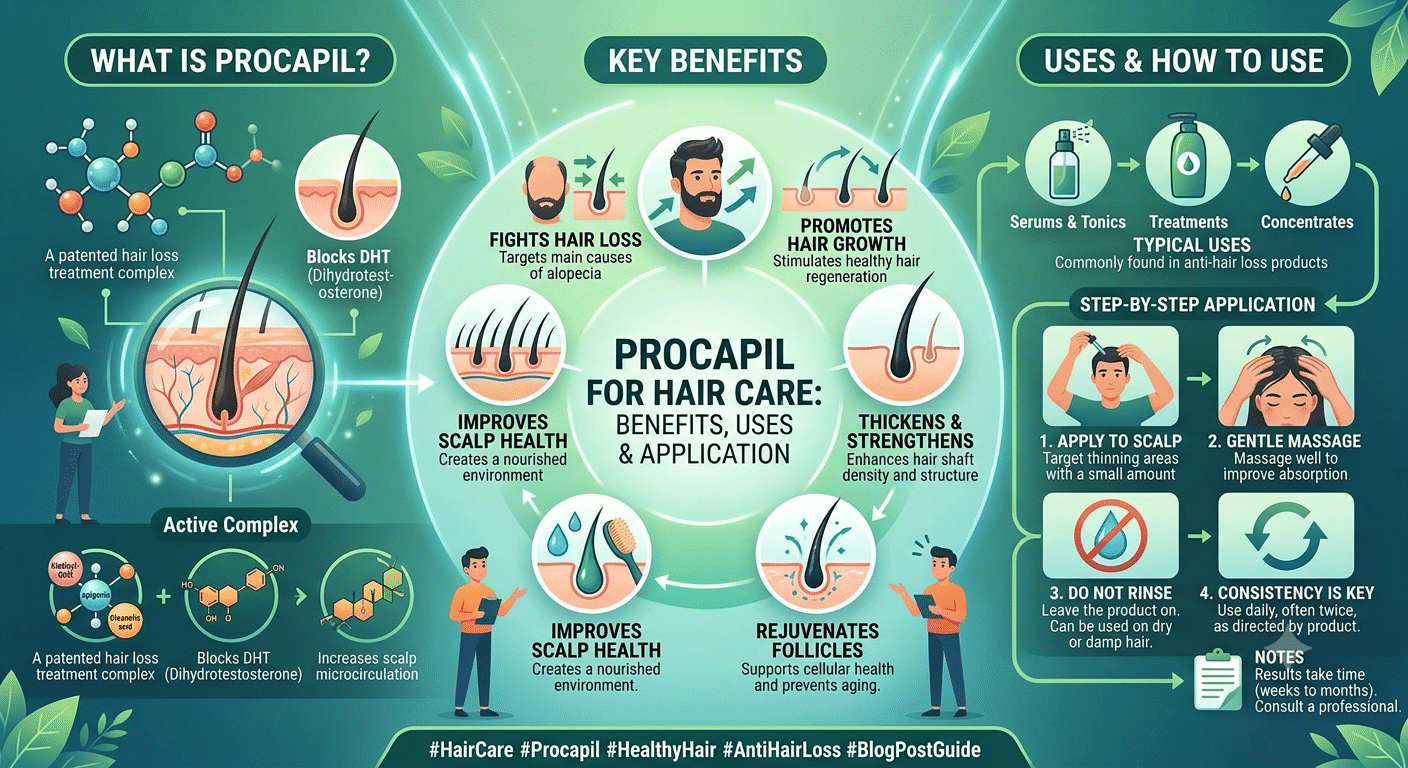
Hair fall can feel like a slow-moving alarm bell. You notice more strands on your pillow, a wider-looking parting, or a little more scalp showing under bright light, and suddenly every shampoo, serum, and hair-care ingredient starts looking interesting. Procapil for hair has become one of the better-known ingredients in modern anti-hair-fall serums because it combines three different actives designed to address several factors involved in hair thinning. Procapil contains biotinoyl tripeptide-1, apigenin, and oleanolic acid, and research has investigated its potential role in follicle anchoring, scalp support, and pathways associated with androgen-related hair loss.
At the same time, it is important to separate cosmetic ingredient claims from established medical treatments. Current reviews describe Procapil as promising, but the overall evidence base remains smaller and less consistent than the evidence available for established hair-loss treatments. A 2025 review noted that many studies of topical hair-growth ingredients have small samples, different formulations, limited comparison with standard treatments, and sometimes potential conflicts of interest. That does not make Procapil irrelevant; it simply means expectations should be realistic. Used as part of a sensible hair-care routine, Procapil may be worth considering for people experiencing early or moderate thinning, particularly when they want a topical cosmetic approach.
What Is Procapil for Hair?
Procapil is a cosmetic hair-care complex made from three active components: biotinoyl tripeptide-1, apigenin, and oleanolic acid. Rather than being a single vitamin or botanical extract, it is designed as a combination in which different ingredients target different biological processes associated with the hair follicle. Scientific reviews describe biotinoyl-GHK as a matrikine associated with follicle anchoring and cellular activity, apigenin as a flavonoid with vascular-related effects, and oleanolic acid as a compound that can inhibit 5-alpha-reductase activity in experimental contexts.
This combination is one reason Procapil appears frequently in leave-on scalp serums. The concept is relatively simple: if a hair follicle is supported from multiple angles, the environment around the follicle may become more favorable for maintaining healthier-looking hair. However, that mechanism should not be interpreted as proof that every person using Procapil will experience significant regrowth. Hair loss has many possible causes, including androgenetic alopecia, telogen effluvium, nutritional deficiencies, inflammatory scalp conditions, medications, hormonal changes, and physical or chemical damage. A serum containing Procapil therefore addresses only part of a much larger picture.
The Three Key Ingredients in Procapil
Understanding the individual components makes it easier to understand why the ingredient is used in hair serums. Biotinoyl tripeptide-1 is a peptide derived from the biotinyl-GHK concept and is associated with hair-fiber anchorage and extracellular-matrix-related processes. Apigenin is a flavonoid commonly described in Procapil literature as supporting microcirculation-related mechanisms. Oleanolic acid is a plant-derived triterpenoid that has been studied for its influence on 5-alpha-reductase, an enzyme involved in androgen metabolism.
The important point is that these ingredients are not identical to prescription hair-loss medicines. Procapil is generally marketed as a cosmetic active, and its proposed mechanisms come from laboratory research, ingredient studies, and relatively small clinical investigations. That distinction matters when deciding how much improvement to expect. Think of Procapil less like a guaranteed reset button and more like a supporting tool in a broader hair-care strategy.
Biotinoyl Tripeptide-1
Biotinoyl tripeptide-1 is one of the most distinctive components of Procapil. Research discussed in scientific reviews describes biotinyl-GHK as a matrikine that may support the structures responsible for anchoring hair within the follicle. It has also been investigated for effects involving keratinocytes and extracellular matrix components, including proteins such as collagen IV and laminin 5.
Why does anchoring matter? A hair follicle is not simply a hole in the scalp from which a strand emerges. It is a complex biological structure surrounded by supporting tissue. If the follicular environment is compromised, the visible hair can become weaker or easier to shed. Supporting follicular anchorage is therefore one of the ideas behind Procapil. This does not mean a peptide can reverse every type of hair loss, but it explains why Procapil is positioned differently from products that merely condition the hair shaft.
Apigenin and Oleanolic Acid
Apigenin and oleanolic acid provide the other two parts of the Procapil combination. Apigenin is a flavonoid, while oleanolic acid is a plant-derived triterpenoid. Scientific literature describes apigenin as having vasodilatory or microcirculation-related potential, while oleanolic acid has been studied for inhibition of 5-alpha-reductase pathways.
These mechanisms are especially interesting because androgenetic hair loss involves complex interactions between follicles and androgen signaling. However, laboratory or mechanistic activity should not automatically be translated into the same degree of clinical effectiveness seen with prescription medicines. The practical takeaway is that Procapil has a biologically plausible rationale, but the strength of human evidence still needs to be considered before making strong claims about regrowth.
How Does Procapil Work for Hair Growth?
Procapil is intended to work through several complementary pathways rather than relying on a single action. The proposed mechanisms include supporting hair follicle anchorage, promoting a favorable scalp environment, and influencing pathways connected with 5-alpha-reductase and androgen metabolism. Scientific reviews describe these three targets as part of the rationale for using Procapil in anti-hair-loss formulations.
One early placebo-controlled pilot trial described in the literature evaluated a 3% Procapil lotion used twice daily for four months in men with a high proportion of telogen-phase hairs. Among the participants who received Procapil, 67% showed significant improvement in the mean anagen-to-telogen ratio. The manufacturer’s technical material also reports a four-month placebo-controlled study and recommends a 3% use level for cosmetic formulations. These findings are interesting, but they should be interpreted cautiously because the trial was small and ingredient-sponsored technical evidence is not equivalent to the large independent trials available for established medical therapies.
Procapil and Hair Follicle Anchorage
Hair anchorage is an important but often overlooked part of hair health. The idea behind Procapil is that improving the surrounding follicular structure may help hair remain attached and continue through a healthier growth cycle. Research has associated biotinoyl-GHK with adhesion-related proteins and follicular structures, while Procapil’s other ingredients are intended to complement that activity.
This makes Procapil particularly interesting in formulations designed for hair shedding and early thinning. Still, hair density depends on much more than anchorage. If follicles are significantly miniaturized or another medical condition is causing the shedding, a cosmetic serum alone may not address the underlying problem.
Benefits of Procapil for Hair
The potential benefits of Procapil can be summarized as support for a healthier-looking scalp and stronger-looking hair rather than guaranteed hair regrowth. Available research suggests that Procapil-containing formulations may help improve certain measures associated with the hair-growth cycle, while users may notice reduced shedding or improved visual density over time. A recent review describes Procapil as promising but emphasizes the limitations of the existing clinical evidence.
One 12-week study involving a formulation containing 3% Procapil, caffeine, and zinc PCA followed 19 men with androgenetic hair loss. The researchers reported improvement in participant-reported hair loss, while no statistically significant improvement in total hair count or density was found at weeks six and twelve. No treatment-related adverse effects were reported during the study. This is a useful example of why claims should be precise: a person may perceive less shedding or better-looking hair without the study demonstrating a major increase in measured density.
May Help Reduce Hair Shedding
Reducing excessive shedding is one of the main reasons people look for Procapil-containing serums. By supporting follicular anchorage and potentially influencing the hair-growth cycle, Procapil may help create conditions associated with less visible shedding. However, shedding can come from many different causes, and a serum cannot be expected to correct a deficiency, hormonal disorder, medication reaction, or inflammatory scalp disease by itself.
A clinical review of Procapil notes a placebo-controlled pilot study in which the active group demonstrated a significant improvement in the anagen-to-telogen ratio. Another study of a broader formulation containing Procapil and several additional ingredients reported improvements in hair-related outcomes, but because the formula included multiple actives, the individual contribution of Procapil could not be isolated. This is an important distinction when reading online hair-growth claims.
May Support Thicker-Looking Hair
Another possible benefit is improved appearance of hair thickness and density. When fewer hairs are visibly shedding and existing strands remain in the growth phase for longer, the scalp can appear less exposed. Procapil-containing products are therefore commonly positioned as daily scalp serums for people noticing early thinning.
However, visual thickness can be affected by styling, hair length, hydration, scalp oil, and even lighting. A useful way to judge progress is to take standardized photographs under the same lighting, angle, hairstyle, and distance every four to eight weeks. That approach is much more reliable than checking the mirror several times a day and trying to detect tiny changes.
Procapil for Male and Female Hair Loss
Procapil is used in products marketed to both men and women. It is especially relevant to discussions around androgenetic alopecia, commonly called male-pattern or female-pattern hair loss, although the causes and patterns can differ considerably between individuals. Research has investigated Procapil in male androgenetic alopecia and in combination formulations used for broader hair-loss complaints.
For men, thinning commonly becomes noticeable around the temples, frontal hairline, or crown. For women, diffuse thinning or a widening central part can be more common, although individual patterns vary. A topical Procapil serum may be considered as part of a cosmetic routine, but anyone experiencing rapid, patchy, severe, or unexplained hair loss should consider professional evaluation rather than relying solely on a cosmetic active.
Procapil for Pattern Hair Loss
Pattern hair loss is progressive, which makes early attention useful. A 2023 randomized study compared Procapil with PRP against another combination of topical ingredients with PRP in men with androgenetic alopecia; both groups were investigated through serial photographic assessments. Such studies contribute to the evidence around Procapil, but they also show why combination treatments make it difficult to determine exactly how much benefit comes from Procapil itself.
If someone has progressive pattern hair loss, it is sensible to view Procapil as a possible supporting topical, not automatically as a substitute for medical treatment. Current clinical literature continues to identify minoxidil and finasteride as established therapies for androgenetic alopecia, with their own benefits, limitations, contraindications, and side-effect considerations.
How to Use Procapil for Hair Care
The exact instructions should always come from the specific product because concentration, formulation, applicator, and directions vary. Generally, Procapil is found in leave-on scalp serums, lotions, and tonics, rather than products that are immediately rinsed away. A typical routine involves applying the serum directly to the scalp, concentrating on thinning areas, and gently distributing it with clean fingertips.
The goal is to put the product on the scalp rather than coating the hair lengths. Start with a clean, dry or product-directed scalp, part the hair where necessary, apply the recommended amount, and massage gently without aggressive rubbing. Excessive application does not necessarily produce better results and may simply increase product buildup or irritation. Consistency is more important than using a large quantity occasionally.
Step-by-Step Procapil Application
A simple routine can look like this:
- Clean the scalp with a suitable shampoo and allow it to become dry if the product instructions recommend dry application.
- Part the hair to expose areas where thinning or shedding is noticeable.
- Apply the recommended amount of Procapil serum directly to the scalp.
- Massage gently with fingertips for a short period so the product spreads across the target area.
- Leave it on according to the manufacturer’s instructions instead of washing it off immediately.
- Use consistently according to the product directions and track progress over several months.
Avoid applying the serum to broken, irritated, or infected skin unless a healthcare professional specifically advises it. If burning, significant redness, swelling, or persistent itching occurs, discontinue the product and seek professional advice.
How Often Should You Use Procapil?
There is no universal schedule for every Procapil product. Some formulations recommend daily use, while others may specify once or twice daily. In the published studies, schedules have varied; for example, one pilot study used a 3% Procapil lotion twice daily for four months, while a 12-week study investigated a Procapil-containing formulation used daily.
That variation is exactly why following the specific serum’s label instructions matters. Using more serum than recommended is not a shortcut to faster growth. Hair follicles operate on biological cycles that take time, so changing the amount every few days because results are not immediately visible can make a routine inconsistent and difficult to evaluate.
When Can You Expect Procapil Results?
Hair does not behave like skin after applying a moisturizer. Hair follicles move through growth, transition, and resting phases, so visible changes usually require consistent use over weeks or months. The Procapil studies that have reported encouraging outcomes have generally examined periods ranging from around 12 weeks to four months or longer.
A practical approach is to think in stages. During the first few weeks, the main goal is establishing tolerance and consistency. Around two to three months, some users may notice changes in shedding or the visual condition of their hair, although individual responses vary. A longer period may be needed before judging whether the routine is genuinely helping, and continuing progression of hair loss should prompt professional assessment rather than simply increasing the serum.
Procapil vs Minoxidil
Procapil and minoxidil should not be treated as identical ingredients. Procapil is a cosmetic complex, while topical minoxidil is an established drug treatment for certain forms of hair loss. A 2026 dermatologist-reviewed overview described Procapil’s evidence as promising but not comparable in strength to the evidence supporting minoxidil or finasteride.
| Feature | Procapil | Minoxidil |
|---|---|---|
| Category | Cosmetic active complex | Hair-loss medication |
| Main components | Biotinoyl tripeptide-1, apigenin, oleanolic acid | Minoxidil |
| Typical use | Topical hair-care serums | Topical treatment for certain hair-loss conditions |
| Evidence | Promising but relatively limited | More extensive clinical evidence |
| Primary appeal | Multi-ingredient cosmetic approach | Established medical treatment |
| Professional guidance | Useful when hair loss is persistent or unexplained | Important, particularly with medical conditions or side effects |
This comparison does not mean one product is automatically suitable for everyone. Someone with mild cosmetic concerns may have different priorities from someone with progressive androgenetic alopecia. A dermatologist can help identify the cause and discuss appropriate options.
Possible Side Effects and Precautions
Procapil is generally used topically, and published studies have reported good tolerability in the formulations tested. For example, the 12-week caffeine-plus-Procapil study reported no dryness, itching, redness, scaling, folliculitis, or burning among participants. However, that does not guarantee that every person will tolerate every commercial serum because products contain different bases, preservatives, fragrances, and additional active ingredients.
Anyone with a sensitive scalp should consider a small patch test according to the product’s instructions before applying a new serum widely. Stop using the product if significant irritation develops. People with sudden hair loss, bald patches, scalp pain, heavy scaling, inflammation, or other unusual symptoms should not assume the issue is simply weak hair and should consider medical evaluation.
Who May Consider Using Procapil?
Procapil may appeal to adults who are noticing early thinning, increased shedding, or reduced-looking density and want a topical cosmetic hair-care product. It can also be considered as an additional component of a broader hair-care strategy when its formulation suits the individual. The strongest reason to consider it is not that it promises miraculous regrowth, but that its ingredients have a plausible mechanism and some early human research behind them.
At the same time, Procapil should not delay evaluation when hair loss is sudden or severe. Conditions such as thyroid disorders, nutritional deficiencies, autoimmune hair loss, scalp infections, medication-related shedding, and hormonal changes require attention to the underlying cause. A serum may support hair care, but it cannot replace diagnosis.
Tips for Getting Better Results
The most useful hair-growth routine is usually the one you can follow consistently. Start with a product that clearly lists its ingredients and concentration, follow the recommended application schedule, and avoid constantly switching between multiple serums. Give the routine enough time to evaluate rather than changing products every two weeks because a social-media video promises faster results.
Your broader habits matter too. Treat the scalp gently, avoid excessive heat and repeated chemical processing, choose a shampoo appropriate for your scalp, maintain a balanced diet, and avoid very tight hairstyles when possible. If hair loss continues despite consistent care, consider professional assessment. The objective is not to collect as many hair-growth ingredients as possible; it is to identify what is actually driving the hair loss and choose an approach that matches the cause.
Is Procapil Scientifically Proven?
The most accurate answer is there is scientific evidence for Procapil, but the evidence is still limited compared with established medical treatments. A 2025 review of topical hair-growth ingredients identified Procapil among several promising actives but highlighted recurring limitations across the literature, including small study populations, inconsistent study designs, lack of standard-treatment comparisons, and conflicts of interest.
The evidence is not entirely theoretical. A placebo-controlled pilot study reported an improvement in the anagen-to-telogen ratio with 3% Procapil, while a 2023/2024 publication examined a caffeine and Procapil 3% formulation in men with androgenetic alopecia. However, the latter study was small and did not find a statistically significant improvement in total hair count or density after 12 weeks. That combination of encouraging signals and evidence limitations is why Procapil is better described as a promising cosmetic hair-growth ingredient than as a proven replacement for established hair-loss medications.
Conclusion
Procapil for hair is a multi-component cosmetic active containing biotinoyl tripeptide-1, apigenin, and oleanolic acid. Its proposed benefits include supporting follicle anchorage, maintaining a favorable scalp environment, and influencing biological pathways associated with hair shedding and androgen-related follicle changes. Early clinical research has produced encouraging findings, including improvements in hair-cycle measures, while more recent studies suggest that Procapil-containing formulations may be well tolerated and may help some users perceive an improvement in hair loss.
The key is to keep expectations realistic. Procapil is not a guaranteed cure for baldness, and the evidence is not as extensive as it is for established treatments such as minoxidil. If you decide to try it, choose a clearly formulated product, apply it consistently according to its instructions, photograph your scalp periodically to monitor changes, and give the routine enough time to evaluate. If hair loss is rapid, severe, patchy, or unexplained, professional diagnosis should come before relying on any cosmetic serum.
FAQs About Procapil for Hair
1. What is Procapil used for?
Procapil is primarily used in topical hair-care products designed to support hair growth, reduce the appearance of shedding, and maintain healthier-looking hair. It combines biotinoyl tripeptide-1, apigenin, and oleanolic acid. Research has investigated these ingredients in relation to follicle anchorage, scalp microcirculation, and androgen-related pathways.
2. Can Procapil regrow lost hair?
Procapil may help support the hair-growth environment, but it should not be presented as a guaranteed regrowth treatment. Some clinical studies have reported improvements in hair-cycle measurements and user-perceived hair loss, but the evidence remains limited. People with significant or progressive hair loss should discuss established treatment options with a dermatologist.
3. How long does Procapil take to work?
Hair-growth changes take time because hair follicles operate through biological growth cycles. Published Procapil studies have evaluated periods such as 12 weeks and four months, rather than expecting results within a few days. Consistent use and standardized progress photographs can make changes easier to assess.
4. Is Procapil better than minoxidil?
Procapil and minoxidil are different types of products and should not be considered interchangeable. Procapil is a cosmetic active complex, whereas minoxidil is an established hair-loss medication with a larger clinical evidence base. The appropriate choice depends on the type and severity of hair loss and individual medical circumstances.
5. Can Procapil be used every day?
Many Procapil-containing serums are designed for regular or daily use, but the correct frequency depends on the specific formulation. Follow the manufacturer’s directions rather than assuming that a higher application frequency will produce faster results. If irritation occurs, discontinue use and seek professional advice when necessary.