
What Is Nanoplastia and How Does It Work?
-
Dokmai London
- Posted on
- 0 comments
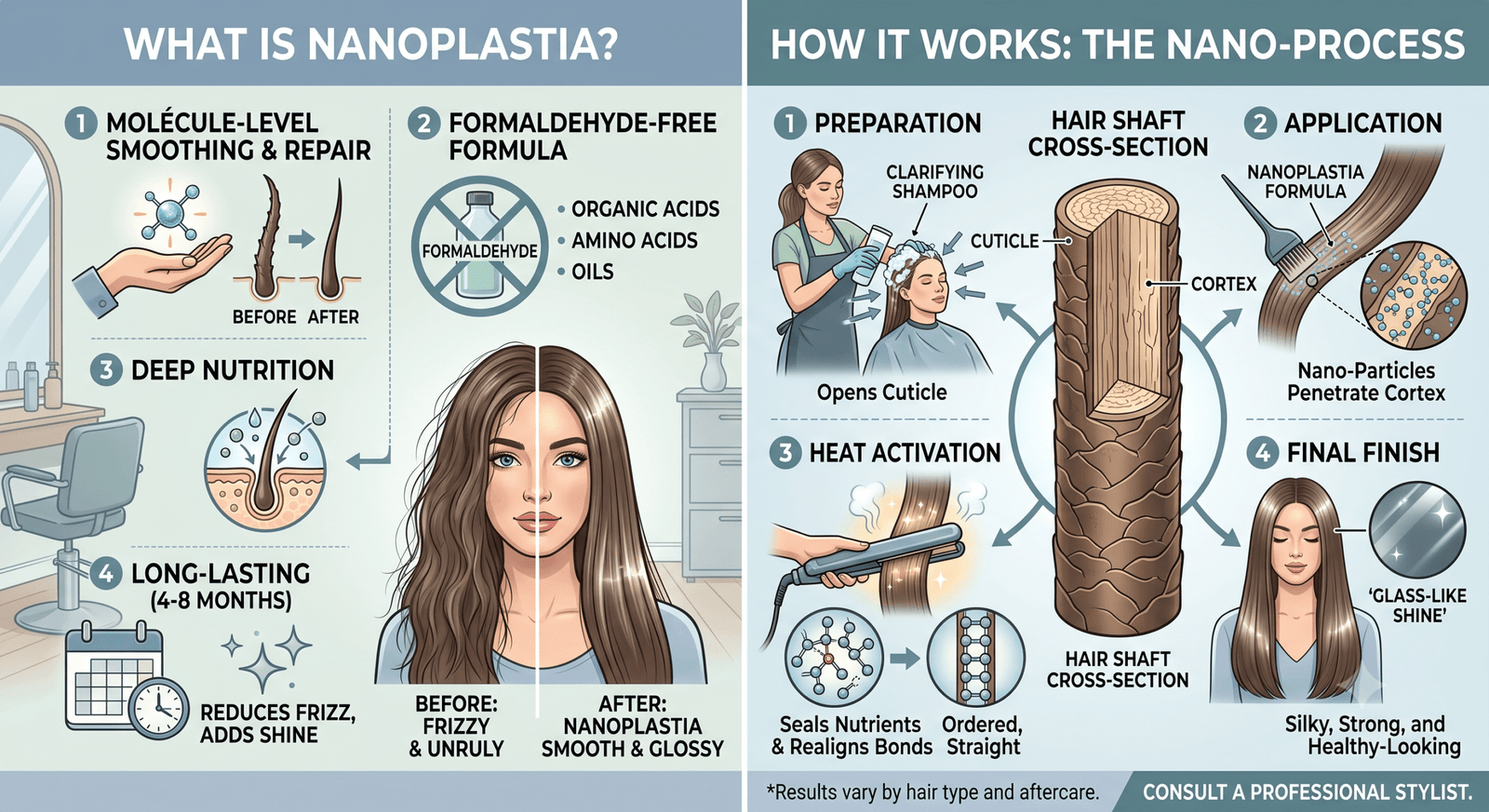
If you’re dealing with dry, frizzy, rough, or difficult-to-manage hair, you’ve probably heard about nanoplastia hair treatment. This modern salon treatment has become increasingly popular among people who want smoother, shinier, softer, and more manageable hair without choosing a traditional straightening service.
But what exactly is nanoplastia? How does it work? Is it suitable for coloured or damaged hair? How long do the results last? And is nanoplastia really different from keratin, smoothening, or rebonding?
This guide answers these questions in simple language.
Nanoplastia is generally marketed as a professional hair-smoothing and restructuring treatment. Formulas can vary considerably between brands, so the ingredients and exact process aren’t identical everywhere. Many professional formulations use combinations of amino acids, proteins, conditioning ingredients, organic acids, and heat activation to create a smoother-looking hair surface.
Before choosing any smoothing treatment, it’s also important to check the actual product ingredients and the salon’s safety practices. The U.S. FDA warns that some hair-smoothing products can release formaldehyde when heated, so consumers should check labels and ask salon professionals about ingredients and ventilation.
Comprehensive Article Outline
| Section | What You’ll Learn |
|---|---|
| What Is Nanoplastia? | Definition and basic concept |
| How Does Nanoplastia Work? | Treatment mechanism |
| Main Ingredients | Common ingredients used |
| Treatment Process | Step-by-step salon procedure |
| Benefits | Key advantages for hair |
| Hair Types | Who may benefit |
| Nanoplastia vs Keratin | Major differences |
| Nanoplastia vs Smoothening | How results differ |
| Nanoplastia vs Rebonding | Permanent vs temporary effects |
| Results & Duration | What to expect |
| Cost Factors | What affects pricing |
| Aftercare | How to maintain results |
| Risks & Precautions | Important safety considerations |
| FAQs | Common questions answered |
| Conclusion | Final recommendations |
What Is Nanoplastia Hair Treatment?
Nanoplastia hair treatment is a professional hair-smoothing service designed to reduce frizz, improve manageability, enhance shine, and create a smoother-looking hair texture.
The word “nano” is commonly used in the beauty industry to describe technology or ingredients intended to work at a very small scale. However, it’s important not to assume that every product sold as nanoplastia has the same scientific formulation or mechanism.
In practical salon terms, nanoplastia is usually a heat-activated smoothing treatment. The stylist applies a specialized formula to the hair, processes it according to the manufacturer’s instructions, and uses blow-drying and flat-ironing techniques to create the final smooth appearance. Contemporary descriptions of the treatment commonly mention amino acids, proteins, conditioning agents, and other smoothing ingredients.
Unlike a haircut, the purpose isn’t simply to change the shape of your hair. Instead, the service is focused on changing how the hair looks, feels, behaves, and responds to styling.
For people with frizzy hair, that can be a big deal.
Instead of spending a long time fighting puffiness every morning, hair may become easier to brush, blow-dry, and style.
Is Nanoplastia a Hair Straightening Treatment?
Nanoplastia can produce a straighter-looking finish, but the result depends on several factors:
- Natural hair texture
- Hair density
- Porosity
- Previous chemical treatments
- Product formulation
- Processing technique
- Flat-iron temperature
- Number of passes
- Home aftercare
Some clients may achieve a sleek, straight appearance, while others may retain some natural waves or curls.
That’s why a professional consultation matters.
How Does Nanoplastia Work?
The basic principle is relatively simple.
The stylist prepares the hair, applies the treatment formula, processes it, dries the hair, and then uses controlled heat to create the finished result.
The treatment isn’t simply “putting a product on the hair.” The preparation, application, timing, drying, and heat technique all influence the final appearance.
Step 1: Hair Assessment
Before beginning, a professional stylist should examine the hair.
They may consider:
- Hair thickness
- Porosity
- Elasticity
- Existing damage
- Split ends
- Previous colour
- Bleaching history
- Previous keratin or smoothening services
- Scalp condition
- Natural curl or wave pattern
This step is easy to overlook, but it’s crucial.
Healthy-looking hair doesn’t automatically mean healthy hair. Hair can appear shiny while still being fragile from previous chemical processing.
Step 2: Deep Cleansing
The hair is generally cleansed to remove oil, dirt, styling residue, and buildup.
Clean hair allows the treatment formula to distribute more evenly.
Step 3: Application
The nanoplastia formula is applied section by section.
A professional stylist usually works systematically to make sure the product reaches the intended areas without unnecessarily overloading the hair.
Step 4: Processing
The product is left on the hair for a period specified by the product manufacturer.
Processing time shouldn’t be guessed.
It may vary depending on the formula and the client’s hair condition.
Step 5: Blow-Drying
The hair is dried carefully.
This prepares the hair for the heat-sealing stage.
Step 6: Flat-Ironing
Controlled heat is used to create the smooth finish.
This is one of the most important stages because excessive heat can damage fragile hair.
A trained stylist should choose the appropriate temperature and technique according to the hair’s condition and the product’s instructions.
Step 7: Final Styling
Once the process is complete, the hair is styled and inspected.
The result is typically smoother, shinier, softer, and easier to manage.
What Ingredients Are Commonly Used in Nanoplastia?
There isn’t one universal nanoplastia formula.
Different brands can use different ingredients and technologies.
Commonly discussed ingredients include:
- Amino acids
- Proteins
- Conditioning agents
- Organic acids
- Oils
- Moisturizing ingredients
- Film-forming ingredients
- Other cosmetic smoothing compounds
Some manufacturers market their formulas as formaldehyde-free. However, consumers shouldn’t assume that every product marketed under the term “nanoplastia” is automatically free from formaldehyde or other potentially irritating substances.
The safest approach is to check the exact product label and Safety Data Sheet where appropriate.
The FDA specifically recommends asking salon professionals about ingredients in hair-smoothing products and checking for formaldehyde-related ingredients such as formaldehyde, formalin, or methylene glycol.
For more information, see the FDA’s guidance on hair-smoothing products.
11 Powerful Benefits of Nanoplastia Hair Treatment
Nanoplastia is popular because it can offer several cosmetic and styling benefits.
1. Helps Reduce Frizz
Frizz is one of the biggest reasons people choose smoothing treatments.
Nanoplastia can help hair look more controlled and polished.
2. Creates a Smoother Appearance
The treatment is designed to improve the surface appearance of the hair, making it look smoother and more refined.
3. Adds Visible Shine
Smoother hair surfaces often reflect light more evenly, which can create a glossy appearance.
4. Improves Manageability
Hair that’s easier to comb and style can save significant time during daily routines.
5. Helps Reduce Puffiness
People with thick, coarse, or naturally voluminous hair may appreciate the reduction in unwanted bulk.
6. Makes Blow-Drying Easier
After treatment, many people find that their hair requires less effort to style.
7. Creates a Sleek Finish
Nanoplastia can provide a polished, salon-finished appearance without necessarily creating the same result as permanent rebonding.
8. Can Improve Hair Feel
Depending on the formula and hair condition, the hair may feel softer and more conditioned after treatment.
9. Makes Styling More Convenient
For busy professionals, students, brides, and frequent travellers, easier-to-manage hair can be a practical benefit.
10. Can Be Used on Selected Chemically Treated Hair
Some nanoplastia services are marketed for coloured or chemically treated hair. However, suitability depends heavily on the actual condition of the hair.
A strand test may be appropriate when damage is a concern.
11. Gives a Professional Hair Makeover
Sometimes you simply want your hair to look better without changing its colour or length.
That’s where a smoothing service can make a noticeable difference.
Who Is Nanoplastia Best Suited For?
Nanoplastia may be considered by people who have:
- Frizzy hair
- Dry-looking hair
- Rough texture
- Unmanageable hair
- Wavy hair
- Thick hair
- Coarse hair
- Puffy hair
- Hair that’s difficult to style
- Hair affected by humidity
It may also appeal to people who want a smoother finish but don’t necessarily want a permanently straightened look.
However, suitability should always be assessed individually.
Who Should Be More Careful?
Extra caution may be needed if hair is:
- Severely bleached
- Extremely brittle
- Breaking easily
- Overprocessed
- Highly elastic when wet
- Recently exposed to multiple chemical services
If your hair is severely damaged, another conditioning or restorative approach may be more appropriate before considering a high-heat smoothing treatment.
Nanoplastia vs Keratin Treatment
Nanoplastia and keratin treatments are often confused because both can reduce frizz and improve smoothness.
However, they aren’t necessarily identical.
| Feature | Nanoplastia | Keratin Treatment |
|---|---|---|
| Main purpose | Smoothing and manageability | Smoothing and frizz reduction |
| Formula | Varies by brand | Varies by brand |
| Straightening effect | Can be significant | Can be significant |
| Heat used | Usually yes | Usually yes |
| Result | Smooth, glossy, manageable | Smooth, glossy, manageable |
| Duration | Depends on formula and aftercare | Depends on formula and aftercare |
| Chemical profile | Product-specific | Product-specific |
The biggest mistake is assuming that the treatment name tells you everything.
The formula matters more than the marketing label.
Always ask which product will be used.
Nanoplastia vs Hair Smoothening
Traditional smoothening services can use chemical processes to alter the hair’s appearance and texture.
Nanoplastia is generally marketed as a newer smoothing approach focused on frizz control, softness, shine, and manageability.
The final result can vary significantly.
| Factor | Nanoplastia | Smoothening |
|---|---|---|
| Focus | Smoothness + manageability | Texture modification |
| Frizz control | High potential | High potential |
| Finish | Often sleek and glossy | Often straight and polished |
| Longevity | Temporary | Usually semi-permanent |
| Hair texture | May retain some movement | Can reduce natural movement |
| Formula | Brand-dependent | Brand-dependent |
The right option depends on your desired result.
If you want movement and a natural-looking finish, one treatment may be preferable. If your goal is a more dramatic change in texture, another option might suit you better.
Nanoplastia vs Rebonding
Rebonding is fundamentally different from temporary or semi-permanent smoothing services.
Rebonding chemically changes the internal structure of the hair to create a permanently straightened section.
Nanoplastia, by contrast, is generally positioned as a smoothing treatment whose effects gradually diminish as the hair grows and the treatment wears off.
Rebonding
- Strong structural change
- Very straight result
- Permanent on treated lengths
- Requires careful maintenance
- Regrowth becomes noticeable
Nanoplastia
- Smoothing-focused
- Results gradually fade
- Can provide shine and manageability
- Usually creates a softer overall transformation
- Retouching depends on hair growth and treatment longevity
So, if you’re looking for a dramatic permanent straightening effect, rebonding and nanoplastia shouldn’t be treated as the same service.
How Long Does Nanoplastia Last?
The duration of nanoplastia results isn’t identical for everyone.
Several factors influence longevity:
- Hair texture
- Washing frequency
- Shampoo formulation
- Heat styling
- Swimming
- Sun exposure
- Hair porosity
- Previous chemical treatments
- Product formulation
- Professional application technique
Some sources describe results lasting for several weeks to a few months, but the exact duration depends on the product and the individual’s hair and maintenance routine.
So don’t believe claims that promise exactly the same duration for every person.
Your hair isn’t a machine with a fixed expiry date.
What Does Nanoplastia Cost?
The nanoplastia hair treatment price varies widely.
There isn’t one universal price because salons may calculate the service according to:
- Hair length
- Hair thickness
- Product quantity
- Product brand
- Stylist expertise
- Salon location
- Hair condition
- Treatment complexity
- Additional services
For example, treating short, fine hair may require considerably less product and time than treating very long, thick hair.
Therefore, salons often provide a price range rather than one fixed amount.
Is Cheap Nanoplastia Always Better?
Not necessarily.
A very low price may mean:
- Lower product quantity
- Less experienced application
- Different product formulation
- Limited consultation
- Fewer aftercare instructions
When comparing prices, ask what product is being used and what is included in the service.
Nanoplastia Aftercare: How to Maintain the Results
Aftercare can make a huge difference.
Use a Suitable Shampoo
Choose products recommended for your treated hair and follow your stylist’s instructions.
Avoid repeatedly using harsh cleansing products if they aren’t appropriate for your treatment.
Don’t Overwash
Frequent washing can gradually reduce the cosmetic effect of many smoothing treatments.
Use Conditioner
Conditioning helps maintain softness and manageability.
Apply a Hair Mask
A suitable hair mask can help support moisture and improve the feel of treated hair.
Protect Hair From Heat
If you’re using a straightener, curling iron, or blow dryer, use an appropriate heat protectant.
Don’t Ignore Split Ends
Smoothing treatment isn’t a substitute for regular trimming.
If the ends are damaged, trimming may make the hair look healthier and cleaner.
Protect Your Hair While Sleeping
A smooth pillowcase and gentle nighttime routine can reduce unnecessary friction.
Follow Your Stylist’s Instructions
Different nanoplastia formulations can have different post-treatment requirements.
Therefore, generic internet advice shouldn’t replace the manufacturer’s directions or your stylist’s professional instructions.
Is Nanoplastia Safe?
This question deserves a careful answer.
There is no universal safety profile for every product sold as nanoplastia because formulations differ.
Some products are marketed as formaldehyde-free, but that claim should be verified against the actual product information rather than assumed from the treatment name.
The FDA notes that some hair-smoothing products can release formaldehyde when heated and recommends checking ingredients, asking salon professionals questions, and ensuring appropriate precautions and ventilation.
Smart Questions to Ask Your Salon
Before booking, ask:
- What exact product will you use?
- Can I see the ingredient list?
- Does it contain formaldehyde, formalin, or methylene glycol?
- Is the product intended for professional use?
- Is there a Safety Data Sheet?
- What precautions does the salon follow?
- Is the area properly ventilated?
- Is my hair suitable for the treatment?
- Will you perform a strand test if needed?
- What aftercare should I follow?
These questions aren’t being overly cautious.
They’re simply smart salon habits.
What Can You Expect During a Professional Nanoplastia Appointment?
A typical appointment can involve several stages.
Consultation
Your stylist discusses your hair history and desired result.
Hair Diagnosis
The stylist assesses texture, damage, colour, density, and porosity.
Preparation
Hair is cleansed and prepared.
Treatment Application
The formula is applied carefully.
Processing
The product is allowed to work according to manufacturer instructions.
Blow-Dry
Hair is dried and prepared for heat sealing.
Heat Sealing
The stylist uses a flat iron according to the product’s instructions and the hair’s condition.
Final Styling
The hair is styled and checked.
The entire appointment can take several hours depending on hair length, thickness, condition, and the specific product.
Common Mistakes to Avoid
Even a good smoothing treatment can disappoint if the process isn’t handled correctly.
Choosing Only by Price
The cheapest treatment isn’t automatically the best.
Ignoring Hair Damage
Extremely damaged hair may not tolerate additional chemical processing and high heat well.
Not Asking About Ingredients
Never assume that a treatment is safe simply because it has a modern name.
Using Excessive Heat at Home
Your hair doesn’t need daily high-temperature styling after a salon treatment.
Expecting Permanent Results
Nanoplastia isn’t the same as permanent rebonding.
Skipping Aftercare
Poor maintenance can shorten the cosmetic effect.
How to Choose the Right Salon for Nanoplastia
Choosing the right salon can be just as important as choosing the treatment.
Look for a salon that:
- Has trained stylists
- Performs hair consultations
- Uses professional products
- Explains the treatment honestly
- Provides ingredient information
- Follows manufacturer instructions
- Maintains good ventilation
- Uses appropriate heat settings
- Doesn’t promise unrealistic results
- Gives clear aftercare instructions
A professional salon should be willing to explain what you’re paying for.
That’s a good sign.
Nanoplastia: Pros and Cons at a Glance
| Pros | Cons |
|---|---|
| Reduces visible frizz | Results aren’t permanent |
| Adds shine | Can be expensive |
| Improves manageability | Requires aftercare |
| Creates smoother texture | High heat is involved |
| Can simplify styling | Results vary by hair type |
| May reduce puffiness | Product formulas differ |
| Gives a polished appearance | Not suitable for every damaged hair type |
Frequently Asked Questions About Nanoplastia
1. What is nanoplastia and how does it work?
Nanoplastia is a professional hair-smoothing treatment designed to reduce frizz, improve manageability, and create a smoother, shinier appearance. It generally involves applying a specialized formula followed by blow-drying and controlled heat styling. The exact ingredients and mechanism depend on the product used.
2. Is nanoplastia better than keratin?
Not automatically. Both treatments can improve smoothness and reduce frizz, but their formulations and results vary. The best option depends on your hair type, condition, desired finish, and the specific product used.
3. How long does nanoplastia last?
Results can last from several weeks to a few months, depending on hair type, washing routine, product formulation, styling habits, and aftercare.
4. Can nanoplastia be done on coloured hair?
It may be possible, but the hair’s condition matters more than the fact that it is coloured. Highly bleached or fragile hair should be assessed carefully before treatment.
5. Does nanoplastia make hair permanently straight?
No. Nanoplastia is generally a smoothing treatment rather than a permanent restructuring service like rebonding. The effect gradually diminishes over time.
6. Is nanoplastia suitable for curly hair?
It can be considered for curly or wavy hair when the desired result is reduced frizz and greater manageability. However, it may alter the appearance of the curl pattern temporarily, depending on the formula and technique.
7. Does nanoplastia damage hair?
The answer depends on the product, hair condition, chemical history, and application technique. Any treatment involving chemicals and significant heat should be performed carefully, especially on fragile hair.
8. Can I do nanoplastia at home?
Professional treatment is generally preferable because the process requires product knowledge, hair assessment, controlled application, and heat management. The FDA specifically advises consumers not to apply certain hair-smoothing products themselves and recommends professional application where appropriate.
9. Can nanoplastia remove frizz completely?
It can significantly reduce visible frizz for many clients, but no treatment guarantees identical results for every hair type. Humidity, hair texture, damage, and aftercare all matter.
10. How should I maintain my hair after nanoplastia?
Use suitable hair-care products, avoid unnecessary heat, follow your stylist’s aftercare instructions, condition regularly, and avoid excessive washing. Your salon should give you product-specific guidance.
Final Thoughts
So, what is nanoplastia and how does it work?
In simple terms, nanoplastia is a professional hair-smoothing treatment designed to make hair look smoother, shinier, softer, less frizzy, and easier to manage. It commonly involves a treatment formula followed by controlled heat styling, although the exact formulation and procedure vary between products and salons.
The treatment can be especially attractive for people who struggle with frizz, puffiness, rough texture, or time-consuming daily styling.
However, don’t choose nanoplastia based on the name alone.
Your hair’s condition, the exact product, the stylist’s expertise, the treatment procedure, and aftercare all matter. Most importantly, ask questions about ingredients and salon safety before proceeding. The FDA’s guidance on hair-smoothing products is a useful reference when evaluating these services.
If you’re considering nanoplastia, the smartest approach is simple: get your hair professionally assessed, understand the product being used, have realistic expectations, and follow proper aftercare.
When done thoughtfully, nanoplastia can be a practical way to achieve a smoother, more polished hairstyle while making everyday hair management much easier.
In short: smoother hair is great—but informed hair care is even better.