
Face Wash, Toner and Serum: The Correct Skincare Routine for Beginners
-
Dokmai London
- Posted on
- 0 comments
Starting a skincare routine can feel confusing, especially when we encounter products such as face wash, toner, serum, moisturiser, and sunscreen. Each product serves a different purpose, and using them in the correct order helps us maintain healthy-looking skin and get the most out of our skincare products. For beginners, the key is to understand the function of each product, choose formulas suitable for their skin type, and follow a consistent daily routine.
A basic skincare routine does not need to include numerous products or complicated steps. By learning how to use face wash, toner, and serum in the correct order, we can build a simple routine that supports skin cleansing, hydration, and a brighter, smoother appearance.
In this comprehensive guide, we will explore the correct skincare routine for beginners, explain the benefits of each product, discuss how to choose products for different skin types, and share practical tips for achieving healthier-looking skin.
What Is the Correct Order for Face Wash, Toner and Serum?
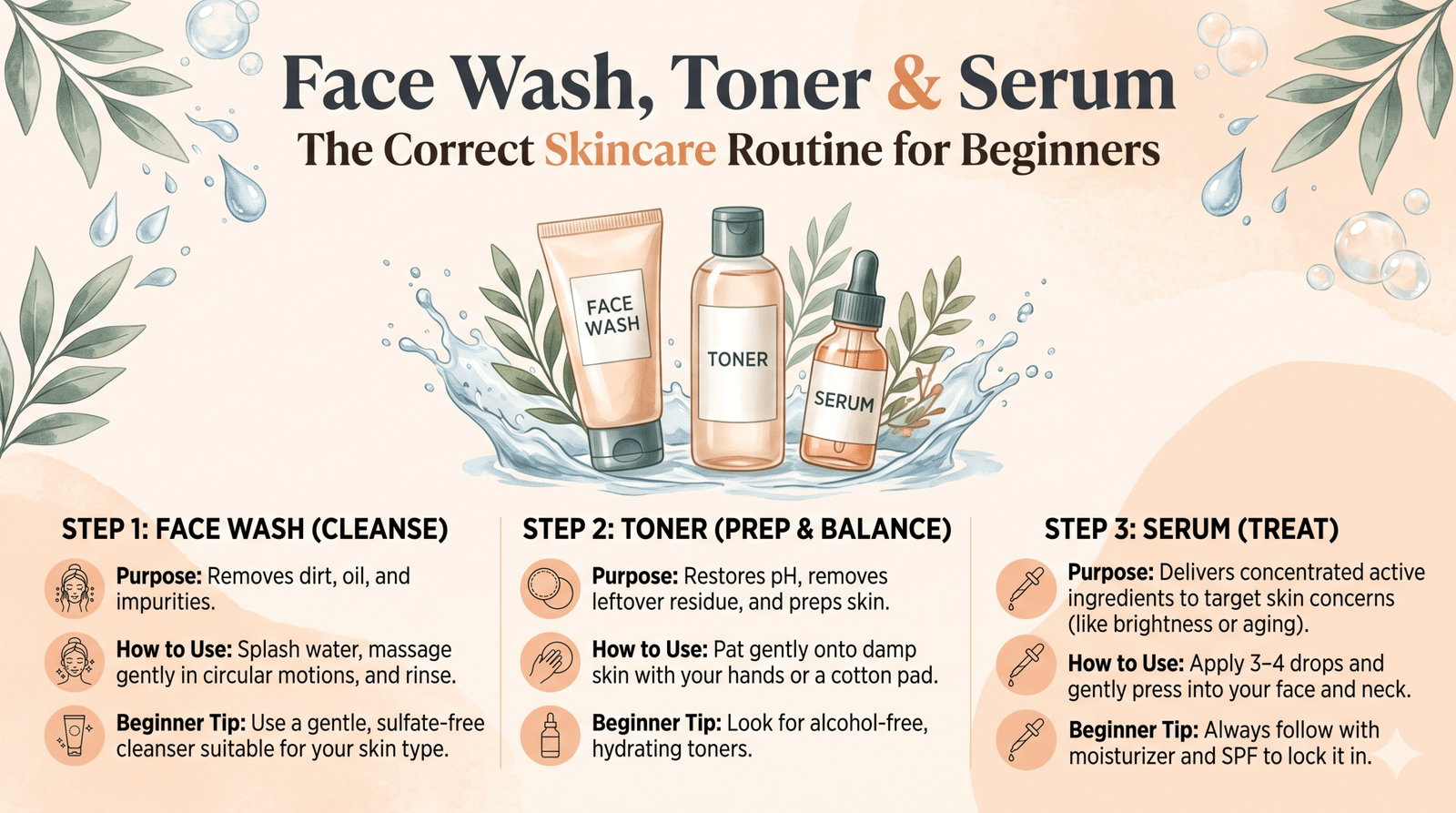
The correct order of a basic skincare routine is essential because each product is designed to perform a specific function. Generally, we should apply skincare products from cleansing to treatment and then moisturising.
The recommended order is:
- Face Wash: Cleanses the skin and removes dirt, excess oil, sweat, and makeup residue.
- Toner: Provides additional hydration or helps address specific concerns, depending on its formulation.
- Serum: Delivers concentrated skincare ingredients to target concerns such as dullness, uneven skin tone, dehydration, or the appearance of fine lines.
- Moisturiser: Helps retain moisture and supports the skin barrier.
- Sunscreen: Protects the skin from harmful ultraviolet (UV) radiation during the daytime.
For beginners, following this order makes the routine easier to understand and maintain. However, we should always follow the product instructions, particularly when using exfoliating toners or active serums.
Step 1: Cleanse Your Face with a Suitable Face Wash
Recommended routine: Morning and evening, depending on skin type and product needs.
Cleansing is the first and one of the most important steps in any skincare routine. Throughout the day, our skin accumulates sweat, environmental pollutants, excess sebum, and other impurities. At night, makeup, sunscreen, and everyday residue can remain on the skin if we do not cleanse properly.
A suitable face wash for daily skincare helps remove these impurities without unnecessarily stripping the skin of its natural moisture.
Benefits of Using Face Wash
A properly formulated face wash can provide several benefits:
- Removes dirt and impurities: Helps cleanse the skin after exposure to environmental pollutants and everyday residue.
- Controls excess oil: Suitable cleansing products can remove excess sebum without leaving the skin feeling excessively dry.
- Supports clearer-looking skin: Regular cleansing helps remove the buildup that can contribute to clogged pores.
- Prepares the skin for other products: Clean skin provides a practical starting point for applying toner, serum, and moisturiser.
- Removes makeup and sunscreen residue: An appropriate cleansing routine helps prevent product buildup.
It is important to understand that face wash alone cannot eliminate acne, pigmentation, or persistent skin concerns. Its primary purpose is to cleanse the skin gently and effectively.
How to Use Face Wash Correctly
To cleanse the face properly, we should follow these steps:
- Wet the face with lukewarm water.
- Take a small amount of face wash into clean hands.
- Gently massage the product over the face using circular movements.
- Avoid scrubbing aggressively, especially around the eyes and areas with active breakouts.
- Rinse thoroughly with lukewarm water.
- Pat the face dry with a clean, soft towel.
We should avoid using very hot water or harsh cleansers that leave the skin feeling tight, uncomfortable, or irritated.
How to Choose the Best Face Wash for Your Skin Type
The right cleanser depends on our skin type and individual concerns.
| Skin type | Face wash to consider |
|---|---|
| Oily skin | A gentle foaming cleanser; salicylic acid may help some people with clogged pores. |
| Dry skin | A creamy, hydrating cleanser with ingredients such as glycerin. |
| Combination skin | A gentle cleanser that removes excess oil without drying the cheeks. |
| Sensitive skin | A fragrance-free cleanser designed to minimise irritation. |
| Normal skin | A mild cleanser that maintains comfort without excessive dryness. |
For example, a Vitamin C Face Wash may appeal to people looking to complement a routine focused on a brighter-looking complexion. However, the benefits depend on the formulation, and a rinse-off cleanser generally provides less contact time than a leave-on serum.
Step 2: Apply Toner After Face Wash
Recommended routine: After cleansing, when needed.
Once we have cleansed our face, the next step may be applying a toner. Toners are lightweight skincare products available in different formulations, including hydrating, soothing, and exfoliating varieties.
Modern toners are not all designed for the same purpose. Some help replenish moisture, while others contain ingredients such as salicylic acid or glycolic acid to exfoliate the skin.
For beginners, a gentle hydrating toner is often a straightforward option, particularly if the skin feels dry or dehydrated after cleansing.
Benefits of Using a Face Toner
The benefits of a toner depend on its ingredients and formulation.
1. Provides Additional Hydration
Hydrating toners may contain ingredients such as glycerin, hyaluronic acid, or panthenol. These ingredients help attract or retain moisture, supporting a softer and more comfortable skin feel.
2. Supports a Smoother Skin Appearance
Some toners contain exfoliating ingredients that help remove dead skin cells from the surface. When used appropriately, they can improve the appearance of rough texture and uneven skin.
3. Complements Other Skincare Products
A lightweight toner can add a layer of hydration before serum and moisturiser. However, toner is optional, and we do not need it to make every skincare routine effective.
4. Helps Address Specific Skin Concerns
Depending on the formula, a toner may be designed for oily skin, dehydration, uneven texture, or a dull-looking complexion.
How to Apply Toner Correctly
We can apply toner using clean hands or a soft cotton pad, depending on the product instructions.
- Begin with freshly cleansed skin.
- Dispense the recommended amount of toner.
- Gently spread it over the face, avoiding the eyes and lips unless the product is specifically designed for those areas.
- Allow the product to settle before applying serum.
- Continue with moisturiser as appropriate.
There is no need to rub or scrub the skin vigorously. Gentle application is usually sufficient.
Which Toner Should Beginners Choose?
The best toner for beginners depends on the skin’s needs.
- For dry skin: Look for hydrating ingredients such as glycerin, hyaluronic acid, and panthenol.
- For oily skin: Consider a lightweight, non-comedogenic formula.
- For sensitive skin: Choose a fragrance-free, gentle toner and avoid introducing several active ingredients at once.
- For uneven texture: An exfoliating toner may help, but it should be introduced gradually.
- For dull-looking skin: A hydrating toner can improve the appearance of skin by supporting moisture levels.
Beginners should avoid starting with multiple exfoliating products simultaneously. Excessive exfoliation can cause redness, dryness, irritation, and increased skin sensitivity.
Step 3: Apply Serum to Target Specific Skin Concerns
Recommended routine: After toner, or directly after cleansing if toner is not used.
Serums are concentrated skincare formulations developed to address particular skin concerns. Depending on their ingredients, they may support hydration, improve the appearance of uneven skin tone, or help reduce the visible signs of ageing.
Unlike a cleanser, which is rinsed away, most facial serums remain on the skin. This allows their ingredients to provide ongoing contact with the skin according to the formulation.
For beginners, the best approach is to choose one serum that addresses the main skin concern rather than purchasing several products and introducing them simultaneously.
Benefits of Using a Face Serum
1. Helps Improve the Appearance of Dull Skin
Vitamin C serums are popular in skincare routines focused on brighter-looking skin. Depending on the formulation, vitamin C can help improve the appearance of uneven skin tone and provides antioxidant support against environmental oxidative stress.
2. Supports Skin Hydration
Hydrating serums containing hyaluronic acid or glycerin can help the skin retain moisture. They are useful for people who experience dehydration, tightness, or a temporarily rough appearance.
3. Helps Improve the Appearance of Uneven Skin Tone
Certain serums containing niacinamide, vitamin C, or other suitable ingredients may help improve the appearance of uneven pigmentation over time. Results vary depending on the ingredient, concentration, formulation, and cause of the pigmentation.
4. Supports Smoother-Looking Skin
Some serums contain ingredients that help improve the appearance of skin texture and fine lines. Retinoids, for example, can support changes in skin texture over time but may cause irritation when introduced too quickly.
5. Complements a Consistent Skincare Routine
A serum can provide targeted care that a basic cleanser and moisturiser may not offer. Nevertheless, a serum is not essential for everyone, and its effectiveness depends on choosing an appropriate product and using it consistently.
How to Apply Face Serum Correctly
Follow these steps to incorporate serum into a beginner-friendly skincare routine:
- Cleanse your face using a suitable face wash.
- Apply toner if it forms part of your routine.
- Dispense the amount of serum recommended on the product label.
- Gently spread the serum across the face, avoiding areas not intended for application.
- Allow it to settle before applying moisturiser.
- In the morning, finish with broad-spectrum sunscreen.
We should not assume that applying a larger quantity will produce faster results. Using more than the recommended amount can increase irritation without improving the product’s effectiveness.
Which Serum Is Best for Beginners?
Suitable for routines focused on dullness and the appearance of uneven skin tone. It is commonly used in the morning, followed by moisturiser and sunscreen. Sensitive skin may require a gentler formula.
Hyaluronic Acid Serum
A useful option for people seeking additional hydration. It can help the skin feel plumper and more comfortable, particularly when followed by moisturiser.
Niacinamide Serum
May help support the skin barrier, improve the appearance of uneven tone, and reduce the appearance of excess oil in some people.
Retinol Serum
Used in routines targeting the appearance of fine lines, uneven texture, and certain acne concerns. Beginners should introduce it gradually and follow product directions. Retinoids should be avoided during pregnancy unless a qualified clinician advises otherwise.
We should select a serum based on our primary concern, skin sensitivity, and tolerance. Introducing several active ingredients at once makes it harder to identify which product is helping or causing irritation.
Step 4: Use Moisturiser to Maintain Skin Hydration
Moisturiser is an important part of a complete skincare routine, even for people with oily skin. While a serum provides targeted ingredients, a moisturiser helps reduce moisture loss and supports the skin’s protective barrier.
A well-formulated moisturiser can help prevent the uncomfortable dryness that sometimes occurs when we introduce new skincare products.
How to Choose a Moisturiser
- Oily skin: Consider a lightweight lotion or gel moisturiser.
- Dry skin: Look for richer creams containing emollients and occlusive ingredients.
- Sensitive skin: Choose a fragrance-free formula with ingredients designed to support the skin barrier.
- Combination skin: A lightweight moisturiser may be sufficient for most areas, while drier areas may need additional moisture.
Apply moisturiser after serum, following the product’s directions. In the morning, sunscreen should be the final step of the routine.
Step 5: Apply Sunscreen Every Morning
Sunscreen is one of the most important steps in a daytime skincare routine. Without adequate sun protection, ultraviolet radiation can contribute to sunburn, premature skin ageing, and uneven pigmentation.
We should use a broad-spectrum sunscreen with SPF 30 or higher and apply it according to the label. Water-resistant sunscreen is particularly useful when swimming or sweating.
Why Sunscreen Matters
- Helps protect the skin against UVA and UVB radiation.
- Reduces the risk of sunburn when used correctly.
- Helps prevent premature skin ageing caused by sun exposure.
- Supports efforts to improve the appearance of uneven pigmentation.
- Helps protect skin when using ingredients that can increase sensitivity to sunlight.
Apply sunscreen generously to exposed skin and reapply approximately every two hours when outdoors, as well as after swimming, sweating, or towel drying, according to the product instructions.
Sunscreen should not be skipped simply because we use vitamin C serum or other brightening products. These products do not replace sun protection.
Morning vs Evening Skincare Routine for Beginners
The morning and evening routines can be slightly different because they serve different purposes.
Morning Routine
Protect and hydrate
- Gentle face wash
- Hydrating toner, if needed
- Vitamin C or hydrating serum
- Moisturiser
- Broad-spectrum SPF 30+ sunscreen
Evening Routine
Cleanse and replenish
- Face wash to remove sunscreen, makeup, and impurities
- Hydrating toner, if needed
- Suitable treatment or hydrating serum
- Moisturiser
Beginners do not need to use every product twice daily. If a product causes irritation, we should reduce its frequency or discontinue it, depending on the severity of the reaction.
How Long Should We Wait Between Face Wash, Toner and Serum?
A common skincare question is whether we need to wait several minutes between products.
In most cases, there is no need to follow a strict waiting period. We can move to the next step once the previous product has settled sufficiently for comfortable application.
A practical approach is:
| Skincare step | When to apply the next product |
|---|---|
| Face wash | After rinsing and gently drying the face |
| Toner | Once it has spread evenly and settled |
| Serum | Once it has absorbed or settled according to its formulation |
| Moisturiser | After the serum has settled sufficiently |
| Sunscreen | As the final morning skincare step, following label directions |
The goal is not to wait a specific number of seconds but to apply products comfortably without excessive rubbing or pilling.
Common Skincare Mistakes Beginners Should Avoid
Even a good skincare routine may become less effective or irritating when products are used incorrectly. Understanding common mistakes helps us build better habits.
1. Using Too Many Products at Once
Introducing several new products simultaneously can increase the risk of irritation and make it difficult to identify the cause of a reaction.
Better approach: Begin with a gentle cleanser, moisturiser, and sunscreen. Introduce toner or serum gradually as needed.
2. Choosing Products Without Considering Skin Type
A cleanser designed for very oily skin may feel too drying on already dry skin. Similarly, rich formulations may feel uncomfortable for some people with oily skin.
Better approach: Select products based on skin type, sensitivity, and the concern we want to address.
3. Overusing Exfoliating Toners
Frequent use of exfoliating acids can damage the skin barrier and cause dryness, redness, stinging, or peeling.
Better approach: Start with the frequency recommended on the label, avoid combining multiple strong exfoliants initially, and adjust according to tolerance.
4. Skipping Moisturiser Because of Oily Skin
Oily skin can still become dehydrated. Avoiding moisturiser entirely may leave the skin feeling uncomfortable.
Better approach: Choose a lightweight, non-comedogenic moisturiser suitable for oily skin.
5. Expecting Overnight Results
Skincare products generally require consistent use before visible improvements occur. The timeline depends on the ingredient and the concern being addressed.
Hydration may improve the skin’s feel relatively quickly, while uneven pigmentation and texture may take several weeks or longer to improve.
Better approach: Follow a consistent routine and evaluate changes over time rather than frequently switching products.
6. Skipping Sunscreen
Sun exposure can worsen uneven pigmentation and contribute to premature skin ageing.
Better approach: Use broad-spectrum sunscreen every morning and reapply when necessary.
How to Build a Simple Skincare Routine on a Budget
We do not need an expensive collection of products to start caring for our skin. A practical routine can begin with three essential products:
- A gentle face wash to remove dirt, oil, sunscreen, and everyday residue.
- A suitable moisturiser to maintain hydration and support the skin barrier.
- A broad-spectrum sunscreen to protect against ultraviolet radiation during the day.
Once these essentials are established, we can add a serum to address a specific concern. A toner can also be included if it provides a benefit that our existing routine does not offer.
For example, someone concerned about dullness may choose a vitamin C serum, while someone experiencing dehydration may prefer a hydrating serum. Those dealing with persistent acne or pigmentation may benefit from professional advice before adding stronger active ingredients.
Choosing fewer, suitable products is often more practical than purchasing a large number of products without a clear purpose.
How to Introduce New Skincare Products Safely
When trying a new face wash, toner, or serum, we should pay attention to how our skin responds.
Follow these precautions:
- Read the product label and ingredient list.
- Perform a patch test according to the manufacturer’s directions.
- Introduce one new product at a time.
- Start active ingredients gradually when appropriate.
- Avoid applying products to broken or severely irritated skin unless specifically directed by a healthcare professional.
- Stop using a product if it causes persistent burning, swelling, or significant irritation.
A patch test can help identify some reactions, but it cannot guarantee that a product will never cause irritation or an allergic reaction.
If we experience persistent acne, severe sensitivity, worsening pigmentation, or a rash that does not improve, a qualified dermatologist can help identify the cause and recommend appropriate treatment.
Frequently Asked Questions About Face Wash, Toner and Serum
1. Can We Use Face Wash, Toner and Serum Every Day?
Yes, many people can use a gentle face wash and suitable serum daily. A hydrating toner can also be used regularly if it suits the skin. However, exfoliating toners and potent treatment serums may require less frequent application, especially for beginners.
2. Can We Apply Serum Without Toner?
Yes. Toner is optional. We can apply serum directly after cleansing and follow it with moisturiser. A simple routine can be effective without toner.
3. Should We Use Toner Before or After Serum?
In a typical routine, toner is applied before serum. This allows us to use a lightweight toner first, followed by a targeted treatment. However, product-specific directions should always take priority.
4. Which Is More Important: Toner or Serum?
Neither product is essential for everyone. A serum may be more useful if we have a specific concern, such as dehydration or uneven skin tone. A toner can provide additional hydration or exfoliation, depending on its ingredients.
If we are building our first routine, we should prioritise cleansing, moisturising, and sun protection before investing in optional products.
5. Can We Use Vitamin C Serum Every Day?
Many people can use a well-formulated vitamin C serum daily, often in the morning. However, the appropriate frequency depends on the formulation and skin tolerance. Beginners with sensitive skin should start cautiously and discontinue use if significant irritation develops.
6. Is Toner Necessary for Oily Skin?
No. Oily skin does not automatically require toner. A gentle cleanser, suitable moisturiser, and sunscreen may be sufficient. If we choose a toner, it should address a genuine need without causing excessive dryness or irritation.
7. How Long Does It Take to See Results from a Skincare Routine?
Hydration and softness may improve relatively quickly, depending on the products used. Changes in uneven skin tone, fine lines, and texture may require several weeks or longer. Results vary by individual, ingredient, and skin concern.
Consistency and sun protection are important, and we should avoid expecting every product to produce dramatic results within a few days.
8. Can We Use Face Wash, Toner and Serum for All Skin Types?
These product categories are available for different skin types, but not every formula suits everyone. We should choose products based on our skin’s needs, sensitivity, and tolerance rather than relying on product category alone.
9. Should We Apply Serum on Wet or Dry Skin?
The answer depends on the serum. Some hydrating serums are designed to be applied to slightly damp skin, while other treatment products may be better tolerated on dry skin. We should follow the manufacturer’s directions, particularly when using exfoliating acids or retinoids.
10. Can We Skip Moisturiser After Applying Serum?
It depends on the serum and our skin’s needs, but using a moisturiser is generally helpful. It supports the skin barrier and helps reduce moisture loss. Even when a serum feels hydrating, it may not provide all the benefits of a moisturiser.
Conclusion: Follow the Correct Skincare Routine for Healthy-Looking Skin
Building a skincare routine becomes much easier when we understand the purpose of each product and apply them in the correct order. Face wash cleanses the skin, toner provides optional hydration or exfoliation, and serum targets specific skincare concerns. Moisturiser helps maintain hydration, while sunscreen protects the skin from UV damage during the day.
For beginners, the most effective approach is to start with a simple routine, choose products suitable for the skin type, introduce new ingredients gradually, and remain consistent. We do not need dozens of products to care for our skin; we need a routine that meets our individual needs without causing unnecessary irritation.
By following these principles, we can create a practical daily skincare routine that supports clean, hydrated, and healthy-looking skin over time.