
Antioxidant Face Wash: Benefits for Dull, Tired-Looking Skin
-
Dokmai London
- Posted on
- 0 comments
Your skin can tell a story before you say a single word. When it looks fresh, smooth, and healthy, you naturally appear more awake and energetic. But when your complexion starts looking dull, rough, tired, or uneven, even a good night’s sleep may not seem to show on your face. Daily exposure to sunlight, pollution, dust, makeup, excess oil, and other environmental stressors can leave the skin looking less radiant over time. This is where an antioxidant face wash can become a useful part of a simple skincare routine. Instead of treating cleansing as just a way to remove dirt, an antioxidant cleanser combines the basic job of washing the face with ingredients associated with antioxidant support. Antioxidants are widely studied in skincare because oxidative stress can contribute to skin damage, while topical antioxidants may help provide additional protection against reactive molecules generated by environmental exposure. The idea is simple: clean the surface without making the routine unnecessarily complicated, while choosing ingredients that complement your skin’s needs. If your complexion frequently looks tired after a long day, an antioxidant-based cleanser can be an easy first step toward a more refreshed-looking appearance.
What Is an Antioxidant Face Wash?
An antioxidant face wash is a cleanser formulated with one or more ingredients that have antioxidant properties, alongside cleansing agents designed to remove impurities from the skin. Depending on the formula, these ingredients may include vitamin C, vitamin E, green tea extracts, botanical antioxidants, or other compounds selected for their ability to help counter oxidative stress. The cleanser’s primary purpose is still cleansing: it should help remove sweat, excess sebum, sunscreen residue, makeup, dust, and everyday buildup without unnecessarily disrupting the skin barrier. What makes an antioxidant face wash different is the additional skincare role of its selected ingredients. Vitamin C, for example, has been extensively studied for antioxidant, photoprotective, anti-pigmentation, and collagen-related effects when used topically. However, it is important to keep expectations realistic because a face wash is a rinse-off product, meaning it does not remain on the skin like a serum or cream. The quality of the overall formula therefore matters more than simply seeing the word “antioxidant” on the label. A well-formulated cleanser should leave your skin feeling clean and comfortable rather than tight, squeaky, or stripped. Think of it as the first checkpoint in your skincare routine: it prepares the skin while helping remove the daily layer of environmental buildup.
How Antioxidants Work on the Skin
To understand why antioxidants are used in skincare, it helps to understand oxidative stress. Skin cells naturally encounter reactive molecules as part of normal biological processes, while external factors such as ultraviolet radiation and pollution can contribute additional oxidative stress. Research reviews have examined how reactive oxygen species can participate in cellular and tissue damage and how topical antioxidants may provide additional support against this process. Antioxidants work through different mechanisms, depending on the particular ingredient and formulation. Some can help neutralize reactive molecules, while others may support the skin’s natural antioxidant defenses or work alongside other antioxidant compounds. Vitamin C is particularly well researched in dermatology and cosmetic science, with studies describing antioxidant activity as well as potential effects related to pigmentation and collagen. This does not mean an antioxidant face wash can reverse every sign of aging or undo all environmental damage. Skincare works more like daily maintenance than a magic eraser. Consistent cleansing, moisturization, sun protection, and appropriate treatment products work together to support healthier-looking skin over time.
Why Skin Starts Looking Dull and Tired
Dull-looking skin rarely has just one cause. Sometimes the issue is simple surface buildup, such as excess oil, sweat, dead skin cells, pollution particles, or leftover skincare and makeup. At other times, dehydration can make the complexion appear rough and less reflective, while prolonged sun exposure and environmental stress can contribute to uneven pigmentation and visible signs of photoaging. Lifestyle factors can also affect how your complexion looks, although skincare cannot compensate for every factor influencing skin appearance. When the skin’s surface becomes uneven, light does not reflect as smoothly, which can make the face appear less radiant. This is one reason cleansing matters: removing accumulated residue can immediately make skin feel fresher. But harsh cleansing can create the opposite effect by leaving the skin uncomfortable, dry, or tight. The goal is therefore not to make your face feel “squeaky clean”; the goal is to remove unwanted buildup while maintaining a comfortable skin barrier. An antioxidant face wash can fit into this approach by combining gentle cleansing with antioxidant-oriented ingredients. It is best viewed as one small but useful piece of a broader routine rather than a standalone solution for every type of dullness.
The Role of Oxidative Stress
Environmental oxidative stress is one reason antioxidants have attracted attention in skincare research. Ultraviolet radiation can generate reactive oxygen species in the skin, and environmental pollution can also contribute to oxidative processes. Scientific reviews have explored the relationship between oxidative stress, photodamage, and skin aging, including the potential role of topical antioxidant protection. This matters when discussing tired-looking skin because environmental exposure can gradually affect the appearance and condition of the skin. An antioxidant ingredient may help support the skin against oxidative challenges, but the strength of that benefit depends on the ingredient, concentration, formulation, stability, and how the product is used. Vitamin C is a good example: research supports several topical applications, but published reviews also emphasize that formulation stability and skin penetration are important challenges. That is why choosing a product simply because it says “with antioxidants” is not enough. Look at the complete ingredient list, consider your skin type, and pay attention to how your skin responds. A smart skincare routine is less about collecting powerful-sounding ingredients and more about using compatible products consistently.
Key Benefits of Antioxidant Face Wash
One of the most practical benefits of an antioxidant face wash is that it can make cleansing feel like a more purposeful part of your skincare routine. The first benefit is basic but important: it helps remove sweat, oil, dirt, sunscreen, makeup residue, and environmental buildup from the skin’s surface. When those impurities accumulate, the complexion can look congested and less fresh. Depending on the formula, antioxidant ingredients can provide additional skincare support while cleansing. Vitamin C, for example, has documented antioxidant properties and has been studied for its potential effects on pigmentation, photoaging, and collagen-related processes. Another potential benefit is the feeling of freshness that follows effective but gentle cleansing. This can be especially appealing for people whose skin looks tired after commuting, working outdoors, exercising, or spending long hours in air-conditioned environments. The key is to avoid interpreting “antioxidant” as a promise of instant transformation. A cleanser cannot replace sunscreen, moisturizer, or targeted leave-on treatments. Its role is more modest: cleanse effectively while incorporating ingredients that may complement your broader skincare strategy.
Helps Refresh Dull-Looking Skin
When dullness is partly caused by surface buildup, cleansing can make the skin look and feel fresher. A suitable face wash can remove excess sebum, sweat, pollutants, and cosmetic residue that accumulate throughout the day. The result may be a cleaner-looking complexion with a smoother surface appearance. Antioxidant ingredients can add another layer of interest to the formula, particularly when the product is designed for regular use rather than aggressive exfoliation. Vitamin C has been studied in topical skincare for its antioxidant and pigmentation-related properties, although most of the stronger evidence concerns leave-on topical formulations rather than rinse-off cleansers. This distinction is important because a face wash has relatively brief contact with the skin. If your main concern is persistent pigmentation or photoaging, a leave-on product may have a more direct role in a treatment routine. Still, a gentle antioxidant cleanser can be useful as the foundation of that routine. It is like clearing a workspace before beginning an important project: cleansing does not complete the project, but it creates a cleaner starting point for everything that follows.
Supports Protection Against Environmental Stressors
Your skin interacts with the outside world all day. Sunlight, airborne pollution, dust, heat, sweat, and other environmental factors can contribute to oxidative stress and visible skin changes. Research has investigated the potential of topical antioxidants to supplement the skin’s natural defenses against oxidative damage and photoaging. Ingredients such as vitamin C and vitamin E are among the antioxidants frequently discussed in this area. Research has also explored the interaction between vitamins C and E, including evidence that combinations can provide complementary antioxidant effects in topical photoprotection. An antioxidant face wash should not, however, be treated as a substitute for sunscreen. Sunscreen remains a central part of protecting skin from ultraviolet exposure, while an antioxidant cleanser can simply complement the routine. For someone dealing with daily urban exposure, this approach can make sense: cleanse away the day’s buildup, moisturize according to your skin type, and use broad-spectrum sun protection during the day. The goal is not to create an elaborate ten-step ritual but to build consistent habits that your skin can tolerate and that you can realistically maintain.
Antioxidant Ingredients to Look For
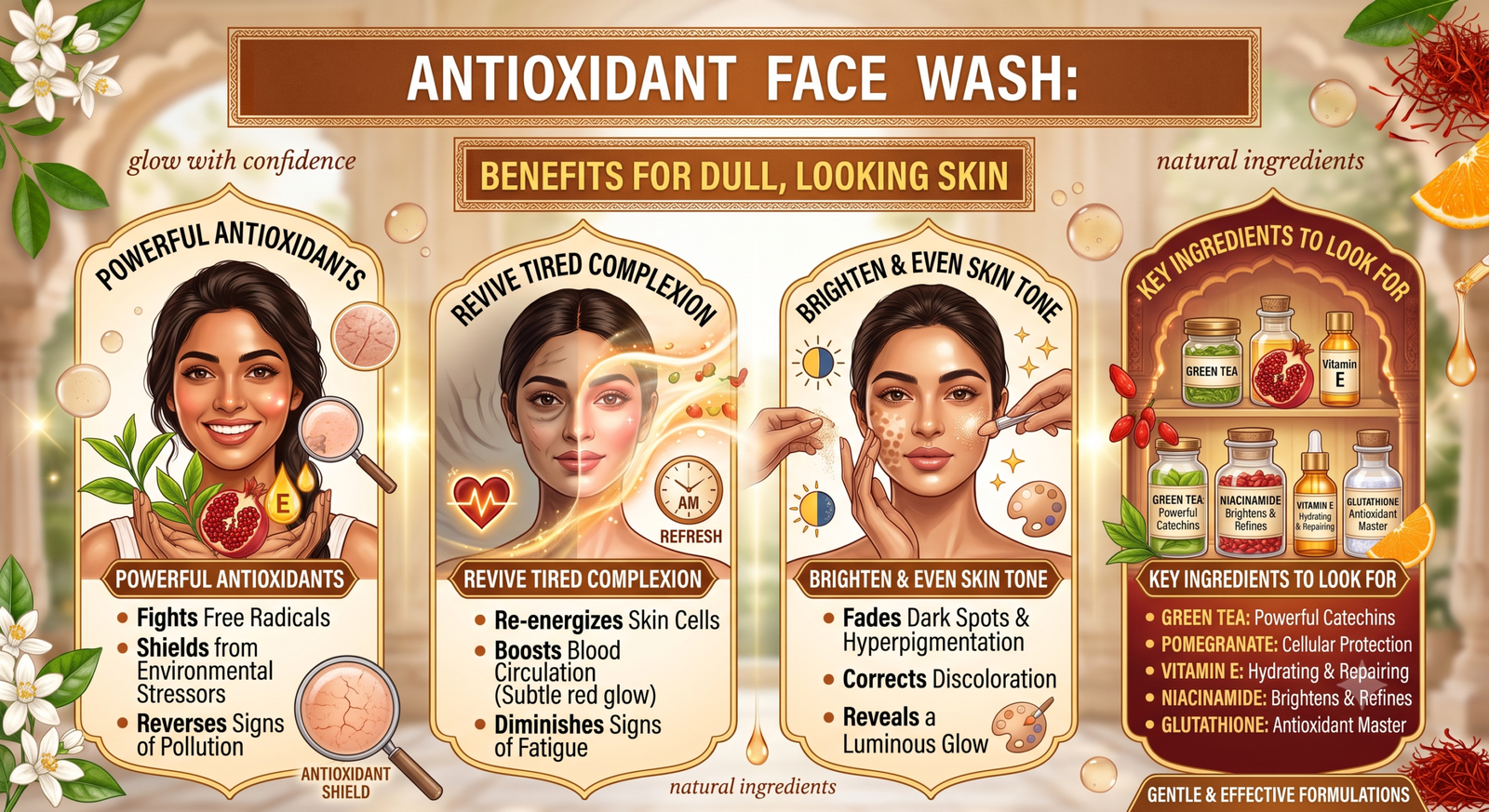
Not every antioxidant ingredient behaves in exactly the same way, and not every formula is suitable for every person. Vitamin C is one of the best-known skincare antioxidants and has been investigated for photoprotection, pigmentation, collagen synthesis, and photoaging. Vitamin E is another commonly discussed antioxidant, and research has examined its role in topical photoprotection and its interaction with vitamin C. Green tea polyphenols and other plant-derived compounds are also used in cosmetic formulations because of their antioxidant properties. The important thing is to evaluate the complete product rather than chasing a single ingredient. A cleanser containing an impressive-sounding antioxidant can still be a poor choice if it is too drying, heavily fragranced, or irritating for your skin. Likewise, a simple formula with a gentle cleansing system may be more useful for everyday use than an aggressive product packed with numerous actives. When shopping, look for clear ingredient information, a formula suited to your skin type, and a product that leaves your skin comfortable after rinsing. Your skin’s response is valuable feedback, so pay attention to persistent burning, excessive dryness, redness, or tightness.
Vitamin C and Its Skin Benefits
Vitamin C has become one of the most recognizable antioxidant ingredients in modern skincare for good reason. Scientific literature describes topical vitamin C as having antioxidant, photoprotective, anti-aging, and antipigmentary applications. Research also indicates that vitamin C can influence collagen synthesis and melanin formation, which helps explain why it appears in products marketed for brighter-looking or more even-toned skin. A systematic review published in 2023 found evidence from seven publications involving 139 volunteers suggesting improvements in uneven, wrinkled skin and pigmentation, while also noting that longer use may be necessary and that more research is needed regarding ideal formulations and concentrations. This is useful context when considering a vitamin C face wash. A cleanser can introduce vitamin C into your routine, but its short contact time means it should not be expected to perform exactly like a leave-on vitamin C serum. Stability is another important consideration because vitamin C formulations can vary considerably. For a person who wants a simple first step, an antioxidant cleanser can still be a convenient way to include antioxidant-focused skincare without immediately building a complicated routine.
Vitamin E, Green Tea, and Other Antioxidants
Vitamin E is frequently paired conceptually with vitamin C because the two antioxidants can work together in topical formulations. Research has examined the photoprotective roles of vitamins C and E and reported enhanced effects when antioxidants are combined under certain conditions. Green tea compounds are another example of plant-derived antioxidants used in cosmetic skincare. Other formulas may include botanical extracts or antioxidant-supporting ingredients selected for their compatibility with particular skin concerns. However, “more antioxidants” does not automatically mean “better skincare.” The concentration, stability, delivery system, cleansing base, pH, preservatives, fragrance, and overall formulation all influence how a product behaves. A person with sensitive skin may prefer a shorter ingredient list and a fragrance-free cleanser, while someone with oily skin may want a lightweight formula that rinses clean without leaving a heavy film. The smartest approach is to focus on what your skin actually needs. Choose a cleanser that provides comfortable daily cleansing first, then consider antioxidant ingredients as an added benefit rather than the only reason to buy it.
Antioxidant Face Wash for Different Skin Types
The ideal antioxidant face wash depends heavily on your skin type. Dry skin generally benefits from a cleanser that removes impurities without creating excessive tightness, while oily skin may prefer a lightweight formula that effectively removes excess sebum. Combination skin often requires a middle ground because the T-zone can be oily while the cheeks feel normal or dry. Sensitive skin requires additional caution because fragrance, strong cleansing agents, or multiple active ingredients may cause discomfort. An antioxidant label does not override these differences. Two people can use the same product and have completely different experiences because their skin barriers, oil production, sensitivities, and existing routines are different. If you are introducing a new antioxidant cleanser, start by using it according to the manufacturer’s directions and observe how your skin responds. If persistent irritation develops, stop using the product and consider professional advice. A good cleanser should make your face feel clean and comfortable, not tight and uncomfortable. In practical terms, choosing the right base formula is often more important than choosing the most fashionable antioxidant ingredient.
For Dry and Dehydrated Skin
Dry and dehydrated skin can look particularly tired because roughness and reduced surface hydration can make the complexion appear less smooth and luminous. For this skin type, the biggest mistake is often over-cleansing. A harsh face wash may remove too much surface oil and leave the skin feeling tight after rinsing. When choosing an antioxidant face wash for dry skin, look for a gentle cleansing formula that prioritizes comfort and supports a consistent moisturizing routine. Ingredients designed to cleanse without excessive stripping may be preferable to very strong surfactant systems. An antioxidant ingredient can be a useful addition, but it should not come at the expense of skin comfort. After cleansing, applying a moisturizer can help support the skin barrier and reduce the uncomfortable feeling associated with dryness. If your skin frequently flakes, stings, or becomes red after washing, consider simplifying your routine rather than adding more active products. Dullness is sometimes a sign that the skin needs better hydration and barrier support rather than stronger cleansing. Think of your cleanser as the opening act, not the entire performance.
Antioxidant Face Wash for Oily and Combination Skin
Oily and combination skin can accumulate sebum, sunscreen, makeup, and environmental residue more quickly, particularly around the forehead, nose, and chin. This can make the complexion appear congested and dull even when the skin is naturally oily. An antioxidant face wash can be useful if it effectively removes excess oil without leaving the skin feeling stripped. The word “deep cleansing,” however, should not automatically mean aggressive cleansing. When a cleanser is too harsh, some people may experience increased discomfort, dryness, or irritation, which can make the overall skin routine harder to maintain. A balanced cleanser should leave the skin clean but not painfully tight. If your main concern is oiliness, look for a lightweight, rinseable formula and avoid piling multiple harsh active products into the same routine without a reason. Antioxidants can complement this approach by addressing the environmental side of skincare, but they do not directly eliminate oil production. If you experience persistent acne, significant inflammation, or painful breakouts, an antioxidant cleanser should not be treated as a substitute for appropriate acne care. The right product is one you can use consistently while keeping the rest of your routine balanced.
Antioxidant Face Wash for Sensitive Skin
Sensitive skin needs a particularly thoughtful approach because the wrong cleanser can create problems that no antioxidant ingredient can compensate for. When choosing a face wash for sensitive skin, consider a gentle cleansing system and be cautious with heavy fragrance, strong exfoliating acids, or numerous active ingredients in one formula. Antioxidants themselves are not automatically irritating, but the complete formulation matters. Even a well-known ingredient can feel uncomfortable if the product is not appropriate for your individual skin. Patch testing a new product can be a sensible precaution, particularly if you have a history of reacting to cosmetics. If you experience persistent redness, burning, swelling, or irritation, discontinue the product and seek medical advice when appropriate. For sensitive skin, consistency usually beats complexity. A basic routine built around gentle cleansing, moisturizer, and daily sun protection can provide a stronger foundation than constantly switching products. An antioxidant face wash can then be introduced when you know your skin tolerates it. The objective is comfortable, healthy-looking skin—not the strongest possible sensation after cleansing.
How to Use an Antioxidant Face Wash Correctly
Using an antioxidant cleanser does not require a complicated technique. Start by wetting your face with lukewarm water, apply an appropriate amount of cleanser, and gently massage it across the face using clean fingertips. Avoid aggressive scrubbing because friction can irritate the skin and does not necessarily produce better cleansing. Rinse thoroughly and pat your face dry with a clean towel rather than rubbing it vigorously. Follow with the next products in your routine, such as moisturizer, and use sunscreen during daytime exposure. The frequency depends on your skin type and the product’s instructions. Many people cleanse twice daily, while some people with dry or sensitive skin may find that a gentler schedule works better. If the cleanser contains additional exfoliating or active ingredients, follow its directions rather than assuming more frequent use will produce faster results. Remember that a cleanser is a rinse-off product. You are not trying to leave it on your skin for several minutes unless the manufacturer specifically instructs you to do so. Gentle, consistent use is generally a better strategy than treating every wash as an intensive treatment.
Morning or Night: When Should You Use It?
Whether you use an antioxidant face wash in the morning, at night, or both depends on your skin and the rest of your routine. Morning cleansing can remove overnight sweat and oil while preparing your skin for moisturizer and sunscreen. Nighttime cleansing is especially useful for removing sunscreen, makeup, pollution, sweat, and the buildup accumulated during the day. For people exposed to substantial environmental pollution or outdoor activity, evening cleansing can be particularly satisfying because it removes the physical residue from the skin’s surface. However, more cleansing is not always better. If your skin becomes tight or irritated when washed twice daily, you may need to adjust the frequency or choose a gentler formula. Antioxidant cleansing should also never create a false sense of security about sun protection. Research into topical antioxidants supports their potential role as an adjunct to photoprotection, but antioxidants are not a replacement for sunscreen. A practical routine might therefore look like gentle antioxidant cleansing, moisturizer, and sunscreen in the morning, followed by cleansing and moisturizer at night.
Antioxidant Face Wash vs Regular Face Wash
The biggest difference between an antioxidant face wash and a basic cleanser is the formulation philosophy rather than the fundamental purpose. Both products are designed primarily to cleanse the skin. An antioxidant cleanser adds ingredients selected for antioxidant properties, potentially giving the product an additional skincare angle. A standard cleanser may focus primarily on removing oil, dirt, makeup, and other impurities while maintaining skin comfort. Neither category is automatically superior for every person. If a regular gentle cleanser keeps your skin comfortable and healthy-looking, there may be no need to replace it simply because another product contains antioxidants. On the other hand, if you want to make your cleansing step more aligned with an antioxidant-focused routine, an appropriate antioxidant face wash can be a convenient option. The distinction becomes especially important when making claims about treatment. Evidence for topical vitamin C’s effects on pigmentation, photoaging, and collagen largely comes from topical formulations that remain on the skin, not necessarily from short-contact face washes. So choose based on the entire formula, your skin’s tolerance, and the role you expect the cleanser to play.
Can It Help With Uneven Skin Tone?
An antioxidant face wash may support a brighter and more even-looking complexion, particularly when dullness is associated with surface buildup and environmental exposure. Certain antioxidants, especially vitamin C, have been studied for their influence on pigmentation. Research reviews describe vitamin C’s potential to decrease melanin formation, while a 2023 systematic review found evidence of lightening in objectively assessed pigmentation in the studies it evaluated. But there is an important distinction between supporting a more even appearance and treating a pigmentation disorder. Persistent melasma, dark patches, post-inflammatory pigmentation, or rapidly changing pigmentation may require professional assessment and targeted treatment. A cleanser alone is unlikely to provide the same effect as a properly formulated leave-on treatment because it is rinsed away relatively quickly. If uneven tone is your primary concern, think of the antioxidant face wash as one supporting product rather than the main treatment. Daily sun protection is particularly important because ultraviolet exposure can contribute to pigmentation and photoaging. A simple routine that combines gentle cleansing, targeted leave-on products when appropriate, moisturizer, and sunscreen is generally more logical than expecting one face wash to solve every pigmentation concern.
Can Antioxidant Cleansing Support Brighter-Looking Skin?
The word “brightening” can be confusing because it is sometimes used to describe several different goals. For some people, it means removing dull surface buildup so the skin looks fresher. For others, it means reducing uneven pigmentation or improving the appearance of photodamage. Antioxidants such as vitamin C have been researched in relation to pigmentation and photoaging, which makes them relevant to brighter-looking skin routines. Still, a face wash should be viewed primarily as a cleansing product. It can help remove the layers that make skin look tired, but it does not permanently change your natural skin tone. This distinction matters because healthy skincare should focus on clarity, comfort, hydration, and even appearance rather than unrealistic promises of dramatic color changes. If your skin looks dull because it is dehydrated, over-exfoliated, or irritated, adding more brightening actives may actually make the situation worse. Start with gentle cleansing and barrier support, then introduce targeted products gradually. Healthy-looking radiance usually comes from several small improvements working together rather than one miracle ingredient.
How to Build a Simple Antioxidant Skincare Routine
A good antioxidant skincare routine does not need to contain ten different products. In the morning, start with a gentle cleanser suited to your skin type, follow with a moisturizer if needed, and finish with broad-spectrum sunscreen. If you use a leave-on antioxidant serum such as vitamin C, it can be placed according to the product’s instructions before moisturizer and sunscreen. At night, cleanse away sunscreen, makeup, sweat, oil, and environmental residue, then use your treatment product if you have one and finish with moisturizer. The goal is to give each product a clear role instead of stacking several products that perform overlapping functions. Research on topical vitamin C suggests that formulation stability and penetration influence effectiveness, so simply choosing multiple products containing vitamin C does not necessarily improve results. Give your routine time to work and introduce new products one at a time whenever possible. If your skin suddenly becomes irritated, you will then have a better idea of which product may be responsible. The best routine is the one that fits your skin, your lifestyle, and your ability to follow it consistently.
Common Mistakes to Avoid
One common mistake is assuming that stronger cleansing produces brighter skin. Scrubbing aggressively or washing repeatedly can compromise comfort and potentially make the skin feel dry and irritated. Another mistake is choosing a product solely because it contains a trendy antioxidant while ignoring the rest of the formulation. A third is expecting an antioxidant face wash to replace sunscreen or a targeted treatment. Antioxidants can complement photoprotection, but research does not support treating a cleanser as a complete substitute for sun protection. People also sometimes introduce several active products at once, making it difficult to identify the cause if irritation develops. A better approach is gradual: choose one cleanser, use it consistently, and monitor your skin. Avoid comparing your results with edited social media images or unrealistic claims about instant transformation. Skin changes take time, and even published research on topical vitamin C indicates that longer use may be necessary for noticeable improvements in some outcomes. Good skincare is less like flipping a switch and more like maintaining a garden: consistent care matters more than one dramatic intervention.
What Results Should You Expect?
The first result you may notice from a suitable antioxidant face wash is simply cleaner, fresher-feeling skin. Depending on the formula and your skin’s starting condition, the complexion may appear less greasy or less weighed down by surface buildup. Over a longer period, the overall skincare routine may help your skin look more consistently healthy and maintained. However, major changes in pigmentation, wrinkles, or photoaging should not be expected from a rinse-off cleanser alone. Studies of topical vitamin C have reported potential improvements in pigmentation and signs of photoaging, but the evidence also indicates that formulation and treatment duration matter. If your primary concern is persistent dullness, consider whether dehydration, excessive exfoliation, lack of sun protection, or another skincare issue may be contributing. Results should also be judged by comfort: if your face feels increasingly dry, itchy, burning, or irritated, the product is not serving your routine well. The right cleanser should support your skincare goals without creating a new problem. Give a routine enough time to evaluate, but do not continue a product that repeatedly causes irritation simply because its label promises impressive results.
Who Should Consider an Antioxidant Face Wash?
An antioxidant face wash may appeal to people who want a simple way to combine effective cleansing with antioxidant-focused skincare. It can be particularly interesting for people who spend considerable time outdoors, live in urban environments, wear sunscreen or makeup regularly, or simply want their cleanser to include more skincare-oriented ingredients. It may also be useful for someone who frequently feels that their complexion looks tired after a long day. That said, not everyone needs an antioxidant cleanser. If your current gentle cleanser works well and your skin is comfortable, changing products is not mandatory. Your skincare priorities should guide your choice. Someone with dry skin may prioritize a creamy, non-stripping cleanser, while someone with oily skin may prefer a lightweight gel formula. Someone with sensitive skin may place fragrance-free and minimal formulations above antioxidant variety. The most useful product is therefore not necessarily the one with the longest ingredient list. It is the one that cleans effectively, suits your skin, and fits comfortably into a routine you can maintain.
Conclusion
An antioxidant face wash can be a practical addition to a skincare routine when dull, tired-looking skin is one of your concerns. Its primary job remains cleansing, but antioxidant ingredients such as vitamin C, vitamin E, and botanical compounds can add an extra layer of skincare value. Research has established strong interest in topical antioxidants, particularly vitamin C, for their potential antioxidant, photoprotective, pigmentation-related, and photoaging benefits. At the same time, the evidence also shows why expectations should remain realistic: formulation, stability, concentration, delivery, and contact time all influence what a product can actually accomplish. A cleanser is only one part of the picture. For healthier-looking skin, combine appropriate cleansing with moisturization, daily sun protection, and targeted products when necessary. If persistent pigmentation, irritation, severe dryness, or other skin concerns continue despite a simple routine, professional dermatological guidance can help identify the underlying issue. Ultimately, the best approach is not about chasing the strongest product; it is about building a routine that keeps your skin clean, comfortable, protected, and consistently cared for.
Frequently Asked Questions
1. Is an antioxidant face wash good for dull skin?
An antioxidant face wash can be useful for dull-looking skin because it helps remove oil, sweat, pollutants, sunscreen residue, makeup, and other surface buildup while incorporating antioxidant-oriented ingredients. However, it should not be expected to dramatically transform pigmentation or photoaging by itself. Vitamin C has been studied extensively for topical antioxidant and pigmentation-related benefits, but much of the stronger evidence concerns leave-on formulations rather than rinse-off cleansers. For best results, combine appropriate cleansing with moisturizer and daily sun protection.
2. Can I use an antioxidant face wash every day?
Many antioxidant face washes are designed for regular daily cleansing, but the correct frequency depends on the specific formula and your skin type. If your skin feels comfortable after washing, the product is likely fitting reasonably well into your routine. If you experience persistent tightness, dryness, burning, or irritation, reduce use or switch to a gentler formula. Always follow the manufacturer’s directions, especially if the cleanser also contains exfoliating acids or other active ingredients.
3. Is vitamin C face wash better than a normal face wash?
There is no universal answer because the best cleanser depends on your skin type and the complete formulation. A vitamin C face wash provides the potential advantage of incorporating an antioxidant ingredient into the cleansing step, but a gentle conventional cleanser may be more suitable for someone with sensitive or dry skin. Vitamin C research supports several topical applications, although formulation stability and skin penetration are important factors. Choose the product that cleans effectively without making your skin uncomfortable.
4. Can an antioxidant face wash remove dark spots?
An antioxidant cleanser should not be considered a primary treatment for dark spots. Vitamin C has demonstrated pigmentation-related potential in topical research, including evidence of lightening in some clinical studies, but a rinse-off cleanser has limited contact time with the skin. Persistent dark spots may require a more targeted skincare routine and, depending on the cause, professional assessment. Daily sunscreen is also important because ultraviolet exposure can contribute to pigmentation.
5. Should I use sunscreen with an antioxidant face wash?
Yes. An antioxidant face wash does not replace sunscreen. Research suggests topical antioxidants may complement photoprotection, but sunscreen remains an important part of protecting skin from ultraviolet exposure. A simple daytime routine can include cleansing, moisturizer when needed, and broad-spectrum sunscreen. If you use a leave-on antioxidant product, follow its directions and continue using sunscreen consistently.
🔍 Want to find the best keywords and rank this article faster? Try the #1 SEO & AI visibility toolkit free for 14 Days. Track your keyword rankings, audit your site, and monitor your AI search visibility on ChatGPT, Gemini & Google AI Overviews
✨ Get better articles, faster. This prompt is powerful. But Pro Article Writer takes it further — AI humanizer, SEO tools, full editor, one-click options, and more control all in one place. Try it free →
If this prompt helped you, please leave a review — it keeps this prompt ranked #1.