
Procapil Hair Serum for Hair Fall: Benefits, Uses and Hair Care Tips
-
Dokmai London
- Posted on
- 0 comments
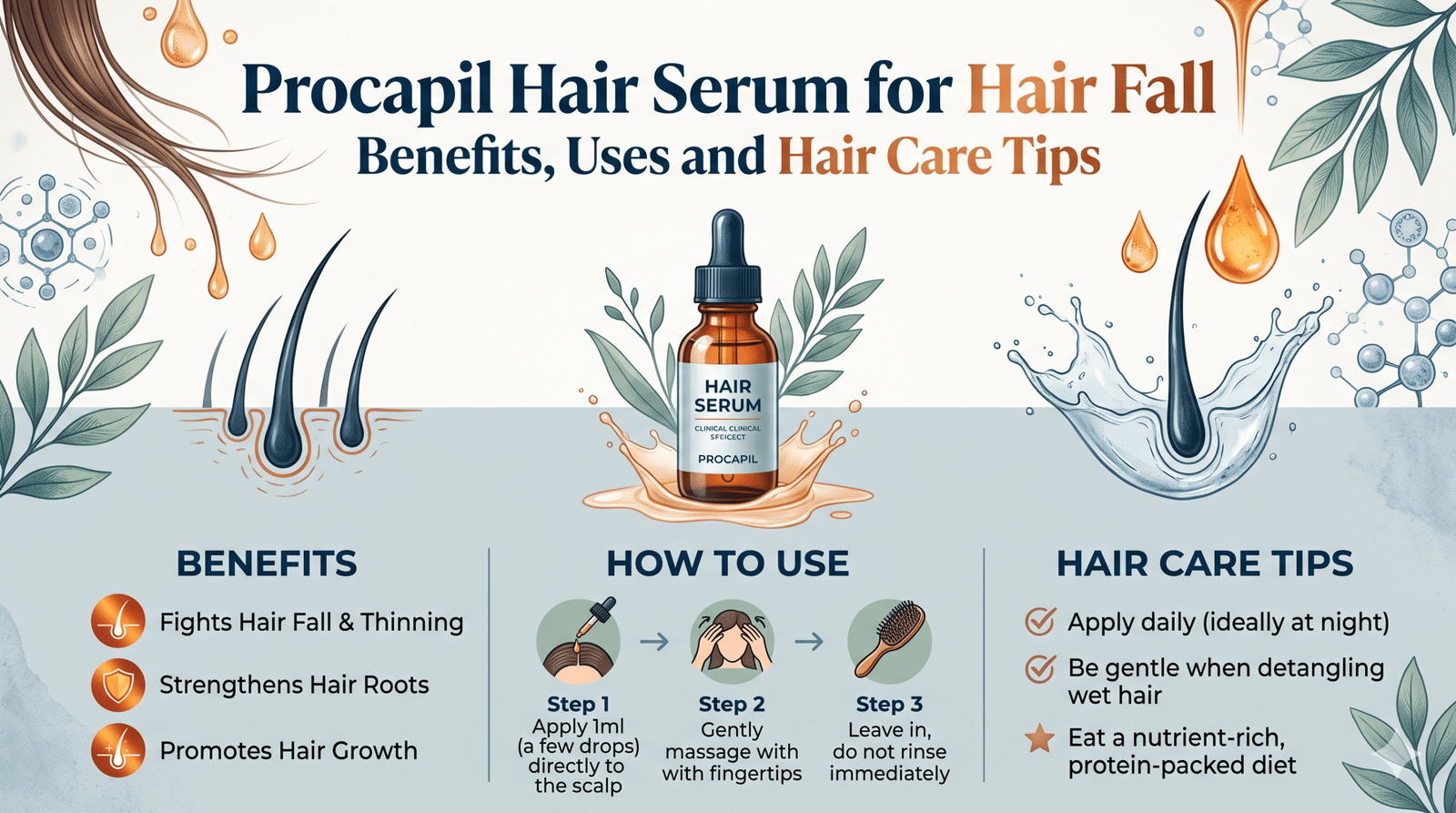
Hair fall is a common hair care concern that can affect hair density, volume, strength, and overall appearance. Factors such as genetics, hormonal changes, nutritional deficiencies, stress, scalp conditions, and improper hair care practices can contribute to excessive shedding. While choosing the right hair care products is an important part of maintaining healthy hair, understanding the ingredients and following a consistent routine can make a meaningful difference.
Procapil Hair Serum is a hair care option formulated around Procapil, an ingredient complex commonly used in products designed to support scalp health and help reduce the appearance of hair thinning. When combined with a balanced diet, gentle scalp care, and appropriate treatment for the underlying cause of hair fall, a suitable hair serum may complement an effective hair care routine.
In this comprehensive guide, we explore the benefits of Procapil hair serum, how to use it, its key ingredients, potential results, and practical hair care tips to help us make informed decisions about managing hair fall.
What Is Procapil Hair Serum?
Procapil hair serum is a topical hair care formulation designed to support the appearance of stronger, fuller-looking hair. It commonly contains Procapil, a cosmetic ingredient complex associated with hair follicle care and scalp-focused formulations.
Procapil is generally described as a combination of three components:
- Biotinoyl Tripeptide-1: A peptide used in cosmetic formulations intended to support the appearance and condition of hair.
- Apigenin: A plant-derived flavonoid included in the complex for its role in cosmetic scalp formulations.
- Oleanolic Acid: A compound derived from plants that is used in formulations targeting factors associated with hair thinning.
These ingredients are combined to create a cosmetic complex intended to support the scalp environment and help maintain healthier-looking hair.
However, it is important to understand that Procapil is not a guaranteed cure for hair loss. The effectiveness of a particular serum depends on its complete formulation, concentration, regular use, and the underlying reason for hair shedding. Evidence supporting cosmetic ingredient complexes is also more limited than the evidence available for certain established medical treatments for specific types of hair loss.
Benefits of Procapil Hair Serum for Hair Fall
A well-formulated hair serum containing Procapil may be a useful addition to a regular hair care routine. Its potential benefits depend on the product formulation and the condition of the scalp and hair.
1. Helps Support Hair Strength
Hair that appears weak, brittle, or fragile may benefit from a hair care routine focused on reducing breakage. A suitable serum can condition the hair and improve its overall feel, depending on its ingredients.
By combining a scalp-focused serum with gentle washing, suitable conditioning, and reduced heat styling, we can help maintain healthier-looking hair and minimise avoidable mechanical damage.
It is important to distinguish between hair breakage and hair shedding. Breakage occurs when the hair shaft snaps, whereas shedding involves hair falling from the follicle. A cosmetic serum may improve hair manageability, but it may not address the cause of either problem in every case.
2. Supports a Healthier Scalp Care Routine
The scalp plays an important role in maintaining healthy hair growth. Excessive oiliness, irritation, dandruff, and certain inflammatory conditions can affect scalp comfort and require appropriate care.
A lightweight hair serum formulated for scalp application may complement a routine designed to keep the scalp comfortable. We should select products according to our scalp type and avoid formulations that cause itching, redness, burning, or irritation.
If persistent itching, scaling, pain, or inflammation develops, a dermatologist can help identify the cause and recommend appropriate treatment.
3. May Help Improve the Appearance of Hair Density
Hair thinning can make the scalp more visible and reduce the appearance of overall hair volume. Some hair serums are marketed to support hair density by targeting factors associated with the hair follicle environment.
However, visible improvements in hair density are not guaranteed, and cosmetic formulations cannot be assumed to reverse genetic hair loss or other medical conditions.
For the best approach, we should identify whether thinning is associated with genetics, nutritional deficiencies, hormonal changes, stress, or another cause before relying on a cosmetic serum alone.
4. Complements a Consistent Hair Care Routine
One of the practical advantages of a leave-on serum is that it can be incorporated into a regular routine without necessarily requiring additional washing.
Depending on the product instructions, we may apply the serum to the scalp after cleansing or as part of our daily hair care schedule.
Consistency helps us evaluate whether a product suits our scalp and hair. Nevertheless, applying more serum than recommended will not necessarily improve results and may increase the risk of irritation or unwanted residue.
5. May Support the Appearance of Stronger, Fuller Hair
The overall appearance of hair depends on several factors, including hair shaft condition, styling practices, scalp health, and natural hair density.
When a serum is used alongside suitable conditioning, gentle detangling, and reduced heat exposure, it may contribute to a routine that helps hair look healthier and more manageable.
We should remember that healthy-looking hair and medically improved hair growth are not the same thing. Cosmetic benefits should not be confused with proof that a product can regrow hair or prevent every type of hair loss.
How to Use Procapil Hair Serum Correctly
Correct application helps us incorporate a serum into our routine while reducing the possibility of scalp irritation or product buildup.
Step 1: Read the Product Instructions
Before applying Procapil hair serum, we should check the product label for its recommended quantity, frequency, application method, and precautions.
Different formulations may contain different ingredients and concentrations, so one product’s instructions should not automatically be applied to another.
Step 2: Prepare the Scalp
A clean scalp can make serum application easier. If the product instructions recommend applying it after washing, we should gently cleanse the scalp with a suitable shampoo and allow the hair to become towel-dried or dry as directed.
Avoid vigorous rubbing, excessive scratching, or aggressive brushing, especially when the scalp is sensitive.
Step 3: Apply the Serum to the Scalp
Part the hair into sections to expose the areas where application is needed. Apply the recommended quantity directly to the scalp rather than concentrating the product only on the lengths of the hair.
For products intended specifically for scalp use, applying the serum to the correct area is important.
Step 4: Massage Gently if Recommended
If the label permits, use your fingertips to spread the serum gently across the scalp. Avoid forceful massage, scratching, or pulling the hair.
Gentle application is generally preferable to vigorous rubbing, which can contribute to irritation and breakage.
Step 5: Follow the Recommended Frequency
Some serums are intended for daily use, while others have different application instructions. Follow the directions provided for the specific formulation.
Do not apply extra product in an attempt to accelerate hair growth. If irritation occurs, stop using the product and seek advice if symptoms persist.
Step 6: Maintain a Consistent Routine
Hair changes take time to assess, and normal shedding can fluctuate from week to week. We should evaluate our hair care routine over an appropriate period rather than expecting overnight results.
If hair loss continues, becomes more pronounced, or develops into visible patches, professional assessment is more useful than repeatedly switching between cosmetic products.
When Can We Expect Results from Procapil Hair Serum?
The time required to notice a difference depends on the cause of hair loss, the formulation, the condition of the scalp, and whether the product provides meaningful benefits for the individual.
Some cosmetic effects, such as improved hair feel or manageability, may be noticed relatively quickly. Changes in hair density or shedding, however, are more complex and cannot be predicted reliably for every user.
There is no scientifically established universal timeline for visible hair regrowth from Procapil hair serum.
A few practical guidelines can help us evaluate a product more objectively:
- Follow the manufacturer’s recommended application schedule.
- Take occasional photographs under similar lighting conditions to assess visible changes.
- Monitor scalp irritation, dryness, or other unwanted effects.
- Avoid combining multiple new scalp products at the same time if doing so makes reactions difficult to identify.
- Seek medical advice if hair loss is persistent, sudden, severe, or accompanied by scalp symptoms.
We should not assume that a reduction in shedding automatically means new hair growth, or that a product will work for everyone.
Who Can Consider Using Procapil Hair Serum?
Procapil hair serum may be considered by adults looking for a cosmetic product to complement their hair care routine, provided the formulation is suitable for their scalp and they follow its instructions.
It may be of interest to people concerned about:
- Hair that appears thinner than before.
- Weak or fragile-looking hair.
- A desire to maintain a consistent scalp care routine.
- Hair that lacks its usual volume.
- Preventable damage associated with rough styling practices.
However, the suitability of the serum depends on the individual’s circumstances.
People experiencing sudden or unexplained hair loss should not rely solely on cosmetic products. Those with persistent scalp irritation, existing scalp disease, or a known sensitivity to an ingredient should consult an appropriate healthcare professional before use.
Pregnant or breastfeeding individuals should seek professional advice if they are uncertain about the safety of a particular formulation.
Possible Side Effects and Precautions
Although many cosmetic hair serums are designed for topical use, individual ingredients can cause irritation or allergic reactions.
Possible unwanted effects include:
- Redness or itching.
- Burning or stinging sensations.
- Dryness or irritation.
- Allergic contact reactions.
- Product buildup or an uncomfortable scalp feel.
To reduce the risk of problems, we should read the ingredient list carefully and follow the product instructions.
A small-area test may help identify some immediate reactions, although it cannot guarantee that an allergic reaction will not develop later. Avoid applying the serum to broken or inflamed skin unless a healthcare professional advises otherwise.
If significant irritation develops, discontinue use. Seek medical advice for persistent symptoms, swelling, or a severe reaction.
Procapil Hair Serum vs. Hair Oil: What Is the Difference?
Hair serum and hair oil can serve different purposes, depending on their formulation.
| Feature | Procapil Hair Serum | Hair Oil |
|---|---|---|
| Main purpose | Often formulated for targeted scalp care | Commonly used for lubrication and conditioning |
| Typical texture | Often lightweight, depending on the formula | Usually oil-based and richer |
| Application | May be applied directly to the scalp | Often applied to the lengths, scalp, or both |
| Hair appearance | May complement a routine for thinning concerns | May improve softness, shine, and manageability |
| Hair regrowth | Not guaranteed | Not guaranteed |
| Washing | Depends on product instructions | Some oils are washed out after use |
A serum is not automatically better than an oil, and an oil is not automatically better than a serum. The right choice depends on the hair concern, scalp type, ingredient composition, and intended use.
For example, someone experiencing dry hair lengths may benefit from a conditioning oil, while someone seeking a targeted scalp product may prefer a serum designed for that purpose.
Neither product should be considered a substitute for medical evaluation when hair loss is persistent or unexplained.
Essential Hair Care Tips to Help Manage Hair Fall
Using a hair serum is only one part of a comprehensive hair care routine. Our everyday habits can influence hair breakage, scalp comfort, and the overall appearance of hair.
1. Choose the Right Shampoo
A suitable shampoo should clean the scalp without causing excessive dryness or irritation. People with oily scalps may need more frequent washing, while those with dry or textured hair may benefit from a different washing schedule.
We should choose a shampoo according to our scalp needs rather than assuming that a particular ingredient or premium product will work for everyone.
2. Use Conditioner to Reduce Breakage
Conditioner helps improve hair smoothness, reduce friction, and make detangling easier. Apply it primarily to the lengths and ends unless the product is specifically formulated for scalp use.
Reducing friction during brushing can help minimise avoidable hair breakage.
3. Avoid Excessive Heat Styling
Frequent use of straighteners, curling irons, and high-temperature blow-dryers can damage the hair shaft.
To protect hair quality, use moderate temperatures, avoid repeated passes over the same section, and consider a heat-protectant product when styling.
4. Avoid Tight Hairstyles
Repeatedly wearing very tight ponytails, braids, or other styles that pull on the hair can contribute to traction alopecia, a form of hair loss caused by sustained tension.
Choose comfortable hairstyles and avoid prolonged pulling around the hairline.
5. Maintain a Balanced Diet
Hair growth requires adequate energy, protein, and essential nutrients. A balanced diet that includes appropriate sources of protein, iron, zinc, and other nutrients supports general health and normal hair growth.
However, supplements should not be taken indiscriminately. Excessive intake of certain nutrients can be harmful, and supplementation is most useful when a deficiency or specific need has been identified.
6. Manage Stress and Sleep Well
Physical or emotional stress can contribute to a temporary increase in hair shedding in some individuals. Major illness, surgery, rapid weight loss, and other physical stressors may also trigger shedding.
Regular sleep, physical activity, stress-management practices, and adequate nutrition can support general well-being, although they do not replace treatment for an underlying hair disorder.
7. Recognise When Professional Help Is Needed
Hair loss may be associated with genetic factors, thyroid disorders, iron deficiency, medication effects, hormonal changes, or scalp conditions.
We should seek a dermatologist’s assessment if we notice:
- Sudden or excessive shedding.
- Bald patches or a widening part.
- Progressive thinning around the crown or hairline.
- Scalp pain, redness, scaling, or persistent itching.
- Hair loss accompanied by other unexplained symptoms.
Identifying the underlying cause is often the most important step in choosing an effective treatment.
Can Procapil Hair Serum Stop Hair Fall Permanently?
No cosmetic serum can guarantee permanent prevention of hair fall.
Hair shedding is a normal part of the hair growth cycle, and the amount of shedding can change over time. When hair loss is associated with genetic pattern hair loss, an underlying medical condition, or nutritional deficiencies, treatment needs to address the relevant cause.
Procapil is used in cosmetic formulations marketed for hair thinning, but claims of permanent results or guaranteed regrowth should be evaluated carefully. Evidence for the specific finished product matters, and ingredient marketing alone does not establish clinical effectiveness.
If hair loss is caused by a treatable deficiency or a medical condition, appropriate treatment may be more important than selecting a particular serum.
For androgenetic alopecia, a dermatologist may discuss evidence-based options such as topical minoxidil, where appropriate. Treatment suitability depends on age, sex, medical history, and the pattern of hair loss.
Frequently Asked Questions About Procapil Hair Serum
1. Is Procapil hair serum good for hair fall?
Procapil hair serum may complement a hair care routine for people concerned about thinning. However, its effectiveness depends on the complete formulation and the cause of hair loss. It should not be considered a guaranteed treatment for excessive shedding or genetic hair loss.
2. Can we use Procapil hair serum every day?
Daily use depends on the instructions for the specific product. Some formulations may be designed for frequent application, while others may recommend a different schedule. We should always follow the label rather than assuming that daily use is appropriate for every serum.
3. Should we apply Procapil hair serum to wet or dry hair?
The correct application method depends on the formulation. Some products recommend application to a clean, dry scalp, while others may allow application to towel-dried hair. Always follow the manufacturer’s directions.
4. Can Procapil hair serum regrow lost hair?
Hair regrowth is not guaranteed. Although Procapil is marketed in products designed for thinning concerns, evidence does not establish that every Procapil-containing serum can regrow lost hair. The cause of hair loss and the effectiveness of the finished formulation are important factors.
5. Is Procapil hair serum suitable for men and women?
Suitability depends on the specific product and its instructions. Some formulations are marketed for both men and women, but individuals with persistent hair loss should seek professional advice to identify the cause and determine appropriate treatment.
6. Can we use hair oil and Procapil hair serum together?
Possibly, provided both products are suitable for the scalp and their instructions allow it. The order of application and compatibility depend on the formulation. Applying several products at once may also cause buildup or make irritation harder to identify.
7. Does Procapil hair serum have any side effects?
Some users may experience irritation, itching, redness, dryness, or allergic reactions. Review the ingredient list, follow the instructions, and discontinue use if significant irritation occurs.
8. Is Procapil hair serum better than biotin shampoo?
The products serve different purposes and cannot be compared by ingredient name alone. A serum is a leave-on product, while a shampoo is rinsed off. Their overall benefits depend on the finished formulation, how it is used, and the particular hair concern.
Conclusion: Make Procapil Hair Serum Part of a Smarter Hair Care Routine
Procapil hair serum can be considered as part of a consistent hair care routine for people concerned about thinning and the appearance of hair density. Its potential benefits depend on the complete formulation, individual scalp condition, and the underlying cause of hair loss.
For a more effective approach, we should combine appropriate scalp care with gentle washing, conditioning, reduced heat exposure, a balanced diet, and professional guidance when necessary.
Most importantly, we should choose hair care products based on realistic expectations rather than promises of instant or permanent results. Persistent, sudden, or unexplained hair loss deserves proper evaluation so that the underlying cause can be identified and treated appropriately.
By understanding the role of Procapil hair serum and maintaining healthy hair care habits, we can make more informed decisions about supporting the appearance, condition, and manageability of our hair.