
Nanoplastia vs Keratin vs Smoothening: Which Hair Treatment Is Really Best for Frizzy, Damaged Hair?
-
Dokmai London
- Posted on
- 0 comments
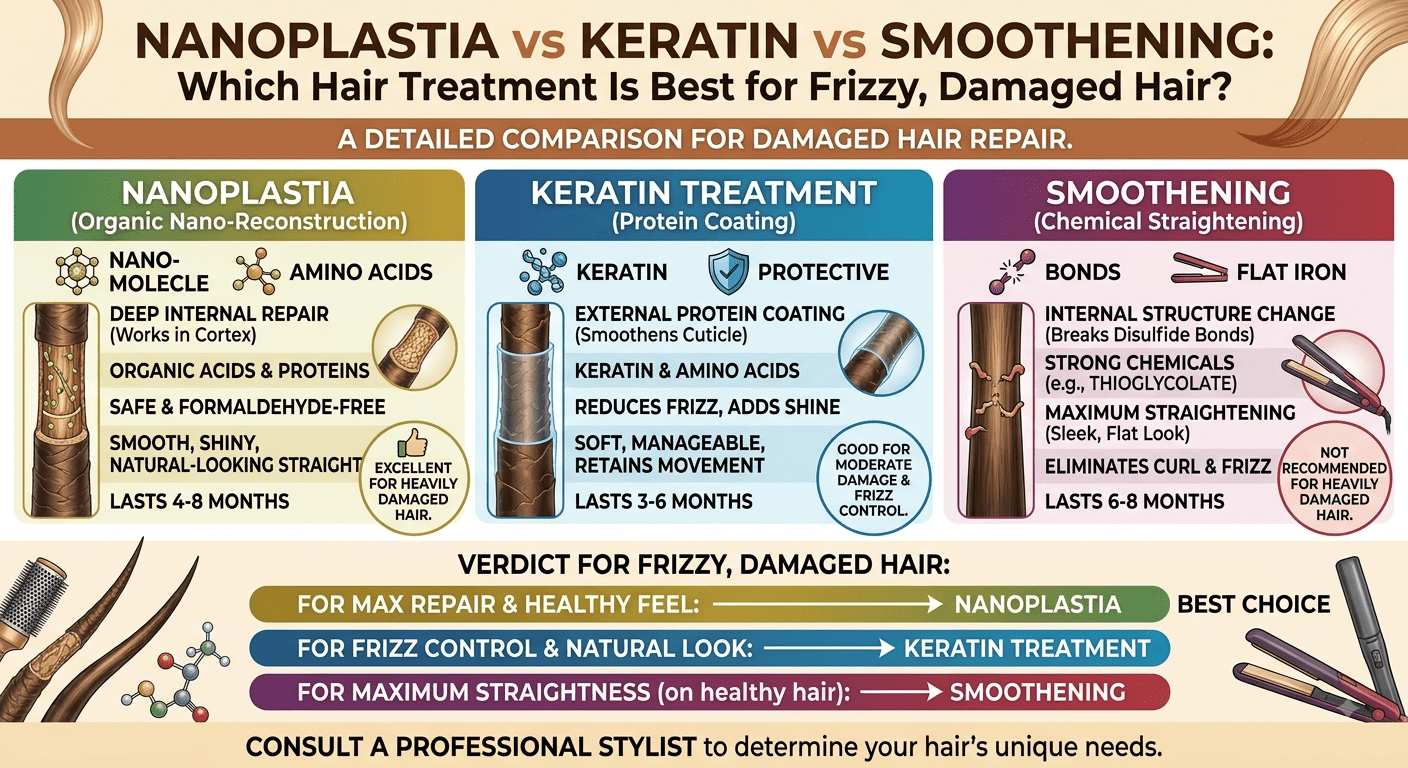
Nanoplastia vs Keratin vs Smoothening: Which Hair Treatment Is Really Best for Frizzy, Damaged Hair?
Frizzy, rough, dry, and unmanageable hair can make everyday styling frustrating. When hair loses its natural moisture and becomes difficult to manage, professional hair treatments such as Nanoplastia, Keratin Treatment, and Hair Smoothening can offer a noticeable transformation. However, these treatments are not identical. They differ in formulation, results, longevity, maintenance, and suitability for different hair types.
For anyone wondering which is better: Nanoplastia, Keratin, or Smoothening, the right answer depends on the current condition of the hair, the desired finish, and how much straightening or frizz control is required.
In this detailed comparison, we will examine all three treatments so we can understand which option may work best for frizzy, damaged, dry, curly, wavy, or chemically treated hair.
What Is Nanoplastia Hair Treatment?
Nanoplastia is an advanced professional hair-smoothing treatment designed primarily to reduce frizz, improve manageability, enhance shine, and create a smoother appearance. It uses specialized formulations that work through the hair fiber to improve its overall cosmetic appearance and smoothness.
Unlike traditional straightening approaches, Nanoplastia is generally positioned as a treatment focused on smoothness, conditioning, frizz reduction, and a sleek finish rather than simply forcing the hair into a permanently straight shape.
One of the major reasons people choose Nanoplastia is its ability to provide a polished, glossy appearance while helping make difficult-to-manage hair easier to style.
Benefits of Nanoplastia
- Helps reduce excessive frizz
- Creates smoother-looking hair
- Improves shine and softness
- Makes hair easier to manage
- Can make blow-drying and styling easier
- Provides a sleek, polished appearance
- Suitable for many wavy, curly, coarse, and frizzy hair types when professionally assessed
The final result depends heavily on the hair’s existing condition, texture, porosity, and the professional technique used.
What Is a Keratin Hair Treatment?
A Keratin Treatment is a professional smoothing service designed to reduce frizz and make hair appear smoother, shinier, and more manageable. Keratin is a structural protein naturally associated with hair, and professional formulations may contain conditioning and smoothing ingredients alongside keratin or keratin-derived components.
The treatment is particularly popular among people who want frizz control without necessarily wanting extremely straight hair.
Depending on the formulation and application technique, a keratin service can soften waves and curls while leaving the hair with a smoother and more polished finish.
Benefits of Keratin Treatment
- Reduces frizz
- Improves smoothness
- Enhances shine
- Makes hair easier to comb and style
- Can reduce styling time
- Helps create a more polished finish
- Can be useful for coarse or unruly hair
The exact result varies according to the product used and the natural texture of the hair.
What Is Hair Smoothening?
Hair Smoothening is a broad term used for professional chemical or heat-assisted services intended to make hair smoother, less frizzy, and easier to manage.
Depending on the salon and product system, smoothening may involve different formulations and techniques. The result can range from significantly reduced frizz and softer waves to a considerably straighter appearance.
Smoothening is often selected by people who want a sleeker, straighter-looking hairstyle and reduced daily styling effort.
However, because different smoothening systems use different ingredients and processing methods, it is important to have the hair evaluated by a trained professional before choosing the service.
Nanoplastia vs Keratin vs Smoothening: Key Differences
| Feature | Nanoplastia | Keratin | Smoothening |
|---|---|---|---|
| Main objective | Smoothing, shine & frizz control | Frizz reduction & manageability | Smoother, straighter appearance |
| Finish | Smooth and glossy | Smooth and natural-looking | Sleek to straighter |
| Frizz control | High | High | High |
| Straightening effect | Moderate to high depending on hair | Moderate depending on formulation | Moderate to high |
| Suitable for damaged hair | Depends on condition | Depends on condition | Requires careful assessment |
| Styling convenience | Excellent | Excellent | Excellent |
| Result | Depends on hair texture and formulation | Depends on hair texture and formulation | Depends strongly on system used |
| Professional consultation | Recommended | Recommended | Essential |
Nanoplastia vs Keratin: Which Is Better?
When comparing Nanoplastia vs Keratin, we should first consider the desired result.
If the primary concern is frizz, dryness, rough texture, lack of shine, and difficult styling, Nanoplastia can be an attractive option because the service is designed around creating a smoother and more polished appearance.
Keratin may be preferable for someone who wants frizz reduction, softness, shine, and improved manageability while maintaining more of their natural movement.
Neither treatment is automatically better for everyone. Hair thickness, curl pattern, previous chemical services, color history, porosity, and damage level all influence the outcome.
Nanoplastia vs Smoothening: Which Should We Choose?
The difference becomes more important when the goal is straightness.
People who want a sleek, smoother appearance with strong frizz control may consider Nanoplastia. Those specifically looking for a more traditional straightened appearance may consider a smoothening service.
However, the term “smoothening” covers many different salon systems. Therefore, we should not judge a treatment solely by its name. The formulation, application technique, processing time, heat application, and condition of the hair are equally important.
For hair that is already highly porous or damaged, aggressive processing may not be appropriate.
Keratin vs Smoothening: Which Is Best for Frizzy Hair?
For people whose biggest concern is frizz rather than straightness, Keratin can be an appealing choice.
Keratin treatments are commonly chosen to make hair smoother and easier to manage while reducing the appearance of frizz. Smoothening may be more suitable when the desired look is noticeably straighter.
The best choice depends on whether we want:
- Natural-looking smoothness
- Maximum frizz control
- Reduced curl or wave
- A straighter appearance
- Improved shine
- Easier everyday styling
A professional consultation can help determine which objective is realistic for the current hair condition.
Which Treatment Is Best for Damaged Hair?
This is one of the most important questions.
If the hair is severely damaged, excessively bleached, breaking, or extremely porous, no chemical smoothing treatment should automatically be considered safe simply because it is marketed as a “repair” or “treatment.”
Damaged hair needs careful assessment first.
A professional should examine:
- Hair elasticity
- Porosity
- Previous chemical treatments
- Bleaching history
- Hair color history
- Split ends
- Breakage
- Scalp condition
- Overall strength of the hair fiber
In some cases, the better approach is to improve the hair’s condition first through appropriate conditioning and professional care before considering a smoothing service.
Which Treatment Lasts the Longest?
The longevity of Nanoplastia, Keratin, and Smoothening varies considerably.
Results depend on:
- Hair growth
- Washing frequency
- Shampoo formulation
- Water quality
- Heat styling
- Hair texture
- Product formulation
- Aftercare routine
- Professional application
Instead of assuming that one treatment always lasts the longest, we should focus on choosing the right service and maintaining it correctly.
Aftercare for Nanoplastia, Keratin, and Smoothening
Professional results can be affected by poor aftercare. We can help extend the appearance of smoothness by following a suitable routine.
1. Use a Suitable Shampoo
A professional may recommend a shampoo appropriate for chemically treated or smoothed hair. Avoid constantly switching between harsh cleansing products without professional guidance.
2. Condition Regularly
Conditioning helps maintain softness and manageability. A suitable conditioner or mask can be particularly useful for dry or coarse hair.
3. Reduce Excessive Heat
Although smooth hair may be easier to style, excessive heat can still contribute to dryness and breakage. Use appropriate heat protection whenever heat styling is necessary.
4. Protect the Hair from Environmental Stress
Sun exposure, pollution, humidity, and frequent swimming can affect the cosmetic appearance of treated hair.
5. Schedule Professional Maintenance
Regular salon consultations can help us decide when additional treatment is actually necessary rather than repeatedly processing the entire length of the hair.
Can Nanoplastia Be Done on Colored or Chemically Treated Hair?
In some cases, yes, but hair history matters.
Colored, highlighted, bleached, rebonded, permed, or previously smoothed hair may respond differently to a new treatment. The professional should assess the hair before applying another chemical service.
A strand or compatibility test may also be appropriate depending on the product system and hair condition.
This is particularly important for highly processed hair because excessive chemical and heat exposure can increase the risk of dryness and breakage.
Is Nanoplastia Better Than Keratin for Curly Hair?
There is no universal answer.
For curly hair, the most important question is whether we want to retain some natural curl or significantly reduce it.
If the goal is smoother, more manageable curls with reduced frizz, a smoothing-focused treatment may be considered.
If the goal is a much straighter appearance, a different professional straightening system may be more appropriate.
The natural curl pattern, hair density, porosity, and previous chemical history should always be considered before selecting the treatment.
Is Smoothening Good for Frizzy Hair?
Smoothening can be effective for reducing the appearance of frizz and making hair easier to manage. However, the outcome depends on the specific product and technique.
Frizz can be caused by dryness, humidity, damaged cuticles, natural texture, and lack of moisture. Simply making the hair straighter does not necessarily address every underlying contributor to frizz.
This is why professional diagnosis is more valuable than choosing a service based solely on its name.
Nanoplastia, Keratin or Smoothening: Which One Should We Choose?
We can simplify the decision:
Choose Nanoplastia when the priority is a smooth, glossy, manageable finish with strong frizz control and a polished appearance.
Choose Keratin when the priority is reducing frizz, improving softness and shine, and making everyday styling easier.
Choose Smoothening when the priority is a more noticeably sleek or straight appearance, provided the hair is suitable for the selected system.
There is no single treatment that is best for every person.
Professional Consultation Is the Most Important Step
Before choosing Nanoplastia vs Keratin vs Smoothening, we should avoid making a decision based only on social media before-and-after photographs.
Two people with apparently similar hair can respond very differently because their hair may have different porosity, elasticity, chemical history, density, and damage levels.
A professional consultation allows the stylist to understand the hair’s condition and recommend a service according to the desired result in Ns4 Salon.
Final Verdict: Nanoplastia vs Keratin vs Smoothening
When comparing Nanoplastia, Keratin, and Smoothening, the best treatment is ultimately the one that matches the hair’s condition and the desired finish.
For frizzy, rough, and difficult-to-manage hair, Nanoplastia can provide a sleek, glossy, manageable appearance. Keratin is a popular choice for frizz control, softness, shine, and easier styling, while smoothening may be preferred by those looking for a straighter, sleeker finish.
For damaged hair, the priority should always be hair assessment and responsible professional treatment rather than choosing the strongest available service.
The smartest approach is to discuss the desired result with a qualified stylist, evaluate the hair’s condition, understand the treatment formulation being used, and follow the recommended aftercare routine. With the right treatment and professional application, we can achieve hair that looks smoother, shinier, healthier, and significantly easier to manage.
Frequently Asked Questions
Is Nanoplastia better than Keratin?
Nanoplastia is not universally better than Keratin. Nanoplastia may be preferred for a polished, smooth, glossy finish, while Keratin can be a good choice for frizz control and manageability. The right option depends on the hair and desired result.
Which is better for damaged hair: Nanoplastia or Keratin?
Neither should automatically be considered the best for severely damaged hair. Hair condition should be professionally assessed first. Highly damaged or bleached hair may require restorative care before another chemical smoothing service.
Which treatment gives straighter hair?
The result depends on the specific formulation and technique. Traditional smoothening systems can produce a more noticeably straight appearance, while Nanoplastia and Keratin are often selected for smoothing and frizz reduction.
Does Nanoplastia remove frizz?
Nanoplastia is designed to significantly improve smoothness and reduce the appearance of frizz. The degree of frizz reduction varies according to hair texture, condition, formulation, and professional application.
How do we maintain Nanoplastia results?
Using suitable hair-care products, conditioning regularly, limiting excessive heat, protecting the hair from environmental stress, and following professional aftercare recommendations can help maintain the appearance of smoothness.
Can we color hair after a smoothing treatment?
Coloring should be planned carefully around a smoothing service because combining chemical processes too closely can increase stress on the hair. A professional stylist can recommend the appropriate sequence and timing based on the hair’s condition.
Which treatment is best for extremely frizzy hair?
Nanoplastia, Keratin, or Smoothening may all help reduce frizz, but the best option depends on whether the goal is primarily frizz control, smoothness, or straightness. Professional hair assessment is recommended before treatment.
Is Nanoplastia suitable for all hair types?
Nanoplastia may be suitable for many hair textures, but not every hair condition is appropriate for chemical or heat-assisted smoothing. A professional consultation is important, particularly for severely damaged, bleached, or heavily processed hair.
What is the main difference between Keratin and Smoothening?
Keratin treatments are commonly focused on frizz reduction, smoothness, shine, and manageability, while smoothening is a broader category of services that can be designed to create a more noticeably sleek or straight appearance. Exact results depend on the formulation used.