
Face Wash vs Cleanser: Which One Is Better for Your Skin?
-
Dokmai London
- Posted on
- 0 comments
Choosing the right skincare products is essential for maintaining healthy, clear, and glowing skin. However, when it comes to daily skincare, one common question confuses many people: Face Wash vs Cleanser – Which One Is Better for Your Skin?
Both face washes and facial cleansers are designed to remove impurities, excess oil, dirt, and environmental pollutants from the skin. Although they serve a similar purpose, their formulations, textures, cleansing properties, and suitability for different skin types can vary significantly.
Some people prefer a refreshing face wash that removes excess oil and leaves the skin feeling clean, while others choose a gentle cleanser that maintains moisture and supports the skin barrier.
But is one really better than the other?
The answer depends on your skin type, skin concerns, daily environment, and skincare goals. Understanding the difference between a face wash and a cleanser can help us make better skincare decisions and build an effective daily routine.
In this comprehensive guide, we will explore the differences between face wash and cleanser, their benefits, how they work, and how to choose the right product for healthy and radiant skin.
What Is a Face Wash?
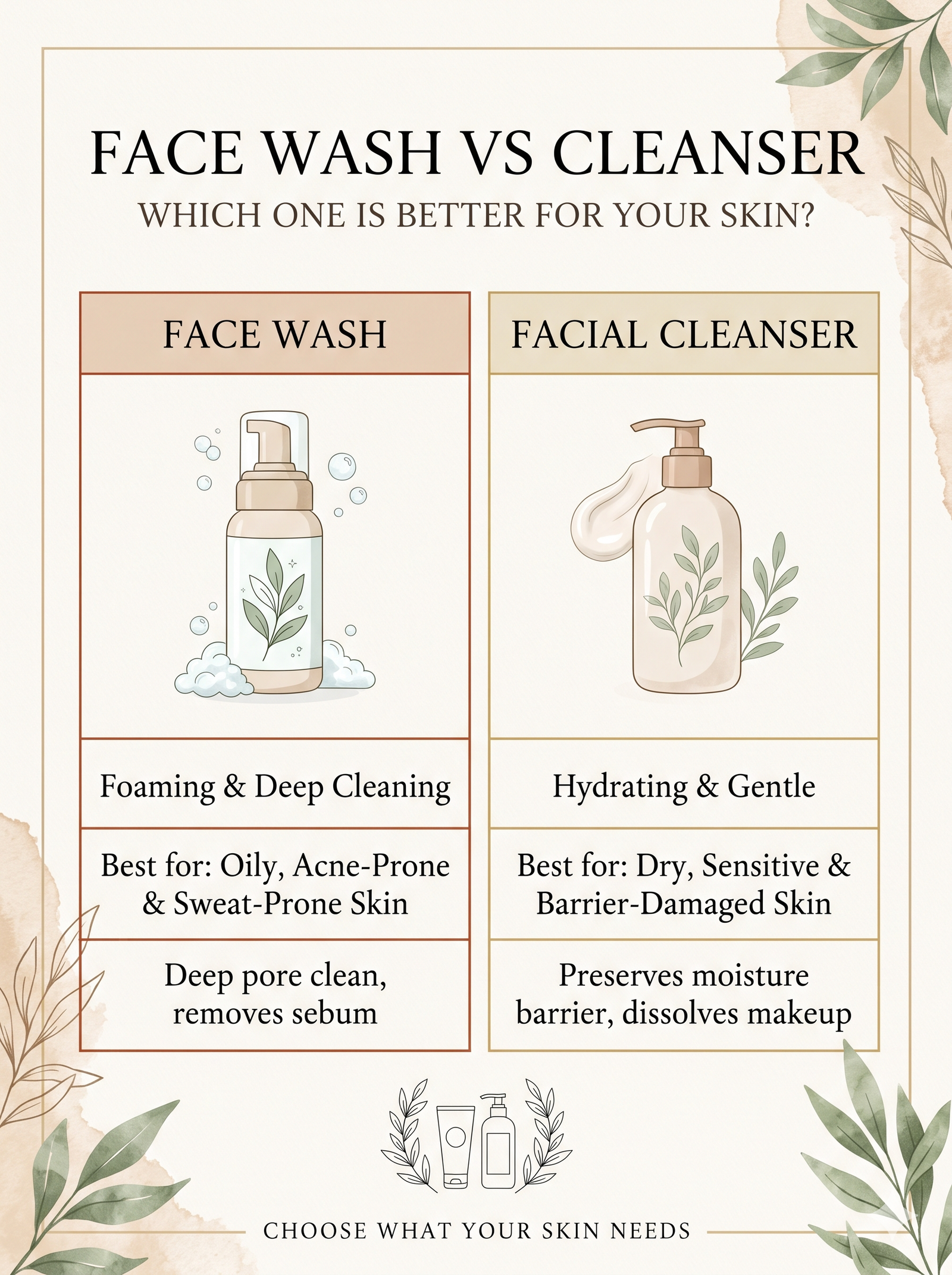
A face wash is a water-based skincare product formulated to cleanse the skin by removing dirt, excess sebum, sweat, and everyday impurities.
Face washes generally produce foam or lather when mixed with water. Their formulations often contain cleansing agents called surfactants, which help lift oil, dirt, and impurities from the skin’s surface so they can be rinsed away.
Face washes are particularly popular among people with oily, combination, and acne-prone skin because certain formulations help remove excess oil and provide a fresh, clean feeling.
However, not every face wash is suitable for every skin type. Some products contain strong cleansing agents or fragrances that may leave sensitive or dry skin feeling tight.
Key Benefits of Using Face Wash
1. Removes Excess Oil
A suitable face wash helps remove excess sebum from the skin. This can be particularly beneficial for people with oily skin who experience shine throughout the day.
2. Cleanses Dirt and Impurities
Daily exposure to pollution, dust, sweat, and environmental contaminants can leave impurities on the skin. A face wash helps remove these unwanted substances.
3. Supports Acne-Prone Skin
Some face washes contain ingredients such as salicylic acid that help exfoliate inside the pores and reduce pore congestion. These formulations may benefit people dealing with blackheads and acne.
4. Provides a Refreshing Feeling
Foaming face washes can leave the skin feeling fresh and clean, making them a popular choice for morning and evening skincare routines.
5. Prepares Skin for Other Skincare Products
Cleansing helps remove surface impurities, allowing subsequent skincare products, such as serums and moisturizers, to be applied to clean skin.
What Is a Facial Cleanser?
A facial cleanser is a skincare product designed to remove makeup, sunscreen, dirt, excess oil, and environmental impurities while cleansing the skin.
Unlike traditional foaming face washes, cleansers are available in different formulations, including cream, lotion, gel, oil, balm, and micellar water.
Many facial cleansers are formulated with gentle cleansing ingredients and moisturizing components to help maintain the skin’s natural moisture balance.
They are particularly useful for people with dry, sensitive, or dehydrated skin who prefer a gentler cleansing experience.
However, cleansers are not always non-foaming or exclusively designed for dry skin. Gel cleansers, for example, can also be suitable for oily and combination skin.
Key Benefits of Using a Facial Cleanser
1. Gently Removes Impurities
Facial cleansers help remove dirt, sweat, sunscreen, and everyday impurities without necessarily stripping away too much of the skin’s natural oil.
2. Helps Maintain Skin Moisture
Many cream and lotion cleansers contain moisturizing ingredients that help reduce the feeling of dryness after washing.
3. Suitable for Sensitive Skin
Gentle, fragrance-free cleansers can be a good option for people with sensitive skin, particularly when formulated without harsh cleansing agents.
4. Helps Remove Makeup and Sunscreen
Oil-based cleansers and cleansing balms can effectively dissolve long-wear makeup, waterproof sunscreen, and excess sebum.
5. Supports the Skin Barrier
A mild cleanser that does not leave the skin feeling tight or irritated can help maintain the skin barrier, which plays an important role in retaining moisture and protecting against external irritants.
Face Wash vs Cleanser: What Is the Difference?
Although face washes and cleansers are often used interchangeably, there are some important differences in their formulations and cleansing experiences.
Here is a detailed comparison to help us understand which product may be more suitable for different skincare needs.
| Feature | Face Wash | Facial Cleanser |
|---|---|---|
| Texture | Gel, foam or liquid | Cream, lotion, gel, oil or balm |
| Foaming | Often produces foam | May or may not foam |
| Main purpose | Removes dirt and excess oil | Removes impurities, makeup and sunscreen |
| Skin feel | Often leaves a fresh feeling | Depends on formulation |
| Dry skin | Gentle versions can work | Cream-based options are often suitable |
| Oily skin | Suitable formulations can help | Gel cleansers can also work |
| Sensitive skin | Depends on ingredients | Gentle, fragrance-free options may help |
| Makeup removal | Not always sufficient | Oil and balm cleansers are effective |
| Daily use | Yes, if suitable | Yes, if suitable |
Important: The terms face wash and cleanser do not have strictly standardized meanings across all skincare brands. The actual ingredients and formulation matter more than the product name.
Which Is Better for Different Skin Types?
There is no universal answer to whether face wash or cleanser is better. The right choice depends on understanding our skin type and its specific requirements.
Let’s explore the best options for different skin types.
1. Face Wash vs Cleanser for Oily Skin
Oily skin produces excess sebum, which can make the face appear shiny and contribute to clogged pores.
People with oily skin often benefit from lightweight gel-based face washes that remove excess oil without excessively drying the skin.
Look for ingredients such as:
- Salicylic Acid: Helps exfoliate inside pores and reduce pore congestion.
- Niacinamide: Supports the skin barrier and can help improve the appearance of excess oil.
- Green Tea Extract: Provides antioxidant benefits.
- Glycerin: Helps attract moisture and reduce excessive dryness.
A gentle gel cleanser can also be an excellent choice for oily skin, especially when the skin feels dehydrated or irritated.
Our recommendation: Choose a gentle gel-based face wash or cleanser that removes excess oil without leaving your skin tight.
2. Face Wash vs Cleanser for Dry Skin
Dry skin often lacks sufficient natural oils, which can lead to roughness, flaking, and discomfort.
Using a harsh face wash may worsen dryness by removing too much of the skin’s natural surface lipids.
Cream-based and lotion cleansers are often better choices because they provide a gentle cleansing experience.
Look for ingredients such as:
- Hyaluronic Acid: Helps attract and retain moisture.
- Ceramides: Help support the skin barrier.
- Glycerin: Helps maintain hydration.
- Squalane: Helps soften the skin and reduce moisture loss.
Our recommendation: Choose a hydrating, non-stripping cleanser that leaves your skin comfortable after washing.
3. Face Wash vs Cleanser for Combination Skin
Combination skin generally has an oily T-zone, including the forehead, nose, and chin, while the cheeks may feel normal or dry.
This skin type requires a balanced cleansing approach.
A gentle gel cleanser can help remove excess oil without unnecessarily drying other areas of the face.
Look for formulations containing glycerin, niacinamide, and other skin-compatible ingredients.
Our recommendation: Use a mild gel-based cleanser that balances cleansing and hydration.
4. Face Wash vs Cleanser for Sensitive Skin
Sensitive skin can react to fragrances, harsh surfactants, certain preservatives, and other ingredients.
People with sensitive skin should prioritize gentle formulations rather than choosing products based on how much foam they produce.
Look for:
- Fragrance-free formulations.
- Gentle cleansing agents.
- Glycerin.
- Ceramides.
- Soothing ingredients such as colloidal oatmeal.
Avoid products that repeatedly cause burning, redness, itching, or excessive tightness.
Our recommendation: Choose a mild, fragrance-free facial cleanser and introduce new products gradually.
5. Face Wash vs Cleanser for Acne-Prone Skin
Acne-prone skin requires cleansing without excessive irritation.
A face wash containing salicylic acid may help remove dead skin cells and reduce clogged pores.
However, using multiple strong acne treatments simultaneously can irritate the skin and damage its protective barrier.
Look for:
- Salicylic acid.
- Gentle cleansing agents.
- Niacinamide.
- Non-comedogenic formulations.
Our recommendation: Choose a gentle cleanser suitable for acne-prone skin. If using an active ingredient such as salicylic acid, follow the product instructions and avoid over-exfoliation.
Can We Use Both Face Wash and Cleanser?
Yes, we can use both face wash and cleanser in the same skincare routine when there is a genuine need.
This approach is commonly known as double cleansing.
Double cleansing is particularly useful in the evening for people who wear makeup, waterproof sunscreen, or long-wear cosmetic products.
How Does Double Cleansing Work?
Step 1: Start With an Oil-Based Cleanser
Apply an oil cleanser or cleansing balm to dry skin. Massage gently to dissolve makeup, sunscreen, and excess sebum.
Step 2: Rinse Thoroughly
Follow the product instructions to emulsify and rinse away the oil-based cleanser.
Step 3: Use a Gentle Water-Based Cleanser
Apply a gentle face wash or gel cleanser to remove remaining impurities.
Step 4: Apply Moisturizer
Finish with a moisturizer suitable for your skin type to help maintain hydration.
Double cleansing is not necessary for everyone. If a single gentle cleanser effectively removes your sunscreen and makeup, there is no need to add another cleansing step.
Common Skincare Ingredients to Look for in Face Wash and Cleansers
The ingredients in a skincare product play a major role in determining how it performs.
Rather than choosing a product based only on its packaging or marketing claims, we should understand its formulation.
1. Hyaluronic Acid
Hyaluronic acid is a humectant that attracts water and helps maintain skin hydration.
It is commonly included in hydrating cleansers and face washes designed for dry or dehydrated skin.
2. Vitamin C
Vitamin C is an antioxidant ingredient known for its role in supporting brighter-looking skin and protecting against oxidative stress.
It is more commonly used in leave-on skincare products such as serums, although it may also appear in cleansing formulations.
3. Salicylic Acid
Salicylic acid is a beta hydroxy acid (BHA) that helps exfoliate inside pores.
It is particularly useful in certain formulations designed for oily and acne-prone skin.
4. Niacinamide
Niacinamide, also known as vitamin B3, helps support the skin barrier and can improve the appearance of uneven skin tone and excess oil.
It is suitable for many skin types.
5. Glycerin
Glycerin is a humectant that attracts water and helps maintain skin hydration.
It is widely used in both face washes and facial cleansers.
6. Ceramides
Ceramides are lipids naturally present in the skin barrier.
Cleansers containing suitable ceramide formulations may help support the skin barrier and reduce the feeling of dryness.
How to Choose the Right Face Wash or Cleanser
Selecting the right cleansing product does not need to be complicated.
We can make better skincare choices by following a few simple steps.
1. Identify Your Skin Type
Determine whether your skin is oily, dry, combination, sensitive, or normal.
2. Understand Your Skin Concerns
Identify whether you are dealing with acne, excessive oiliness, dryness, dullness, sensitivity, or dehydration.
3. Read the Ingredient List
Check the formulation for ingredients suitable for your skin concerns.
4. Avoid Overly Harsh Products
Avoid cleansers that repeatedly cause burning, excessive tightness, or irritation.
5. Consider Your Daily Lifestyle
People who wear makeup, sunscreen, or spend considerable time outdoors may need a more effective evening cleansing routine.
6. Choose Products According to Your Skin’s Needs
Do not select a product simply because it is popular or trending. What works for one person may not work for another.
How Often Should We Wash Our Face?
Cleansing frequency is another important part of maintaining healthy skin.
For most people, washing the face twice daily is a reasonable routine.
Morning Skincare Routine
- Cleanse your face with a gentle face wash or cleanser.
- Apply a suitable moisturizer.
- Apply broad-spectrum sunscreen with SPF 30 or higher.
If your skin is very dry or sensitive, rinsing with water in the morning may be sufficient.
Night Skincare Routine
- Remove makeup and sunscreen when necessary.
- Use a suitable cleanser.
- Apply your preferred skincare serum.
- Finish with a moisturizer.
Avoid washing your face excessively throughout the day, as frequent cleansing can contribute to dryness and irritation.
Common Mistakes to Avoid When Using Face Wash or Cleanser
Even the best skincare products may not deliver the desired results if they are used incorrectly.
Here are some common mistakes we should avoid.
1. Washing Your Face Too Frequently
Excessive cleansing may strip the skin of natural lipids and contribute to dryness.
2. Using Very Hot Water
Hot water can increase dryness and irritation. Use lukewarm water instead.
3. Choosing Products Only Based on Foam
More foam does not necessarily mean better cleansing. A low-foaming cleanser can clean the skin effectively.
4. Scrubbing Too Hard
Aggressive rubbing can irritate the skin and worsen existing sensitivity.
5. Skipping Moisturizer
Cleansing should be followed by suitable hydration, especially for people with dry or dehydrated skin.
6. Ignoring Sunscreen Removal
Some sunscreens, particularly water-resistant formulations, may require a dedicated cleansing step.
Face Wash vs Cleanser: Which One Should You Choose?
Now that we understand their differences, let’s look at the most suitable options.
| Your Skin Concern | Recommended Option |
|---|---|
| Excess oil | Gentle gel face wash |
| Dryness | Hydrating cream cleanser |
| Sensitive skin | Fragrance-free gentle cleanser |
| Acne-prone skin | Gentle cleanser or salicylic acid face wash |
| Combination skin | Balanced gel cleanser |
| Heavy makeup | Oil cleanser or cleansing balm |
| Dehydrated skin | Hydrating cleanser |
Ultimately, neither face wash nor cleanser is universally better. The best product is the one that cleans your skin effectively without compromising its natural moisture barrier.
Frequently Asked Questions (FAQs)
1. Is Face Wash Better Than Cleanser?
Neither is automatically better. Face washes are often preferred for removing excess oil and everyday impurities, while certain facial cleansers offer a gentler or more moisturizing cleansing experience. The best choice depends on your skin type and the product formulation.
2. Can We Use Face Wash Every Day?
Yes. Most gentle face washes can be used daily, usually once or twice a day, depending on your skin type and the product instructions.
3. Can Dry Skin Use Face Wash?
Yes. People with dry skin can use face washes, provided they choose gentle, hydrating formulations that do not leave their skin feeling tight or uncomfortable.
4. Is Cleanser Good for Oily Skin?
Absolutely. Oily skin can benefit from lightweight gel cleansers that remove excess sebum without stripping the skin.
5. Should We Use Cleanser Before or After Face Wash?
If you are double cleansing, start with an oil-based cleanser to dissolve sunscreen and makeup, followed by a water-based face wash or cleanser.
6. Can We Use Face Wash and Cleanser Together?
Yes, when needed. Double cleansing can be useful for removing makeup and water-resistant sunscreen. However, using both products is not necessary for everyone.
7. Does Face Wash Remove Blackheads?
A face wash containing salicylic acid may help reduce clogged pores and improve the appearance of blackheads over time. However, regular face washing alone may not completely remove existing blackheads.
8. Which Is Better for Glowing Skin: Face Wash or Cleanser?
Both can support healthy-looking skin by removing impurities. For glowing skin, we should also maintain hydration, use sunscreen, and follow a consistent skincare routine.
9. Can We Use Cleanser Without Face Wash?
Yes. A suitable facial cleanser can be used as the only cleansing product in a skincare routine if it effectively removes daily impurities.
10. Should We Change Our Face Wash According to the Season?
Our skin’s needs can change with weather conditions. During winter, dry skin may benefit from a more hydrating cleanser, while a lightweight gel cleanser may feel more comfortable during hot and humid weather.
Final Verdict: Face Wash vs Cleanser – Which One Is Better for Your Skin?
Choosing between a face wash and a cleanser is not about finding a universally superior product. It is about understanding what your skin needs and selecting a formulation that supports its natural balance.
If your skin produces excess oil and you prefer a refreshing cleansing experience, a gentle face wash may be an excellent choice.
If your skin feels dry, sensitive, or dehydrated, a hydrating facial cleanser may be more suitable.
For people who wear makeup or water-resistant sunscreen, incorporating an oil-based cleanser into an evening double-cleansing routine can be beneficial.
Most importantly, we should focus on gentle cleansing, proper hydration, consistent sunscreen use, and understanding our skin type.
Healthy skin does not require an unnecessarily complicated routine. It requires the right products, suitable ingredients, and consistent care.
At Dokmai London, we believe that effective skincare begins with understanding your skin. By choosing products according to your individual skin requirements, you can build a simple, balanced skincare routine that supports clean, healthy, and naturally radiant-looking skin.
Explore the world of skincare with Dokmai London and make every step of your skincare routine count.
Is this conversation helpful so far?